

Pump.fun traders have moved back into profit for the first time since May 2024, marking one of the clearest signs that Solana’s memecoin launchpad market has changed after last year’s heavy retail washout.
A Pump.fun trader profitability breakdown found that 50.08% of active wallets with exited positions were profitable in January 2026. The share then rose to 56.83% in February, 70.00% in March, and 73.28% in April. That April reading was the strongest month in the dataset, with 2.30 million profitable wallets versus 839,552 losing wallets.
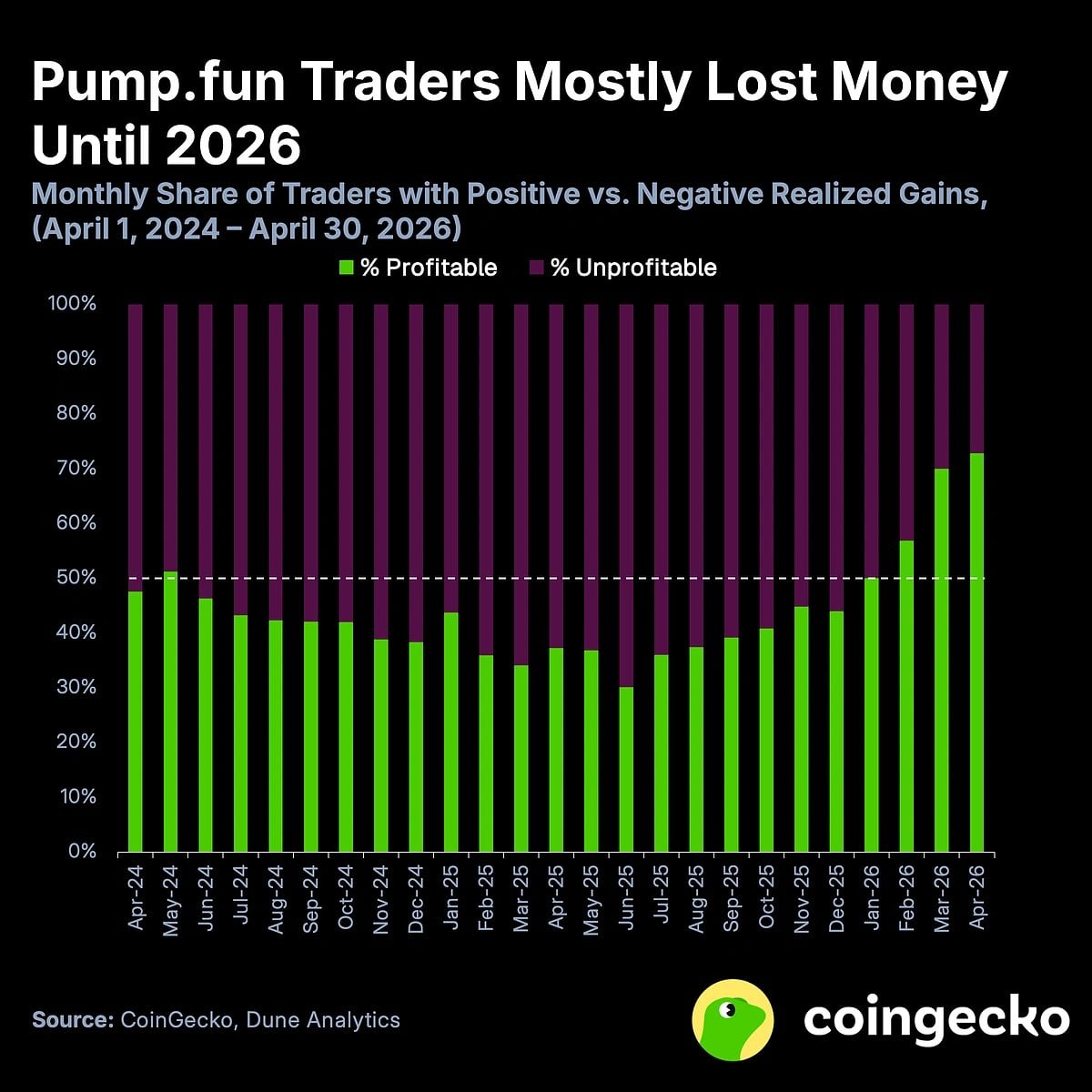
The shift is striking because losing wallets dominated most of the platform’s earlier cycle. From April 2024 through late 2025, the share of profitable traders rarely moved above 50% and dropped as low as 30.08% in June 2025. That period matched the more brutal side of the memecoin boom, when fast launches, low-liquidity tokens, sniping, copycat coins, and short-lived narratives made retail profitability difficult.
The April breakdown also shows that profitability does not mean most wallets made life-changing money. Of the 3.14 million active wallets tracked for April, about 2.05 million made between $1 and $500. Another 87,127 wallets made between $500 and $1,000, while 168,795 wallets made more than $1,000.
Losses were also concentrated in smaller tiers. About 792,724 wallets lost between $1 and $500, while 22,290 lost between $500 and $1,000. Another 24,538 wallets lost more than $1,000.
That distribution fits the nature of Pump.fun’s memecoin model: many wallets trade small positions across fast-moving tokens rather than holding large, concentrated positions. PumpSwap’s native AMM layer has also changed the post-bonding-curve trading path, making Pump.fun’s Solana market structure more important for understanding where liquidity goes after launches graduate.
The profitability rebound should not be read as proof that Pump.fun has become easy money. The dataset measures realized PnL, which means it excludes wallets still holding tokens that may have collapsed in value but were never sold. It also nets buy and sell flows at the wallet level across all tokens, so a wallet can look profitable for the month even if it still holds losing positions elsewhere.
Bot and wash-trading activity was not filtered out, which can inflate wallet counts and trading volume. Pricing can also be distorted for short-lived and illiquid Solana memecoins, especially when USD values are stale or incomplete. Those limits matter because Pump.fun activity often happens in the thinnest part of the crypto market, where execution speed and liquidity access can matter more than the token story itself.
The stronger signal is not that every retail trader is suddenly winning. It is that the weakest part of the 2025 crowd appears to have thinned out. Monthly active wallets peaked near 5.26 million in May 2025 and fell to 1.79 million by December before recovering in early 2026. A smaller, more selective trader base can naturally produce a higher profitability share if inexperienced participants leave and more disciplined wallets remain.
The latest numbers put Pump.fun back in a stronger light, but the memecoin market remains unforgiving. Profitability is improving among realized exits, while unsold bags, bot activity, and token failure risk still sit underneath the surface. For traders, the key change is not that Pump.fun has become safe. It is that the platform’s user base now looks leaner, more selective, and better positioned than it was during the worst of the 2025 drawdown.
The post Pump.fun Traders Flip Profitable As Memecoin Market Narrows appeared first on Crypto Adventure.





