

Retail investors are piling back into technology hardware stocks as the U.S. equity rally becomes increasingly concentrated around AI, chips, storage, and mega-cap platform names.
Fresh retail-flow data estimated that individual investors bought about $1.1 billion of tech hardware stocks in the week ending May 6, the second-largest weekly purchase on record for the group. The buying streak has now stretched across five consecutive weeks, with the only larger weekly inflow coming in September 2020, when retail purchases reached about $1.3 billion.
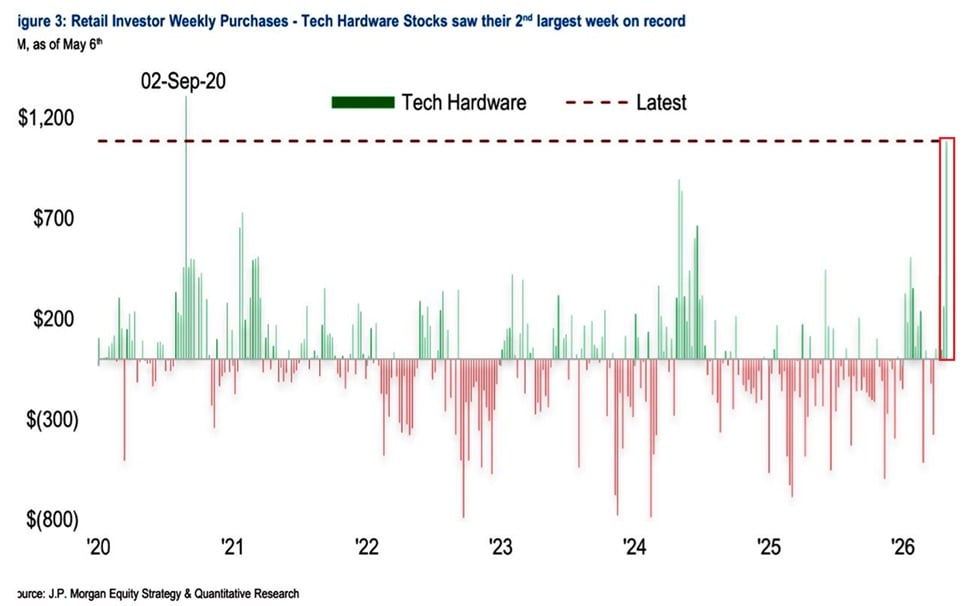
The basket includes Apple, SanDisk, Dell, Super Micro Computer, and other hardware-linked names that sit close to the AI infrastructure trade. Retail demand is not spreading evenly across the market. It is clustering around the same companies and sectors that have benefited from the data-center cycle, high-end chips, memory, storage, and the perception that AI spending can keep earnings growth ahead of the rest of the economy.
SanDisk has become the most extreme symbol of that demand. Yahoo Finance showed SNDK up about 4,067% over the past year at publication time, even stronger than the roughly 3,731% figure circulating in market commentary. The move exceeds Qualcomm’s famous 1999 dot-com bubble surge, when QCOM gained about 2,619% in a single year, one of the most aggressive large-cap rallies of that era.
The broader market rally is also becoming unusually narrow. Recent market coverage shows that Alphabet, Nvidia, Amazon, Broadcom, and Apple have accounted for more than half of the S&P 500’s gains since April, echoing the same concentration flagged in index-contribution data.

Those five stocks have added roughly 6 percentage points to the index’s 12% advance since April 1. Alphabet has led with a gain near 38%, contributing about 2 percentage points to the index. Nvidia added around 1.5 points after rising about 21%, while Amazon added roughly 1 point with a 30% move. Broadcom contributed about 0.8 points after a 33% surge, and Apple added about 0.7 points after gaining 13%.
That leaves the equal-weighted S&P 500 telling a different story. The Invesco S&P 500 Equal Weight ETF has risen far less than the capitalization-weighted index over the same period, showing that the average stock is not participating at the same pace as the largest AI and platform names.
The result is a market that looks powerful at the headline level but more fragile under the surface. A rally led by five giants can keep benchmark indexes near records, yet it also leaves investors exposed if AI hardware demand cools, earnings guidance disappoints, or retail traders begin taking profits from the most crowded winners.
The macro backdrop is giving equity bulls enough support to keep pressing the trade. The Bureau of Labor Statistics said U.S. nonfarm payrolls rose by 115,000 in April, beating expectations for about 65,000 jobs, while the unemployment rate held at 4.3%. Job gains came from health care, transportation and warehousing, and retail trade, while federal government employment continued to decline.
The labor data helped risk appetite because it showed the U.S. economy still adding jobs despite higher energy prices and pressure from the Iran war. That same macro backdrop has already shaped recent stocks and crypto risk moves, with traders rotating quickly between geopolitical fear, oil-price pressure, and renewed confidence in large-cap growth.
The tension is that stronger jobs can also delay Federal Reserve rate cuts if inflation remains sticky. Big Tech is currently absorbing that risk because earnings, AI spending, and retail demand are doing more of the work than broad economic acceleration. SanDisk’s parabolic move, $1.1 billion of weekly retail hardware buying, and five stocks driving half of the S&P 500 rally all point to the same market structure: investors are not buying everything, they are crowding into the names they believe can keep growing through higher rates, oil volatility, and geopolitical stress.
The post Retail Traders Crowd Into Tech As Big Tech Carries The S&P 500 Rally appeared first on Crypto Adventure.





