Ripple, the company behind the XRP Ledger, has landed one of the most significant regulatory milestones in its European history — and $XRP has climbed roughly 8% over the past week to trade near $1.15. But before you read this as "XRP got approved," there's an important distinction worth understanding.
On June 23, 2026, Luxembourg's financial regulator, the CSSF, issued Ripple a preliminary Crypto Asset Service Provider (CASP) license under the EU's Markets in Crypto-Assets (MiCA) regulation. The approval, in the form of a "Green Light Letter," is subject to final conditions, and will enable Ripple to scale regulated cryptoasset services to financial institutions and businesses across all 30 countries of the European Economic Area.
Here's the catch: this is a company-level license, not a token approval. $XRP the asset didn't "get approved" to do anything — MiCA licenses are granted to service providers, not to coins. Combined with Ripple's existing EU Electronic Money Institution (EMI) licence, the CASP license means European banks, fintechs and corporates can access Ripple's full cryptoasset and stablecoins payments infrastructure — collect, exchange and pay out — through a single integration for the first time.

A Green Light Letter is not the finished product. It's the CSSF's signal that a firm has met the substantive requirements, but full authorization — and with it, the ability to formally passport services across the EEA — follows only once all remaining conditions are met. There's precedent for this moving quickly, though: Ripple's EMI license went from Green Light in January to full authorization by early February 2026.
The timing is also strategic. The approval arrives just days before the July 1, 2026, hard deadline, after which unlicensed crypto firms operating in the EU are in breach of MiCA rules. By mid-2026, around 83% of EU crypto firms had not secured MiCA licenses, leaving Ripple among approximately 210 compliant firms — a pool that notably does not include Binance.
This is where objectivity matters. The commercial engine of this approval is RLUSD, Ripple's regulated stablecoin, and Ripple Payments infrastructure — not the $XRP token directly. In Ripple's own announcement, XRP appeared essentially as boilerplate. Tellingly, $XRP actually fell around 2.9% on the day the news broke, dragged down by a broader risk-off sell-off rather than repriced by the license.
That said, there's a longer-term ecosystem argument. The XRP Ledger is the rail Ripple's payment products run on, so deeper institutional adoption of RLUSD and Ripple Payments in Europe means more activity potentially routed through the same infrastructure $XRP secures. The honest framing: this is a genuine win for Ripple's European standing that could translate into token relevance over time — but it is not a direct, mechanical demand catalyst for $XRP.
Look at the chart and the story becomes clearer. $XRP started July near $1.04 and has since recovered to around $1.15 — a roughly 8-11% weekly gain depending on the data source. This move is largely a market-wide bounce, not a delayed reaction to the two-week-old MiCA news.
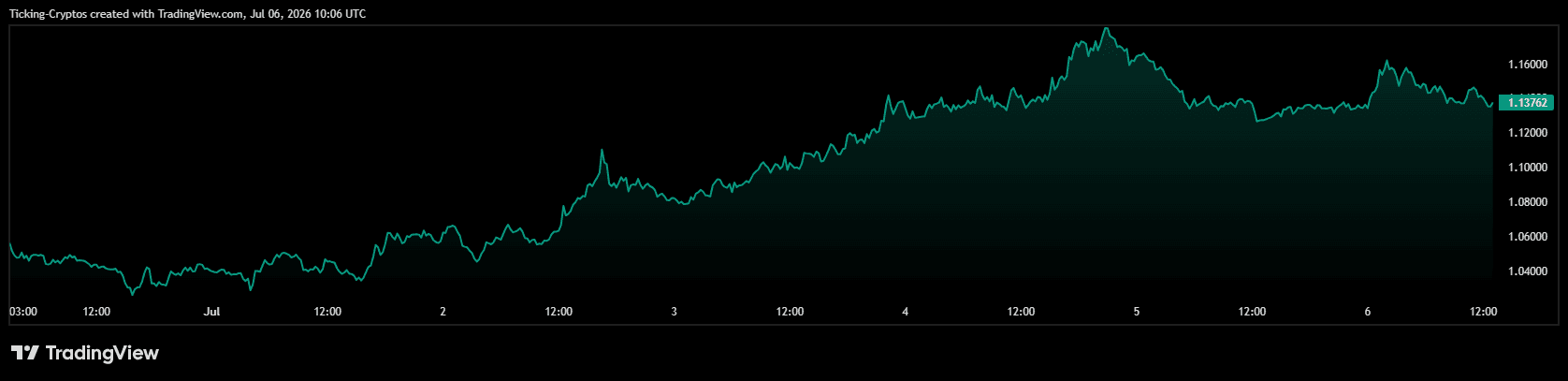
A few real tailwinds are supporting the recovery: XRP ETF inflows have now run positive for eight straight weeks, with cumulative net inflows reaching roughly $1.47 billion, and on-chain data shows exchange outflows deepening — a sign holders may be pulling supply off exchanges with intent. July is also historically one of $XRP's stronger seasonal months.
But the resistance overhead is real. The first hurdle sits at the $1.18 area (the 0.382 Fibonacci level), with heavier resistance clustered around $1.20-$1.22 — the zone that has capped every recent bounce inside XRP's year-long falling channel. Below, the $1.05-$1.10 area is the critical support that bulls need to defend. A clean break and hold above $1.20 would be the first genuine signal that the downtrend is cracking.





