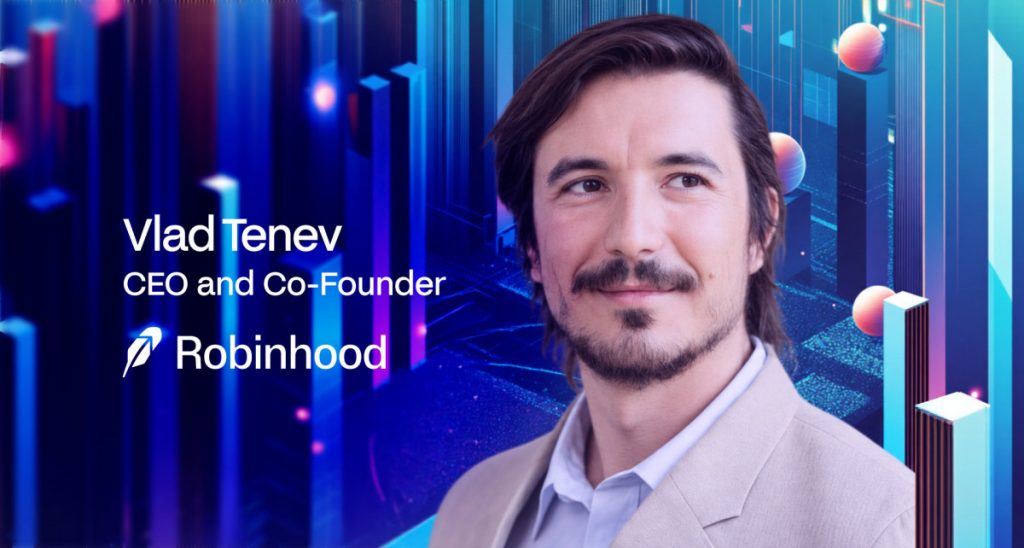
Robinhood CEO and co-founder Vlad Tenev has publicly argued that asset tokenization represents the most viable path toward democratizing access to U.S. capital markets on a global scale.
In a post on X, Tenev stated: “Everyone should be able to access high-quality financial assets, wherever they live. That’s what tokenization unlocks: taking the best of US capital markets and making them available on a global scale.”
His statement frames tokenization not as a speculative technology trend, but as a structural response to the limitations of legacy financial infrastructure — built around fixed trading hours, closed networks, and multi-layered intermediary systems that were never designed for 24/7 execution, programmable assets, composability, or self-custody.
Tenev acknowledged that the tokenized asset industry remains small relative to global finance, but argued that its advantages are becoming increasingly difficult to dismiss, pointing to a broad coalition of founders, liquidity providers, traders, and infrastructure teams now actively advancing the space.
The CEO has previously described the current moment as an early “tokenization supercycle,” positioning it as the logical next phase for modernizing American financial markets as they move toward an always-on model.
The broader market appears to be tracking Tenev’s thesis. Total trading volume in on-chain tokenized equities reached $9 billion in 2026, representing growth of over 207% quarter-over-quarter and more than 800% year-to-date, driven in part by demand for exposure to high-momentum technology stocks in a globally accessible, continuous trading environment.
Robinhood’s own blockchain infrastructure is central to this expansion. Since the launch of Robinhood Chain — a permissionless Ethereum Virtual Machine layer-2 network that went live in July — the platform has become the fastest EVM chain to reach 100 million transactions, offering economic exposure to over 190 U.S. stocks across more than 120 countries, with each token backed one-to-one by underlying shares.
On September 5, Robinhood Chain surpassed Solana in daily decentralized exchange volume, processing $1.45 billion against Solana’s $1.25 billion. The network has also crossed $3 billion in daily DEX volume and increased locked assets by 30% in a single week, with rising activity feeding into broader Ethereum ecosystem growth.
The platform has not been without controversy. AMC Entertainment’s CEO publicly condemned the trading of tokenized AMC shares on Robinhood Chain, questioning both its ethics and legality. Robinhood’s chief legal officer rejected the criticism.
Separately, a meme coin project briefly distorted the price of tokenized Hims & Hers Health shares over a weekend, exposing liquidity constraints in early-stage tokenized equity markets. These episodes highlight that while tokenization’s structural case is gaining traction, the infrastructure surrounding it remains a work in progress.
The post Robinhood’s Vlad Tenev: Tokenization Is The Infrastructure That Will Globalize US Capital Markets appeared first on Metaverse Post.





