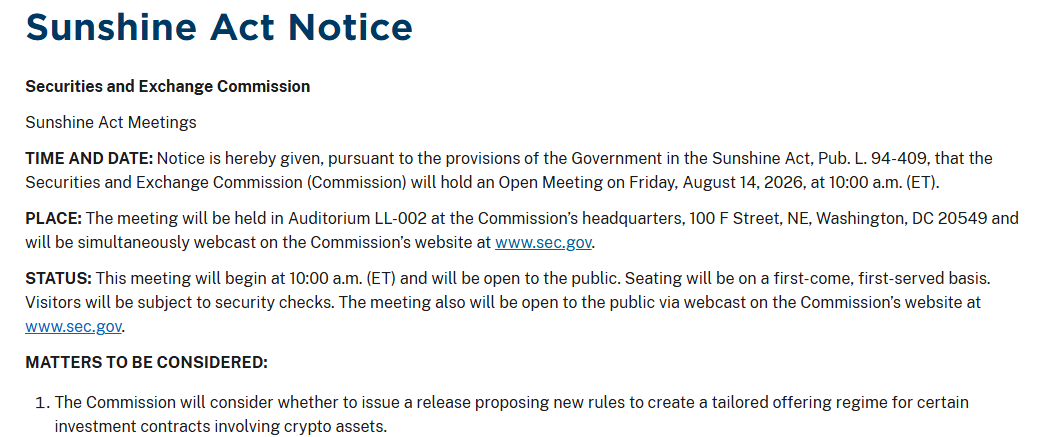
The SEC Open Meeting, named Sunshine Act Meeting, is set for Friday, August 14, 2026, at 10 a.m. ET could reshape how cryptocurrency projects raise money in the United States. The agency will consider a release proposing new rules for a tailored offering regime covering certain investment contracts involving cryptocurrencies.
This is the SEC crypto rules proposal now known across the industry as Regulation or Reg Crypto, and it lands as one of the most closely tracked items in crypto news today.
According to the official meeting notice, the Sunshine Act session will be held at SEC headquarters and streamed live on the agency's website. Commissioners will vote on whether to issue a formal notice of proposed rulemaking, not a final rule.
Key details from the official notice include:
Date and time: Friday, August 14, 2026, at 10:00 a.m. ET
Format: In-person session with a public webcast
Single agenda item: A release proposing cryptocurrency investment contracts rules under a tailored offering regime
Next step if approved: A public comment period, likely lasting 60 to 90 days
A yes vote opens the door to formal rulemaking rather than staff guidance, which carries more legal weight and is harder to undo later.
Reg-Crypto builds on ideas Chairman Paul Atkins outlined in March 2026. The plan is expected to give digital asset projects a clearer, lighter path to raise funds without triggering full securities registration every time.

Expected building blocks include:
A time-limited startup exemption with modest fundraising caps for early-stage projects
A broader fundraising exemption with higher limits paired with fuller financial disclosures
A safe harbor that lets a token exit securities status once managerial efforts end and the network matures
Together, these pieces aim to replace years of case-by-case enforcement with a written rulebook that founders can plan around before token launch.
SEC digital asset regulation history explains why this meeting carries weight. Here is the path, tier by tier:
2021–2025: Enforcement-first era. Most tokens treated as unregistered securities case by case
2025: A Task Force was created to study clearer digital asset rules. Paul Atkins confirmed as Chairman and launches Project Crypto
July 2025: The GENIUS Act becomes law, the first full federal framework for payment stablecoins
January 2026: SEC and CFTC issue a joint interpretation sorting cryptocurrency into digital commodities, collectibles, and tokenized securities
August 7, 2026: Treasury's FinCEN and OFAC propose a rule to carry out the GENIUS Act's anti-illicit-finance requirements
August 14, 2026: Reg reaches the SEC Open Meeting stage as the first tailored offering rule for cryptocurrency investment contracts
Reg Cryptocurrency does not stand alone. It runs alongside the Digital Asset Market Clarity Act, or CLARITY Act, a House-passed bill meant to split oversight between the SEC and CFTC. The Senate has not advanced it yet, with a cloture vote expected September 15, 2026.
The SEC vs Clarity Act comparison comes down to speed versus permanence:
Reg Cryptocurrency: Agency rulemaking that can move now under existing law, without waiting on Congress
CLARITY Act: Full legislation that needs Senate and House approval but offers sturdier, longer-lasting rules a future Commission could not easily unwind
Analysts at TD Cowen described Friday's meeting as the opening move in a longer string of rulemakings meant to give cryptocurrency firms more regulatory certainty after the Senate stalled on the CLARITY Act before its August recess.
The impact on crypto markets, if Reg Crypto moves forward, centers on one thing: fewer projects would need to guess whether a token sale counts as an unregistered securities offering. That uncertainty has pushed some fundraising offshore for years.
Why it matters for cryptocurrency:
Founders would gain a written, compliant path to raise money from US investors instead of relying on enforcement outcomes decided case by case
A formal exit ramp from securities status could apply once a network is decentralized and the founding team's active role has ended
Rulemaking carries more legal staying power than speeches or staff guidance, making the framework harder for a future Commission to reverse quickly
Clearer offering rules could encourage more token launches and institutional capital to stay onshore rather than moving abroad
Trading venues, custody rules, and intermediary oversight are not addressed here and will need separate rulemaking later
For US crypto market regulation in 2026, exact dollar thresholds and disclosure requirements will only become clear once the full proposal text is released.
If the Commission votes yes on Friday, the coming months of public comment will shape the final form of American cryptocurrency fundraising rules for years ahead. The direction, though, already looks set: durable rulebooks are replacing one-off enforcement actions as the primary tool for crypto regulation US 2026 and beyond.
Disclaimer: This article is for informational purposes only and does not constitute financial or investment advice. Cryptocurrency markets carry significant risk. Always do your own research before making any investment decisions.





