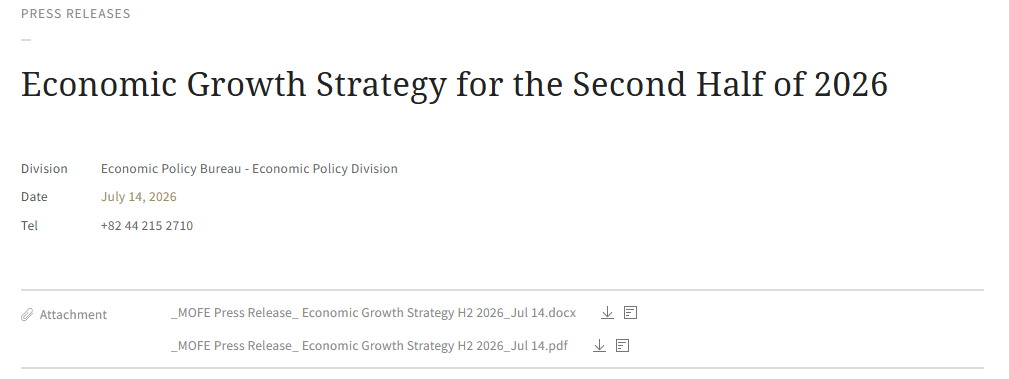
South Korea crypto news took a major turn in July, 2026. The Ministry of Economy and Finance released a full digital asset plan as part of its Economic Growth Strategy for the second half of the year 2026. The plan introduces coordinated reforms covering stablecoins, tokenized bonds, and spot ETFs.
Source: Ministry of Economy and Finance
Current status: Some measures have been officially announced by the Ministry of Finance, while legislative changes, including the Digital Asset Basic Act and ETF amendments, remain subject to approval by the National Assembly.
The centerpiece of this South Korea July 2026 crypto policy is the Digital Asset Basic Act. Lawmakers expect it to pass during the second half of 2026. The proposed law splits digital assets into two categories: general assets and asset-linked assets such as stablecoins.
Source: X Official
The South Korea stablecoin rules under this provision are specific. Issuers need a license from the Financial Services Commission, along with:
Minimum capital of KRW 500 million
Full 100% reserves backing each token
Clear redemption rights for holders
A formal business plan submitted for review
Foreign companies that want to issue stablecoins inside the country may need a local subsidiary first. The rule also sets custody standards and covers cross-border transaction flows.
Alongside the new act, regulators plan to amend the Capital Markets Act. The spot crypto ETF amendments would allow funds to hold virtual assets directly, likely starting with Bitcoin. This reverses years of resistance to direct-holding fund products.
A second piece looks further ahead. Officials confirmed tokenized bond pilots for 2027, linked to the Bank of Korea's wholesale central bank digital currency project. The pilot aims to cut settlement costs and modernize how the state issues debt.
These two pieces work together. One opens investment access today, and the other tests infrastructure for tomorrow.
The nation banned initial coin offerings in 2017 and kept a nine-year limit on corporate cryptocurrency holdings. That corporate crypto ban is now lifted, a response tied partly to an estimated $110 billion in capital outflows during 2025.
The Virtual Asset User Protection Act, active through 2024 and 2025, added real-name accounts, banned wash trading, and required secure custody. Regulators referred over 30 cases to prosecutors under its market manipulation rules.
A first version of the Digital Asset Basic Act reached the National Assembly through the Democratic Party in June 2025 before slower talks pushed it into this year's package.
Separately, the government is updating the 76-year-old State Property Act into a new National Asset Basic Act. This would count virtual assets and intellectual property as part of national wealth, expanding oversight of state holdings valued near 1,400 trillion KRW.
Timeline and Outlook for the New Digital Asset Framework
South Korea crypto adoption stays among the strongest in the world by trading volume and retail participation. Exchanges such as Upbit and Bithumb handle heavy daily activity, and local price gaps known as the "kimchi premium" reflect strong domestic demand.
This adoption level explains the timing of the reforms. Officials tied the plan to broader economic targets, including 3% potential growth and $50,000 per capita income, treating digital assets as part of that goal.
The South Korea crypto strategy 2026 sets a template other governments may study closely. By pairing stablecoin licensing with bond tokenization and ETF access in one package, Seoul is betting that clear rules, not restrictions, will keep capital and innovation inside its own borders
The next milestones arrive through the rest of 2026 and into the 2027 bond pilot, and each step will show whether this framework holds up once put into practice.
Disclaimer: This article is for informational purposes only and does not constitute financial or investment advice. Cryptocurrency markets carry significant risk. Always do your own research before making any investment decisions.





