In major crypto news today, South Korea's top financial regulator has confirmed it will speed up work on the country's long-delayed rulebook, with a formal bill targeted for introduction this fall.
According to a report shared on X by The Block, the Financial Services Commission (FSC) said it will accelerate discussions on the Digital Asset Basic Act, aiming to bring a formal draft before lawmakers in the coming months.
This piece of South Korea Crypto News confirms the regulator wants the bill to cover stablecoin issuance, VASP (virtual asset service provider) licensing, and rules for bitcoin ETFs.
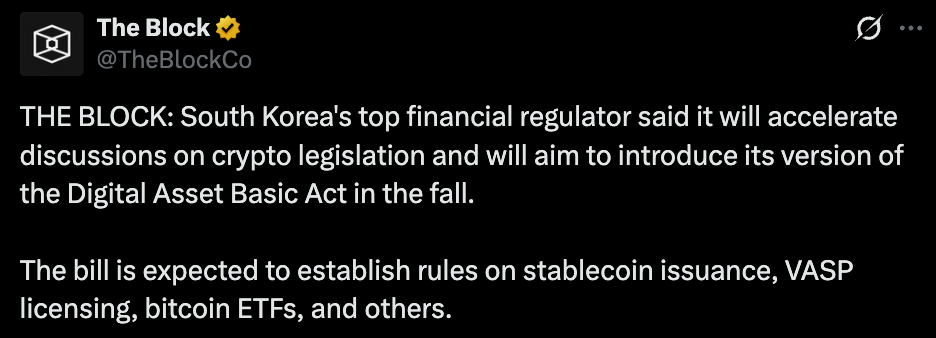
"South Korea's top financial regulator said it will accelerate discussions on legislation and will aim to introduce its version of the Digital Asset Basic Act in the fall," The Block reported on X, adding that the bill is expected to establish rules on stablecoin issuance, VASP licensing, bitcoin ETFs, and other market matters.
The FSC's message is straightforward: the second phase of the country's digital asset framework, commonly called the South Korea Digital Asset Basic Act, has been stuck in committee discussions for months. The regulator now wants to push it through before the year closes out.
Three points stand out from this FSC crypto regulation news:
A formal government-backed draft is targeted for introduction in fall 2026, coinciding with the National Assembly's regular session.
The bill folds together roughly ten separate pending proposals into one unified law.
Officials want the framework passed and reviewed before the annual legislative calendar tightens further.
Per South Korea's official government portal, the FSC has repeatedly named digital asset legislation as a core policy task for the second half of the year, with the Financial Services Commission's newsroom listing related briefings and press notes on stablecoin and digital asset planning.
The bill is not a single-issue law. It is designed as an umbrella framework touching several parts of the crypto industry at once.
Area | What The Bill Covers |
Stablecoins | Issuance standards, reserve backing, and circulation rules |
VASP Licensing | Entry requirements for exchanges and digital asset businesses |
Bitcoin ETFs | Groundwork for regulated exchange-traded products |
Disclosures | Reporting standards for token issuance and business conduct |
Investor Protection | Internal controls and system-resilience requirements |
For token issuers, exchanges such as Upbit, Bithumb, Coinone, and Korbit, and firms exploring won-pegged stablecoin projects.
VASP licensing South Korea rules would set the entry bar for legally operating in the market building upon the FSC's recently approved stricter registration and AML requirements.
The bitcoin ETF Korea component is separate but tied to the same law, since spot crypto ETFs currently sit outside any formal regulatory track in the country.
South Korea has a large retail crypto market, with 11.13 million accounts eligible to trade virtual assets and average daily trading volume of KRW 5.4 trillion in the second half of 2025.
The proposed Digital Asset Basic Act is intended to establish a broader legal framework for South Korea's digital-asset market, although key provisions of the second-phase legislation have not yet been finalized.
The timing also matters. Regional peers have already moved. Japan's parliament recently passed its own reclassification law, and momentum in the US and EU toward comprehensive digital asset statutes has added pressure on Seoul to avoid falling behind.
Industry participants have argued that continued delay pushes local projects and stablecoin issuers toward jurisdictions with clearer rules.
Analysts tracking the Korea crypto bill 2026 timeline note that a fall introduction does not guarantee fast passage.
Key disputes remain unresolved, particularly around whether won-denominated stablecoin issuers must be majority bank-owned, and whether ownership caps should apply to major exchanges.
This South Korea Crypto News points to a regulator finally putting a real timeline on paper.
The FSC's plan to bring the Digital Asset Basic Act before lawmakers this fall would give exchanges, stablecoin developers, and ETF hopefuls their clearest policy roadmap yet, provided the bill actually reaches the National Assembly on schedule.
Given how many times similar targets have slipped in the past, the fall deadline is worth watching closely rather than treating as guaranteed.
The coming weeks, particularly whether a formal draft is tabled during the regular legislative session, will show whether this round of Korea regulation news turns into an actual law or joins the list of delayed attempts.
Market watchers following the latest crypto news and Korea's regulatory updates generally treat the announcement as a signal of intent rather than a guarantee.
The FSC has set similar targets before, only for the bill to slip due to disagreements between the regulator and the Bank of Korea over stablecoin oversight.
Analysts suggest that if the fall deadline holds, it could give exchanges and stablecoin developers their first clear compliance roadmap since South Korea's first-phase user protection law took effect in 2024.
Until a draft is formally tabled in the National Assembly, however, the broader Korea regulation picture remains a work in progress, and market participants may want to treat specific dates as directional rather than final.
Disclaimer: This article is strictly for informational purposes and does not constitute financial, legal, or investment advice. Always conduct your own research before trading or investing in digital assets.





