South Korea just delivered the most violent equity collapse in its history. The KOSPI has fallen more than 33% in July alone, its worst month on record, and roughly 40% from the all-time high it printed barely six weeks ago. Circuit breakers fired on consecutive sessions for the first time ever. Somewhere between $1 trillion and $2 trillion in market value has evaporated, depending on which starting point you measure from.
For crypto traders, this is not a foreign story. Korean retail capital is one of the most influential flows in digital assets, and it spent the last nine months somewhere else entirely. Now that trade has blown up.
The KOSPI, short for Korea Composite Stock Price Index, is the benchmark index of the Korea Exchange main board. It covers every common stock listed on that board and is the standard proxy for South Korean equities, in the same way the S&P 500 stands in for the US market. Its smaller, tech-heavy sibling is the KOSDAQ.
Two things make the KOSPI unusually important right now.
First, concentration. Samsung Electronics and SK Hynix together account for close to half the index weighting. That is not a diversified benchmark. It is a leveraged bet on two memory chip manufacturers, which in 2026 means a leveraged bet on the global AI buildout.
Second, position in the supply chain. High-bandwidth memory is the bottleneck component for AI accelerators. When Korean chipmakers move, the market reads it as a signal about AI capital expenditure everywhere. That is why a Seoul selloff shows up in Nasdaq futures and, increasingly, in Bitcoin.
The rally came first, and it was extraordinary. The index more than doubled in the first half of 2026, gaining 116% at its peak and hitting an all-time high of 9,385.59 in June. That briefly made South Korea the world's sixth-largest stock market by value.
Then the reversal. Measured from the June record, the drawdown now approaches 44%. The index closed at 5,593.56 on Thursday after a 5% morning bounce faded. July's candle opened at 8,591.50 and traded as low as 5,262.77, a 38.95% intra-month collapse. For context, the COVID crash of March 2020 took the index down 31.10% from high to low.
The two sessions of July 28 and 29 did most of the damage. Roughly 864.5 trillion won was wiped out across those two days alone, with the index plunging more than 10% on the 28th and another 6% on the 29th. Bloomberg data circulating this week puts the total destruction at close to $2 trillion since the June peak. South Korea has fallen from the sixth-largest equity market in the world to the eleventh.
Circuit breakers, which halt trading for 20 minutes when the index drops 8% or more within a minute, have now fired nine times in 2026. Before this year, the mechanism had been triggered a handful of times in the entire history of the exchange.
Samsung Electronics has lost more than 35% over the past month. SK Hynix has lost nearly 47%.
There was no single trigger. Five pressures landed on a heavily stretched market at roughly the same time, and each one amplified the next.
The feedback loop did the rest. Falling prices triggered margin calls, forced selling deepened the losses, and leveraged ETFs mechanically sold more into the decline. Regulators held an emergency meeting, and Finance Minister Koo Yun-cheol conceded that the leveraged products deserved closer scrutiny before launch, adding that further stabilisation measures would follow if needed.
Because it is the first large-scale, real-money test of what happens when the AI trade unwinds in a market with retail leverage stacked on top of it.
Every argument being made about US AI capex, circular vendor financing and semiconductor valuations has now been stress-tested in Seoul. The answer was a 40% drawdown in 40 days. Somewhere around 700,000 leveraged retail traders have been caught in it, and the second-order effects on Korean consumer balance sheets have barely started to show.
It also matters because the KOSPI was the best-performing major equity market on the planet as recently as late July, up 41.5% year to date in dollar terms. Best performer to worst crash in a matter of weeks is the kind of whiplash that changes global risk appetite, not just local sentiment.
Yes, and the mechanism is more specific than generic risk-off contagion.
An earlier episode supports the caution. When the KOSPI fell 8.22% and halted on July 13, Upbit's BTC volume rose from around 7,436 BTC to 8,724 BTC over two days, an increase that still left activity roughly 27% below its own 30-day average. A blip, not a migration.
Bitcoin is trading as a high-beta tech asset. $BTC sits near $64,500 as of Thursday, up marginally on the day after the Fed held rates steady, but still around 45% below its October 2025 all-time high. Through the worst of the Korean selloff, Bitcoin traded flat to soft rather than catching a safe-haven bid. The Korea Premium Index, the modern version of the kimchi premium, has been sitting in negative territory, confirming that domestic demand has not yet flipped.
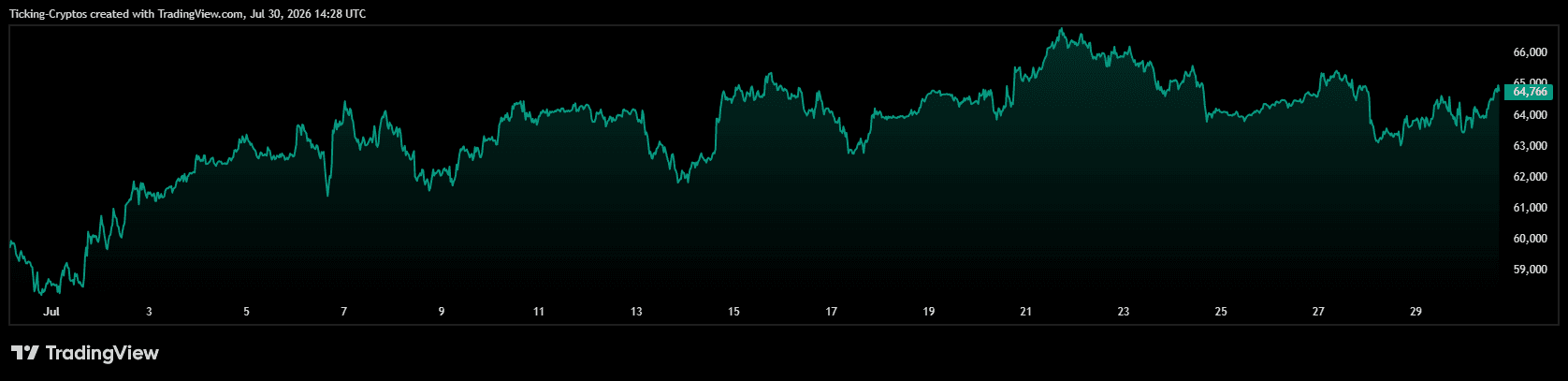
There is a genuine bull case here, and it is worth stating fairly. Korean regulators are now restricting leveraged equity products. Several hundred thousand burned retail traders still want volatility. Historically, when Korean retail gets pushed out of one venue, it reappears in another, and crypto has been the usual destination. If the KOSPI stabilises and risk appetite recovers, Korean flow returning to Upbit and Bithumb would be a real tailwind for altcoins in particular.
The bear case is simpler. Margin calls are settled by selling whatever is liquid, and crypto is liquid 24/7. In a deleveraging event, correlations go to one.
Three levels and one flow.
The 5,100 to 5,300 support zone on the KOSPI has held so far, and the July low landed inside it. If it breaks, the next major support sits between 3,200 and 3,400, roughly 40% lower. That scenario would almost certainly drag global risk assets down with it.
Watch the Korea Premium Index. A flip from negative to positive is the cleanest early signal that Korean retail is re-entering crypto rather than hoarding stablecoins.
Watch Korean exchange volume mix. If the BTC and altcoin share starts taking back ground from USDT, the rotation thesis gains substance. As long as Tether leads, capital is hiding, not buying.
And watch the Fed. Wall Street just posted its worst session since April 2025 following a divided rate decision. Korean stress landing on top of an already fragile US tape is a different problem than Korean stress in isolation.





