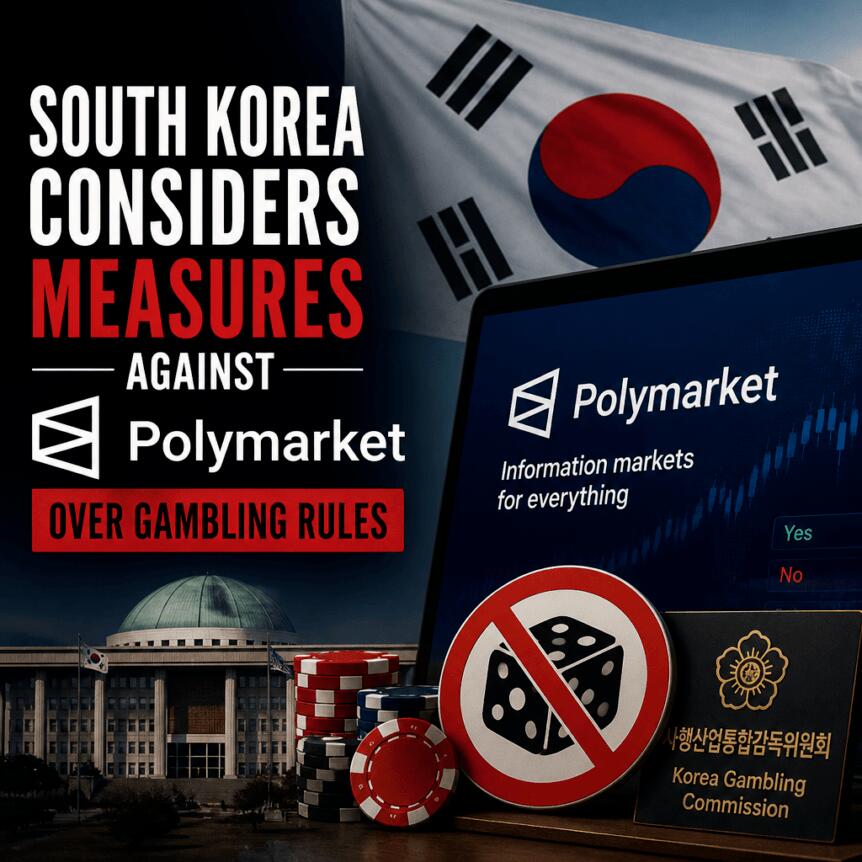
South Korea’s Broadcasting, Media and Communications Review Committee has opened a formal review process involving Polymarket, signaling that regulators are preparing to assess whether the prediction market platform violates local gambling rules. The committee said it will first hear Polymarket’s position before deciding on a corrective request tied to gambling-related concerns.
According to a machine-translated version of the committee’s statement, the regulator chose to “provide an opportunity for Polymarket to submit its opinion to thoroughly verify the legality of Polymarket and the way the service is operated.” The outcome could determine whether additional enforcement steps follow, depending on how regulators view the platform’s operating model under Korean law.
The committee’s decision to request Polymarket’s input marks a notable shift in how the issue is being handled. Earlier attention in South Korea centered on whether local users had engaged with Polymarket markets in ways that could be considered illegal gambling.
Instead, the committee’s current process targets the platform itself—specifically, whether its service and operations align with South Korean legal standards. That distinction matters for Polymarket and other prediction-market operators because a platform-focused action can affect access, compliance obligations, and how services are structured at a system level, not only how individual participants behave.
South Korea’s National Gambling Control Commission Act defines “illegal gaming business” broadly enough to cover online services that enable speculative gambling, granting regulators authority to monitor and take steps against such activity. In practice, that means regulators are likely to evaluate factors such as user access, the presentation of outcomes, and the nature of what participants can wager or trade.
South Korea’s legal framework distinguishes between individual gambling activity and operating gambling venues. Under the Criminal Act referenced in prior reporting, gambling can be punishable by a fine of up to 10 million won (about $6,500). More severe penalties can apply for habitual gambling, with punishment potentially including up to three years in prison or a fine of up to 20 million won.
Operating a gambling venue for profit carries even heavier penalties, including up to five years in prison or a fine of up to 30 million won. While prediction markets aren’t automatically categorized the same way in every jurisdiction, regulators may still treat certain features—such as speculative participation tied to real-world outcomes—as overlapping with gambling definitions.
For platforms like Polymarket, this creates a compliance challenge: even if a service frames itself as a prediction market, regulators may examine whether the user experience functions like betting. As South Korea’s committee moves to verify “legality” and “the way the service is operated,” the practical question becomes how regulators interpret those features under existing statutes.
The review arrives after an earlier police investigation involving Polymarket users in South Korea. On June 5, the Gangwon Provincial Police launched what local reporting described as the country’s first illegal gambling probe into local Polymarket users, with the request reportedly coming from South Korea’s National Police Agency.
That user-focused investigation set the stage for broader scrutiny. Now, the committee’s plan to hear Polymarket indicates that regulators may seek to connect any alleged gambling concerns to the platform’s design and operating practices—an approach that could lead to corrective measures if the service is deemed noncompliant.
Polymarket says its restrictions are designed to meet a range of compliance requirements, including sanctions-related rules, local financial regulations, gambling and prediction market laws, anti-money laundering obligations, and Know Your Customer (KYC) procedures.
The company also states that it applies geofencing not only at the country level but within some regions that would otherwise be accessible. Its documentation indicates that Polymarket’s platform is restricted in 33 countries, including the United States, the United Kingdom, France, Germany, Brazil, Singapore, Japan, and Australia. Polymarket’s materials also list additional restricted areas within those accessible jurisdictions, such as parts of Canada and regions in Ukraine.
For investors and users, this matters because regulators often assess whether geoblocking and compliance controls are sufficient—and whether they are implemented consistently. If South Korea concludes that existing restrictions do not adequately prevent gambling-like participation or otherwise violate local rules, Polymarket may face pressure to adjust its service availability, verification steps, or market mechanics.
At the same time, the presence of geoblocking elsewhere does not guarantee freedom from enforcement in a specific country. The committee’s review suggests that South Korea intends to evaluate the legality of Polymarket on its own terms, regardless of how other jurisdictions approach similar platforms.
With the committee set to review Polymarket’s response before issuing a final decision, the next key signal will be what arguments the platform presents and how the regulator frames any potential corrective request. Observers should also pay attention to how South Korea’s actions align with its earlier police probe—specifically whether enforcement shifts further toward platform-level restrictions or remains focused on individual compliance.
This article was originally published as South Korea Considers Measures Against Polymarket Over Gambling Rules on Crypto Breaking News – your trusted source for crypto news, Bitcoin news, and blockchain updates.





