SpaceX stock has staged one of the most violent reversals of the year. SPCX closed Wednesday at $146.15, up 9.65% on the day, and is now roughly 40% above the $104.83 low printed in the first days of August. On a float basis that swing is worth around $530 billion in added market value, taking the publicly traded market capitalisation back toward $1.9 trillion. Calculated across all share classes, the number sits above $2.2 trillion.
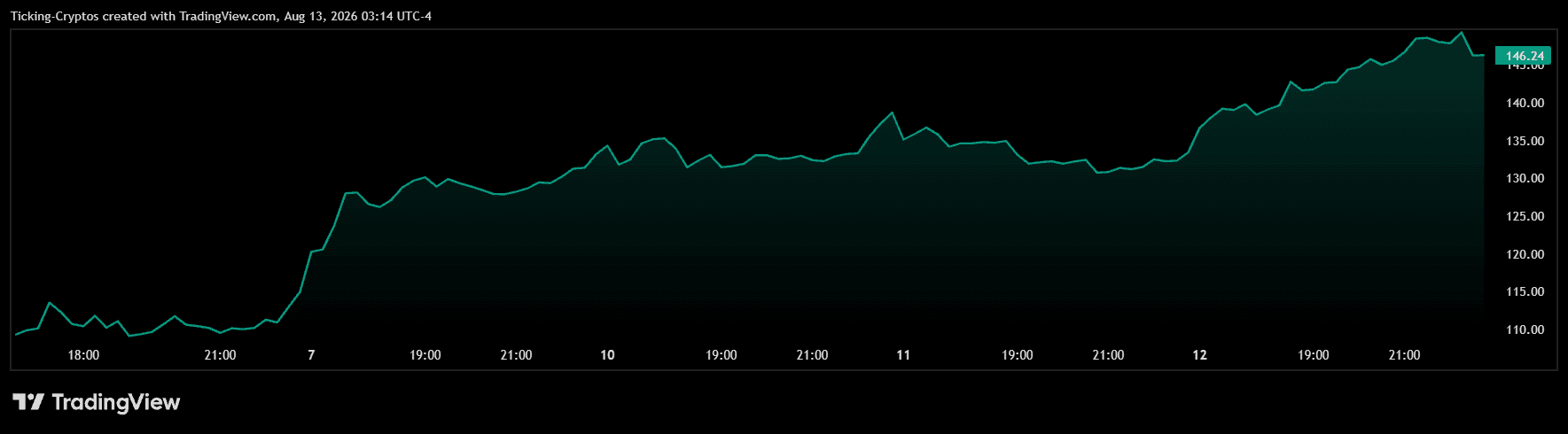
Five sessions ago the stock was an all-time-low story. It is now trading above its IPO price again, with short sellers in retreat and Wall Street reopening the bull case. Below is what actually caused the move, what the 4-hour chart is signalling, and where the risk sits.
Four separate catalysts stacked on top of each other in the space of one week.
The lockup did not break the stock. On 6 August, more than 911 million insider shares became eligible for sale, more than doubling the tradable float. The market had spent the previous session pricing in a flood of selling, sending SPCX to an all-time low near $105. The flood did not arrive. Shares rose on the unlock day itself and have not looked back since. That single fact removed the largest overhang on the name.
The all-hands was the pivot point. In a roughly 30-minute video posted to X, Musk told employees that AI revenue would "exceed all other SpaceX revenue probably in September" and would "significantly exceed" the rest of the business in the fourth quarter. He went further, arguing AI would account for 99% of the company's value within five years.
The supporting targets are aggressive:
The starting point is real but the gap is wide. In Q2, AI contributed $2.56 billion of $7.81 billion in total revenue, behind the $4.29 billion from the Starlink-led connectivity segment. Group revenue rose 92% year over year, Starlink grew 67%, and launches were up 29%, but the company still reported operating losses on $18.4 billion of capital expenditure, $15.8 billion of it AI-related. Management is guiding to a roughly $100 billion annualised revenue run rate by December, more than triple the pace implied by Q2.
Layered on top is the pending $60 billion all-stock acquisition of Cursor, the AI coding platform built by Anysphere, expected to close in Q3. Morgan Stanley models Cursor at $2.5 billion of revenue this year and $13 billion in 2027, with annual recurring revenue reaching $8 billion by year-end and around $33 billion by 2030.
The 4-hour chart shows a textbook V-recovery off a well-defined base.
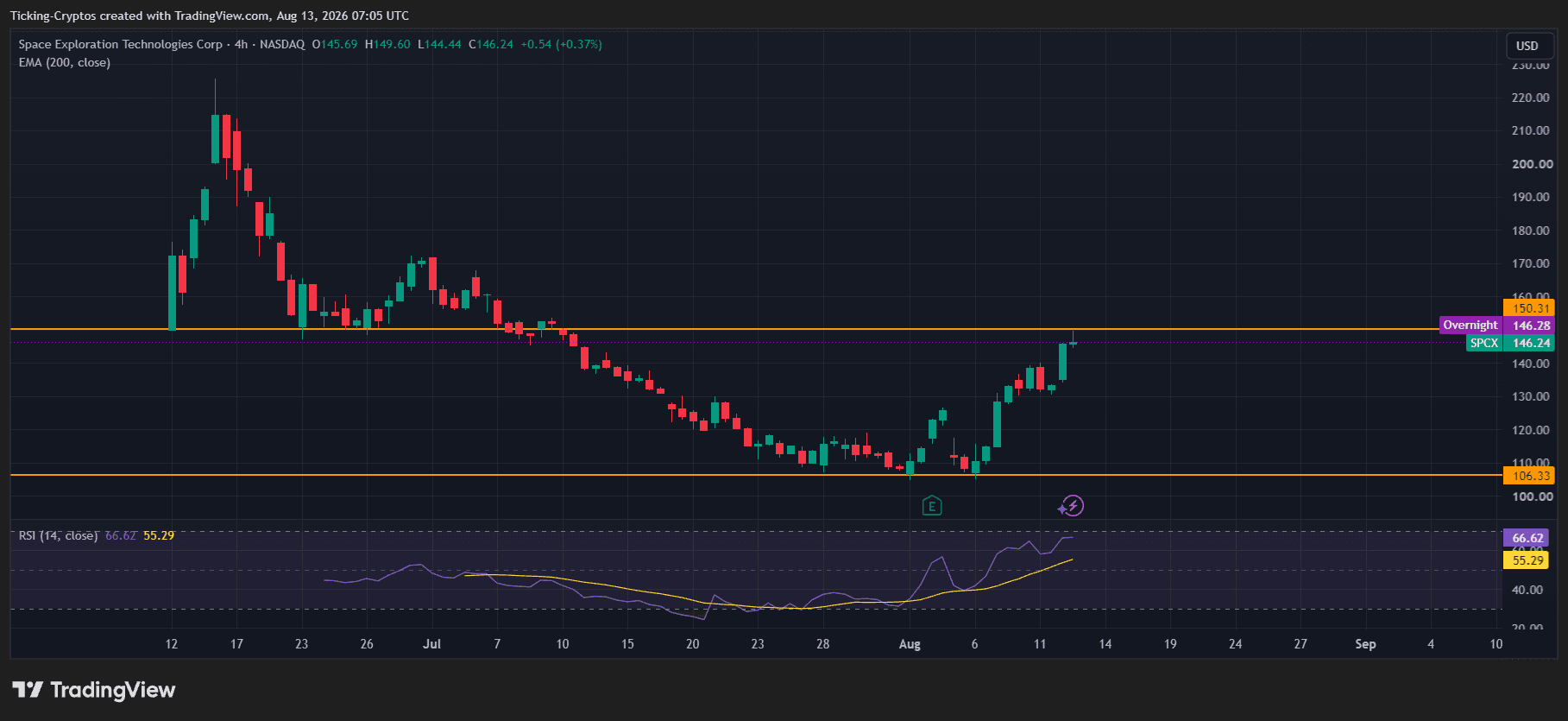
Net read: the trend is up and the base is credible, but the risk-reward for chasing at $146 into $150 resistance with RSI at 67 is poor. The cleaner setups are a confirmed breakout and retest of $150.31, or a pullback into the $135 to $138 pocket.
SpaceX went public on 12 June in the largest IPO in history, raising $75 billion at an indicative $135 per share and a $1.75 trillion valuation. The stock opened at $150, ran to $176.52 intraday, and closed at $160.95, a 19.2% first-day gain. It then spent nearly two months underwater.
Here is where things stand against every relevant reference point:
| Reference | Price | SPCX at $146.15 |
|---|---|---|
| IPO offer price | $135.00 | +8.3% |
| First-day close | $160.95 | -9.2% |
| Post-IPO all-time high | $225.64 | -35.2% |
| August low | $104.83 | +39.4% |
So despite a 40% five-day rally and a $530 billion swing in market value, anyone who bought the first-day close is still down. Only IPO allocation holders and buyers below $135 are in profit. That matters, because it means overhead supply from disappointed June buyers sits directly in the $150 to $176 band the stock is now approaching.
Three concrete ones.
A second lockup tranche lands on 20 August. Roughly 319 million additional shares become eligible. The first unlock was absorbed, but it came at an all-time low with sentiment already washed out. This one arrives after a 40% run, which is a very different setup for anyone sitting on paper gains.
Valuation is stretched on any conventional measure. Morningstar holds a $62 fair value estimate on SPCX with a one-star rating, implying roughly 58% downside, and Chief US Market Strategist Dave Sekera has explicitly urged investors to separate the stock's trading action from its underlying fundamentals. His argument is that the recent move reflects supply and demand mechanics around float and short covering rather than a change in intrinsic value.
The AI timeline is checkable and tight. Musk's September claim is not a vague vision statement. Within roughly six weeks the company either reports AI revenue above the roughly $5.25 billion that the rest of the business generates, or it does not. Goldman Sachs modelled about $15.6 billion in total AI revenue for all of 2026, which sits well below the run rate Musk is implying. Grok also currently trails leading models on several major benchmarks, which complicates a valuation that now leans heavily on AI monetisation.
More than most equities. SpaceX carries 18,712 Bitcoin on its balance sheet according to its S-1, making it one of the larger corporate BTC holders. A tokenised version of SPCX trades on Solana via Backpack, redeemable for the underlying share, and SPCX-USDC perpetual futures trade on Hyperliquid. During the IPO window those perps traded around $176 while the offer price sat at $135, effectively front-running the listing.
That makes SPCX one of the first genuinely cross-market assets: a Nasdaq mega-cap with a Bitcoin treasury, an onchain tokenised twin, and a crypto-native perpetual market that often moves first.
This is the comparison that matters for anyone who had capital to deploy on 12 June 2026, the day SPCX listed. Using the same-day snapshot for crypto and the IPO price for the stock, here is how $10,000 would have fared through Wednesday's close.
| Asset | 12 June 2026 | 12 August 2026 | Return | $10,000 becomes |
|---|---|---|---|---|
| SPCX at IPO price | $135.00 | $146.15 | +8.26% | $10,826 |
| SPCX bought on day one | $160.95 | $146.15 | -9.20% | $9,080 |
| Bitcoin | $63,359.71 | $63,402 | +0.07% | $10,007 |
| Ethereum | $1,664.39 | $1,878 | +12.83% | $11,283 |
| XRP | $1.13 | $1.0044 | -11.12% | $8,888 |
| Equal-weight BTC, ETH, XRP basket | +0.60% | $10,060 |
Three conclusions fall out of that table.
The honest caveat: almost nobody bought SPCX at $135. That price was reserved for institutions and a limited slice of retail participants in the bookbuild. Anyone buying on the open market at the day-one close of $160.95 is down 9.2%, which puts real-world SpaceX buyers behind Bitcoin, behind Ethereum, and behind the basket. The stock only looks like the winner if you had allocation.
It is also worth remembering that these are two very different two-month stories. Bitcoin is roughly 50% below its October 2025 all-time high of $126,198 and has spent 2026 in a drawdown driven by record ETF outflows and a cautious Fed, briefly touching a 21-month low near $58,000 in late June. SPCX, by contrast, completed an entire boom, bust, and recovery cycle inside eight weeks. Similar destination, wildly different journey.
Nobody knows, and anyone claiming otherwise is selling something. What can be done is to lay out what published forecasts actually say, and be clear that these are scenarios rather than predictions.
How the two compare on a scenario basis:
| Scenario | SPCX from $146.15 | Bitcoin from $63,402 |
|---|---|---|
| Bear | $62 to $75, roughly -49% to -58% | $38,000 to $39,000, roughly -39% |
| Base | $300, roughly +105% | $100,000 to $150,000, roughly +58% to +137% |
| Bull | $600, roughly +310% | $200,000 to $250,000, roughly +215% to +294% |
The shapes are strikingly similar. Both assets carry roughly 40% to 55% downside in a bear case and roughly 3x upside in a bull case. The difference is what drives them. SPCX resolves on a company-specific, checkable event: whether AI revenue actually overtakes the rest of the business in September and whether the $100 billion annualised run rate lands by December. Bitcoin resolves on macro liquidity, Fed policy, ETF flows, and whether the four-year cycle framework still holds.
That distinction is the practical takeaway. SPCX gives you concentrated, binary, single-company risk with a defined catalyst calendar. Bitcoin gives you diffuse, macro-driven risk with no earnings date. Holding both is not diversification in the conventional sense, since both are high-beta risk assets that sold off together in the first half of 2026, but they do respond to genuinely different catalysts on different timelines.
One final wrinkle worth flagging: SpaceX holds 18,712 BTC. If you buy SPCX, you own a slice of a Bitcoin position whether you wanted one or not.
XTB offers direct access to SPCX shares on Nasdaq alongside thousands of other global stocks and ETFs, with 0% commission on monthly turnover up to 100,000 EUR. Above that threshold a 0.2% commission applies, minimum 10 EUR, and a 0.5% currency conversion cost may apply. The platform also gives you the charting tools to actually work the levels discussed above rather than market-buying into resistance.





