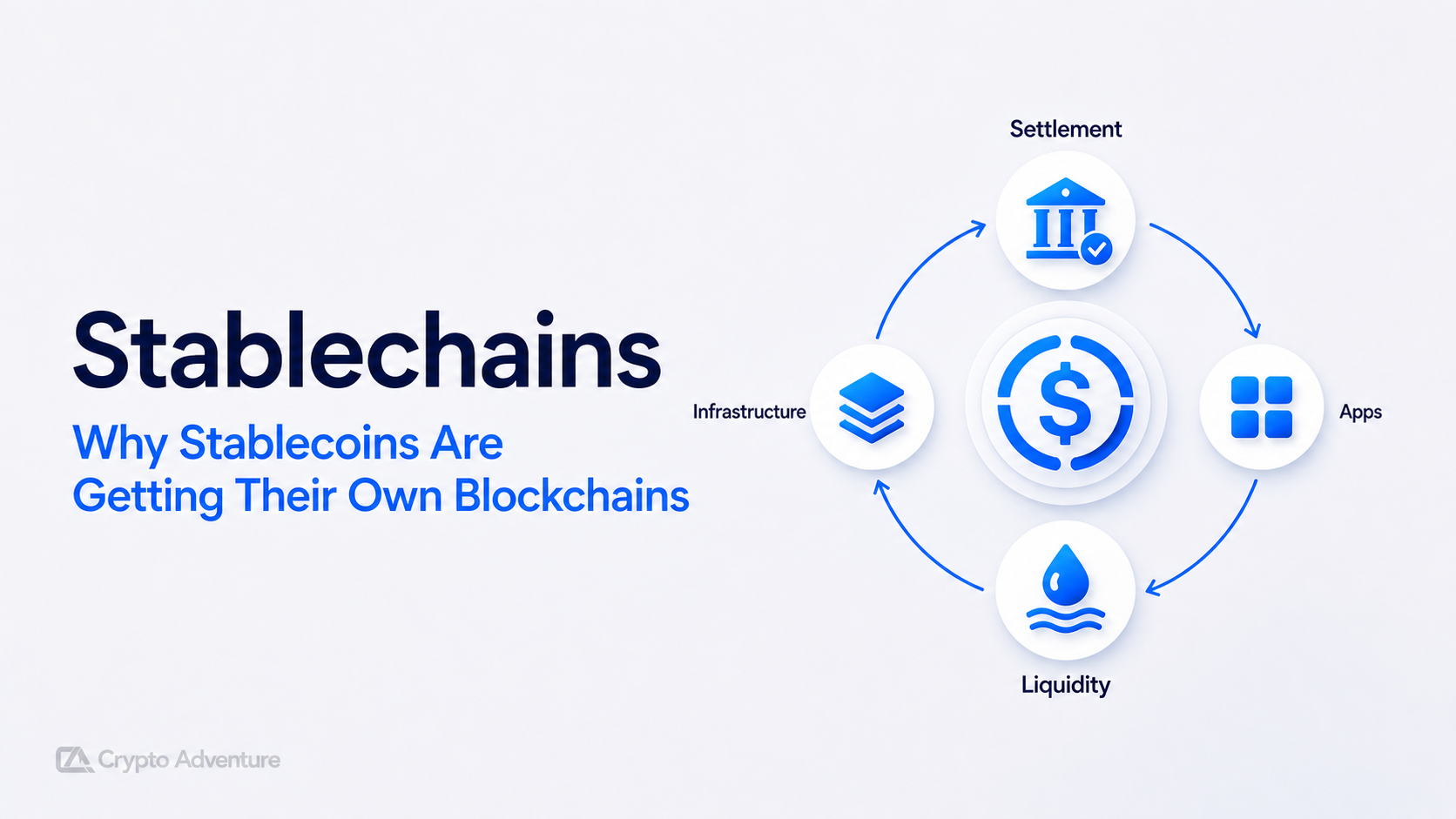
Stablechains are blockchains built specifically for stablecoin payments, settlement, and financial applications. They are not general-purpose smart contract networks first. Their main design goal is simple: make digital dollars easier to move at scale.
That means predictable fees, fast settlement, stablecoin-native gas, payment-friendly wallets, compliance features, enterprise integrations, and better support for merchants, fintechs, banks, exchanges, and AI agents. Stablechains try to solve the awkward parts of using stablecoins on general-purpose chains, where users often need a volatile gas token, fees can spike, and payment flows compete with unrelated DeFi or meme coin activity.
The category has become more important because stablecoins are no longer only trading assets. They are used for cross-border settlement, merchant payments, remittances, treasury movement, card-network settlement, payroll, and on-chain financial products.
Stablecoins already work across Ethereum, Solana, Tron, Base, Arbitrum, BNB Chain, Polygon, and other networks. That broad distribution is useful, but it also creates fragmentation. A user may hold USDC on one chain, a merchant may prefer another, and a payment processor may need consistent settlement across many markets.
General-purpose chains also bring UX problems. A user may have USDC but no ETH for gas. A merchant may want predictable fees but receive payments through a congested network. An enterprise may want compliance hooks, support, finality assurances, and transaction monitoring that a normal DeFi environment does not provide cleanly.
Stablechains respond to those gaps. They are designed around payment reliability first, then apps and composability second.
Arc is Circle’s stablecoin-native Layer 1 blockchain. It is designed as a foundation for stablecoins, tokenized assets, economic contracts, and on-chain markets. The chain is EVM-compatible and built around financial use cases rather than broad consumer-chain branding.
Arc matters because Circle is not only a stablecoin issuer anymore. It is becoming a financial platform around USDC, payments, liquidity, cross-chain movement, and enterprise settlement. Circle’s wider platform also includes Circle Payments Network, which focuses on compliant stablecoin payments and near-instant settlement.
The Arc thesis is straightforward. If stablecoins are becoming a settlement layer for global finance, a chain designed by a major stablecoin issuer can optimize for that use case from day one. The risk is adoption. Arc needs developers, institutions, liquidity, wallets, and real payment volume to prove it can compete with existing high-throughput chains.
Plasma is a high-performance Layer 1 blockchain built for stablecoins, especially USD₮ payments. Its payment-focused design targets instant transfers, low fees, EVM compatibility, and institutional-grade security.
Plasma’s chain design highlights why stablechains exist. It is built for stablecoin volume rather than general-purpose speculation. The Plasma chain overview describes PlasmaBFT, fast block times, EVM compatibility, and stablecoin-focused settlement. That gives developers a familiar execution environment while targeting stablecoin-specific performance.
The appeal is clear for wallets, payment apps, exchanges, and businesses that handle many USDT transfers. The main risk is ecosystem depth. A stablecoin chain needs more than cheap transfers. It needs liquidity, bridges, wallets, payment partners, compliance tools, and users who prefer it over established USDT networks such as Tron and Ethereum.
Stable is another stablecoin-first chain built around USD₮ payments and global commerce. Its StableChain design focuses on predictable fees, a frictionless user experience, and real-world financial applications.
The important design choice is gas. Stable’s whitepaper explains a model where USDT can be used for transaction fees, removing the need for users to hold a separate volatile gas token. That matters for payments because gas-token friction is one of the biggest reasons stablecoin transfers feel confusing to ordinary users.
Stable’s strongest fit is consumer and business payments where the user wants to send dollars and pay fees in dollars. The risk is competition. Many chains now want to become the default stablecoin rail, and USDT already has deep liquidity across existing networks.
Tempo is a purpose-built Layer 1 blockchain for payments, developed with Stripe and Paradigm. It focuses on high-throughput, low-cost global transactions for payments, including machine payments and enterprise use cases.
Tempo’s role is important because Stripe already sits inside global commerce infrastructure. Stripe’s 2026 product updates include stablecoin payments in more markets, custom stablecoin issuance through Open Issuance, and stablecoin micropayments on Tempo for AI-native business models. That makes Tempo less like a speculative chain launch and more like payment infrastructure built for real businesses.
The strongest use case is high-frequency payment activity that needs low cost, strong tooling, and enterprise integration. The risk is that payment chains need real transaction flow. A chain can be technically optimized and still fail if merchants, fintechs, wallets, and developers do not build on it.
Gas is a major reason stablechains exist. On many blockchains, a user can hold stablecoins but still need a separate token to pay fees. That creates friction. A user with USDC on Ethereum may need ETH. A user with USDT on Tron needs TRX. A business handling many small payments needs predictable fee accounting.
Stablechains can reduce this problem by using stablecoins as gas, abstracting gas through paymasters, or giving payment apps better fee control. This matters for merchants because fees need to be predictable. It matters for users because they should not need to understand gas tokens just to send digital dollars.
For payments, the best fee is not only low. It is predictable, easy to account for, and paid in the same unit as the transaction value.
Merchants need settlement, refunds, accounting, compliance, and predictable costs. A stablecoin payment chain that handles those flows well can be more useful than a general-purpose DeFi chain.
Stablechains can also support 24/7 settlement. A merchant can receive digital dollars outside banking hours, while payment processors can convert, route, or hold funds depending on the merchant setup. This can reduce delays in cross-border commerce and marketplace payouts.
The merchant does not always need to see the blockchain. A payment processor can hide the chain while using stablecoins in the back-end settlement layer.
The first risk is fragmentation. If USDC, USDT, PYUSD, and other stablecoins each favor different chains, liquidity can split across ecosystems.
The second risk is centralization. Stablechains tied closely to issuers or payment companies may have stronger compliance and support, but users should understand validator design, governance, upgrade control, censorship risk, and asset-freezing rules.
The third risk is bridge dependence. Stablecoins still need to move between chains, and weak bridge design can create wrapped-asset or liquidity risk.
The fourth risk is adoption. A stablechain must attract real payment volume, not only TVL incentives.
The fifth risk is regulation. Payment-first chains touch money transmission, stablecoin issuance, sanctions compliance, consumer protection, and banking relationships.
Stablechains could make crypto less speculative at the infrastructure layer. Instead of chains competing only for trading volume, NFT mints, or memecoins, payment-first networks compete on settlement reliability, compliance, cost, uptime, and user experience.
They could also make stablecoins easier for AI agents, merchants, payroll systems, remittances, card networks, and business treasury platforms. This is a different growth path from DeFi farming. It is closer to payment infrastructure.
The strongest stablechains will not win because they have the loudest token narrative. They will win if stablecoin transfers become cheaper, easier, safer, and more useful than existing rails.
Stablechains are blockchains designed around stablecoin payments and settlement. Arc, Plasma, Stable, and Tempo all show the same trend from different angles: stablecoins are becoming important enough to justify dedicated infrastructure.
The opportunity is clear. Stablechains can reduce gas friction, improve payment UX, support enterprise settlement, and make digital dollars easier to use in real commerce. The risk is also clear. Fragmentation, centralization, bridge exposure, regulation, and weak adoption can limit the category. Stablechains will matter most if they make stablecoins feel less like crypto assets and more like reliable payment infrastructure.
The post Stablechains: Why Stablecoins Are Getting Their Own Blockchains appeared first on Crypto Adventure.





