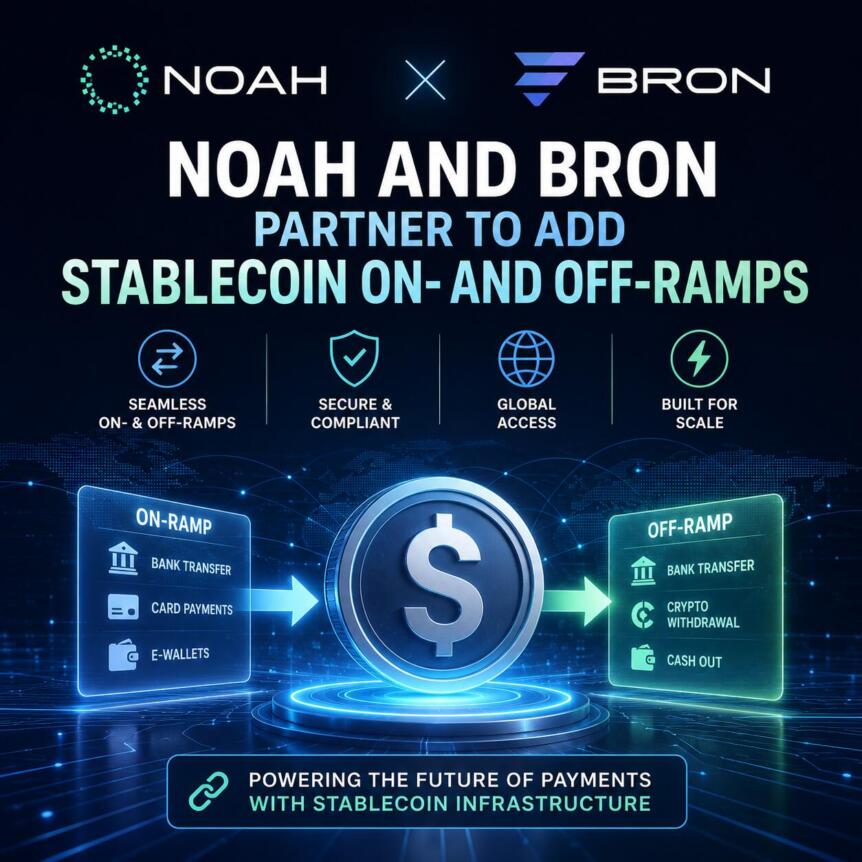
Stablecoin adoption has increasingly hinged on a practical question, how do users move fiat into crypto and back out without sacrificing the control promised by self-custody? On June 25, Noah, a stablecoin payments infrastructure provider, and Bron, a multi-party computation (MPC) self-custody wallet, announced a partnership designed to connect Bron users to Noah-powered stablecoin on- and off-ramp capabilities.
The companies position the integration as a way to streamline funding and withdrawals from a self-custody wallet, while keeping the user experience closer to familiar financial workflows. The development also reflects a broader market trend, stablecoins are shifting from niche trading instruments toward payment and remittance rails, which in turn increases demand for regulated and reliable fiat access.
Noah provides what it describes as stablecoin payment rails for fintechs, exchanges, marketplaces, and other businesses across more than 70 countries. Its platform includes components intended to support compliant money movement, including on-ramps and payout-related services.
Bron, meanwhile, presents its wallet as a non-custodial self-custody product that reduces reliance on seed phrases through an MPC-based security design. According to the announcement, Bron uses a three-party MPC architecture for transaction authorization, splitting signing responsibilities across multiple shards, including one on the user device, one operating within the Bron platform, and one held by an independent third party appointed by the user for recovery. The release states that no single party can reconstruct or control the complete signing material or authorize transactions unilaterally.
Under the partnership, the companies say Bron users will be able to access stablecoin on- and off-ramp functionality powered by Noah’s network. In practical terms, the goal is to make it simpler for users to fund their self-custody wallet with stablecoins, and later convert them back out through the same ecosystem, without changing the underlying self-custody model.
Self-custody is often viewed as a security upgrade because users are expected to control their own signing material. However, many mainstream entry points into crypto are still built around centralized services such as exchanges or custodial wallets. As a result, users may have to navigate multiple steps and user experiences, from buying stablecoins on an exchange to transferring them into a self-custody wallet, and then reversing the process when they need fiat access again.
Stablecoin on- and off-ramps aim to reduce that friction. From an industry perspective, the challenge is not only technical integration, but also compliance and operational readiness, including identity checks where required, transaction monitoring, and the handling of fiat rails across jurisdictions. By routing on- and off-ramp activity through an infrastructure provider, wallet makers can focus on wallet security and usability while relying on an external entity for regulated fiat connectivity.
The Noah-Bron announcement suggests the companies are trying to connect these two layers, keeping the security posture associated with self-custody while using Noah as an intermediary for the fiat-to-stablecoin and stablecoin-to-fiat steps.
The release frames the partnership around users who may want global dollar origination and payouts across markets and international jurisdictions. That points to an audience where cross-border liquidity and payout reliability are often more important than consumer-style onboarding.
For that segment, stablecoins can function as a bridge between traditional payment ecosystems and blockchain settlement. However, the value of the bridge depends on the ability to enter and exit efficiently. If on- and off-ramp access becomes smoother inside a self-custody workflow, it could lower the operational overhead for users who would otherwise rely on transfers between different platforms.
Still, the scope of what users will be able to do depends on how the integration is implemented and which jurisdictions and fiat methods are supported. The announcement indicates that Noah serves businesses in many countries, but it does not provide a detailed list of regions or user flows for Bron consumers.
Bron’s MPC-based approach is central to its positioning. In a traditional wallet, the main recovery and authorization mechanism is often a seed phrase, which can be risky if mishandled and inconvenient if users want a more guided recovery process. Bron states that its architecture eliminates seed phrases and introduces additional protections including biometric authentication, policy controls, delayed transfers, hidden vaults, and guardian-based recovery.
From an editorial standpoint, it is important to separate what the announcement clarifies from what it does not. The release describes how the MPC shards are distributed and emphasizes that no party can unilaterally access or move assets. But details on how users will experience on- and off-ramp steps inside the wallet, and what safeguards apply around fiat conversion and transaction initiation, are not fully specified in the announcement text provided.
Stablecoins continue to be positioned as one of the faster-growing “real-world” use cases in crypto, particularly for payments, remittances, and savings. In that environment, infrastructure partnerships are becoming more common because the ecosystem needs to connect regulated fiat systems with blockchain-based settlement.
Partnerships like the one between Noah and Bron fit a pattern where wallet products and payments rails converge. Wallet providers can improve usability by integrating with established on- and off-ramp providers, while payments infrastructure firms can expand distribution through wallet-based interfaces.
What remains to be seen is how quickly the integration translates into measurable user growth, retention, or transaction volumes, and whether it reduces the need for users to route through centralized exchanges for basic fiat access.
For now, Noah and Bron have outlined a direction that speaks to the core bottleneck in self-custody adoption, connecting secure control with frictionless access. If implemented smoothly and broadly, the integration could help more users treat stablecoins as everyday payment and value transfer tools, rather than assets that require separate, multi-step processes to move in and out of fiat.
This article was originally published as Noah and Bron Partner to Add Stablecoin On- and Off-Ramps on Crypto Breaking News – your trusted source for crypto news, Bitcoin news, and blockchain updates.





