
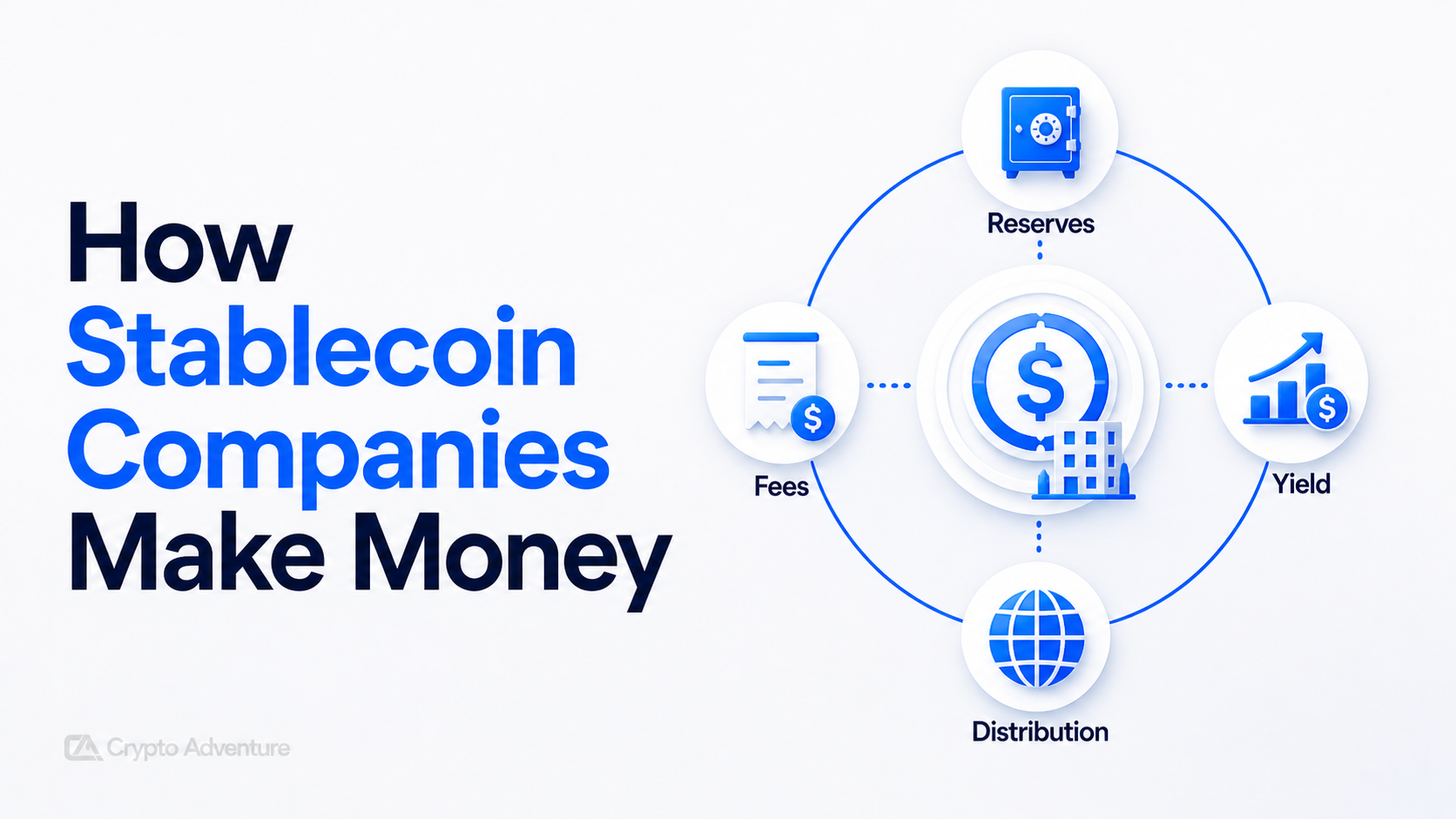
Stablecoin companies usually make their biggest money from reserves. When users buy a fiat-backed stablecoin, the issuer receives dollars or other eligible assets. The issuer then holds those reserves in cash, Treasury bills, money market funds, repurchase agreements, or other approved instruments depending on its model and regulation.
If those reserves earn interest, the issuer can keep much of that income while users hold the stablecoin. This is the core business model behind large fiat-backed stablecoins. The user gets a token designed to stay near one dollar. The issuer earns yield on the assets backing that token.
Circle’s USDC reserve framework uses cash and cash-equivalent assets, with most of the USDC reserve invested in the Circle Reserve Fund, an SEC-registered government money market fund managed by BlackRock. BlackRock’s Circle Reserve Fund page showed a 7-day SEC yield near 3.60% at the end of April 2026, which explains why reserve income can remain meaningful when interest rates are positive.
Stablecoin issuers benefit when reserve yields are high. A large stablecoin supply earning 3% to 5% on short-term safe assets can create billions in annual gross income. When interest rates fall, that income shrinks.
This makes reserve income powerful but cyclical. A stablecoin company can look extremely profitable in a high-rate environment, then face margin pressure if rates decline. The business still has scale, but the easiest revenue line becomes weaker.
Tether’s reserve model shows the scale of this engine. Its transparency reports publish reserve information, and recent public reporting around the Q1 2026 attestation showed USDT reserves dominated by U.S. Treasury bills, with additional exposure to gold and Bitcoin. Tether’s profitability has been heavily linked to the income produced by those reserves.
Some stablecoin companies also earn fees when users mint or redeem stablecoins. Minting turns fiat into stablecoins. Redemption turns stablecoins back into fiat. Large institutions, exchanges, market makers, payment companies, and treasury desks use these flows to manage liquidity.
Fees may be explicit or embedded inside minimum sizes, banking spreads, settlement costs, or foreign exchange. Even when retail users see free transfers inside an app, institutional minting and redemption can still generate operational revenue.
This revenue line depends on volume and trust. If a stablecoin is widely accepted across exchanges, payment processors, DeFi, and wallets, more institutions need access to mint and redeem it. That creates repeat transaction flow for the issuer.
Stablecoin companies increasingly make money through payment infrastructure. The stablecoin itself becomes the asset, while the company sells the rails around it: APIs, compliance, treasury movement, cross-border settlement, merchant settlement, and enterprise tools.
Circle’s Circle Payments Network focuses on compliant global stablecoin payments with near-instant settlement, while CPN Managed Payments gives payment service providers, fintechs, banks, and platforms a way to use stablecoin settlement without directly managing digital assets. That kind of product can create fees beyond reserve interest.
Stripe’s crypto and stablecoin infrastructure shows the same direction from the payment-processor side. Businesses can accept stablecoin payments, manage digital assets, and move money globally. Stablecoin companies and payment companies can both earn by turning stablecoin settlement into enterprise infrastructure.
Stablecoin issuers can also monetize developer tools. APIs for wallets, treasury flows, compliance, transfers, webhooks, payouts, account abstraction, cross-chain movement, and settlement orchestration can become recurring revenue products.
Circle’s Cross-Chain Transfer Protocol lets USDC move natively across chains through burn-and-mint transfers rather than wrapped bridge liquidity. That protocol may not always be a direct fee engine by itself, but it improves USDC utility and can support broader platform revenue.
The business logic is clear. The more useful a stablecoin becomes inside apps, wallets, exchanges, merchants, and chains, the more durable its circulation can become. Circulation supports reserve income, while APIs and enterprise tools can add service revenue.
Stablecoin companies can also make money by serving institutions that need custody, reserve management, and treasury products. A fintech, marketplace, or exchange may not want to build its own stablecoin stack. It may prefer a managed service that handles compliance, wallets, custody, settlement, redemption, and liquidity.
Stripe-owned Bridge received conditional approval from the U.S. Office of the Comptroller of the Currency in 2026 to establish a national trust bank, which would support digital asset custody, stablecoin issuance, orchestration, and reserve management for enterprises and financial institutions. That direction shows where the business model is moving: stablecoin companies are becoming financial infrastructure providers, not only token issuers.
This can create more stable revenue than pure reserve income if customers pay for custody, banking, orchestration, and compliance services. It can also bring more regulation, capital requirements, and operational cost.
Stablecoin companies make money indirectly when partners expand distribution. Exchanges, card networks, wallets, fintechs, remittance apps, and merchants increase usage. More usage can increase stablecoin supply, transaction volume, redemption activity, and platform service demand.
Visa’s stablecoin settlement expansion reached a $7 billion annualized settlement run rate in April 2026 and added more blockchains to the pilot. PayPal’s PYUSD expansion brought PayPal USD to users across 70 markets. These integrations make stablecoins more useful as payment assets and settlement tools.
The issuer benefits when distribution increases demand for the coin. More demand can grow reserves, deepen liquidity, and make the stablecoin more attractive to additional partners.
Not every stablecoin issuer keeps all reserve income. Some products share yield with holders through tokenized Treasury models, savings tokens, or protocol-based reward systems. That changes the business model.
A normal fiat-backed stablecoin often keeps reserve income at the issuer level. A yield-bearing token may pass income to holders through an accumulating token price or rebasing mechanism. Ondo’s USDY is positioned as a yield-bearing token backed by short-term U.S. Treasuries and bank deposits, with clear warnings that holders can incur losses.
This distinction matters. A non-yield stablecoin issuer may earn more reserve spread. A yield-bearing product may sacrifice some issuer margin to attract holders. Users should understand who receives the yield before comparing stablecoins.
The first risk is interest rate compression. If short-term yields fall, reserve income can decline sharply.
The second risk is regulation. Stablecoin issuers may face reserve rules, licensing requirements, disclosure obligations, redemption standards, and restrictions on permissible assets.
The third risk is concentration. A stablecoin company that relies heavily on one revenue source, one reserve manager, one jurisdiction, or one banking network can become fragile.
The fourth risk is competition. If many issuers offer similar digital dollars, fees and spreads may compress.
The fifth risk is trust. A stablecoin business depends on redemption confidence. If users doubt backing, custody, or transparency, supply can fall quickly.
Stablecoin companies make money through reserve income, minting and redemption activity, payments, APIs, custody, treasury services, partnerships, and enterprise infrastructure. Reserve interest is often the biggest engine, especially when rates are high, but the strongest companies are building broader payment and financial platforms around the stablecoin.
The business model works when users trust the backing, institutions need settlement, developers integrate the asset, and partners expand distribution. It weakens when rates fall, regulation tightens, competition grows, or redemption confidence breaks. Stablecoin issuers are no longer only token companies. They are becoming financial infrastructure businesses built around digital dollars.
The post How Stablecoin Companies Make Money appeared first on Crypto Adventure.





