
Stablecoin transaction volume reached a record $1.8 trillion in February, with Circle’s USDC surpassing Tether’s USDT in transfer activity, according to blockchain analytics firm Allium.
The data indicates that this is one of the highest monthly crypto’s transaction levels in history. It also demonstrates that dollar-pegged crypto assets are rapidly growing as a new source of liquidity for the wider digital asset ecosystem.
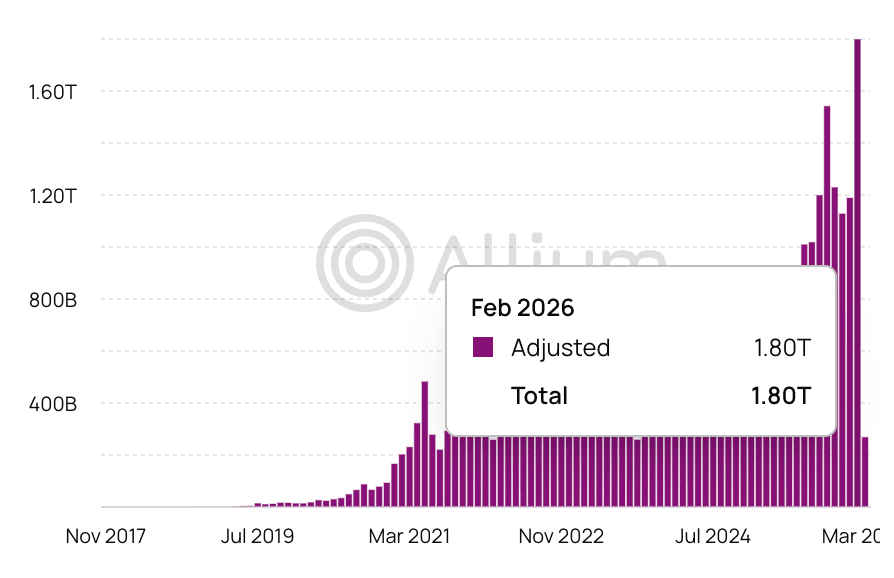
Source: Allium
Per the report, USDC represented around 70% of the total stablecoin transfer volume for the month, which highlights a major spike in adoption. However, its market capitalization remains significantly lower than that of USDT.
The Allium data further indicates that fiat-pegged crypto assets continue to take on an increasingly central role in providing liquidity to the crypto market, supporting payment systems across blockchains, and facilitating trades on those blockchains.
Allium reports that USDC had transaction volume of roughly $1.26 trillion for February, or more than two times higher than the roughly $514 billion recorded for USDT for February.
The data represents the highest monthly transfer volume since USDC launched in 2018 and marks a historic shift in terms of the flow of transactions involving stablecoins, where historically Tether (USDT) has been the dominant player in terms of both transfer volume and circulating supply.
Founder of Moonrock Capital, Simon Dedic, posted on X that “USDC has consistently flipped” USDT in terms of monthly transfer volume,”even with a much smaller circulating supply.”
As of today, USDC has a market capitalization of roughly $77.4 billion, compared to approximately $184 billion for USDT, which adds to the uniqueness of the USDC transaction volume metrics.
Some of the surge in stablecoin use may also be related to recent trends in issuances. Blockchain intelligence firm Arkham reports that more than $3 billion worth of USDC were minted in the first week of March, showing a large demand for the dollar-pegged crypto assets across multiple blockchain networks.
Also Read | SoFi Partners With BitGo to Advance Distribution of SoFi USD Stablecoin
The increased usage of stablecoins has also corresponded with a large increase in liquidity flowing onto cryptocurrency exchanges. CryptoQuant data showed the total amount of stablecoins being held on exchanges has risen to a three-week high of around $66.5 billion.
This is often interpreted as available capital waiting to be deployed into the crypto market. Additionally, the CryptoQuant data revealed that approximately $5.14 billion in stablecoins flowed into exchanges on March 5, a significant increase from the approximately $1.14 billion that flowed into exchanges on March 1.
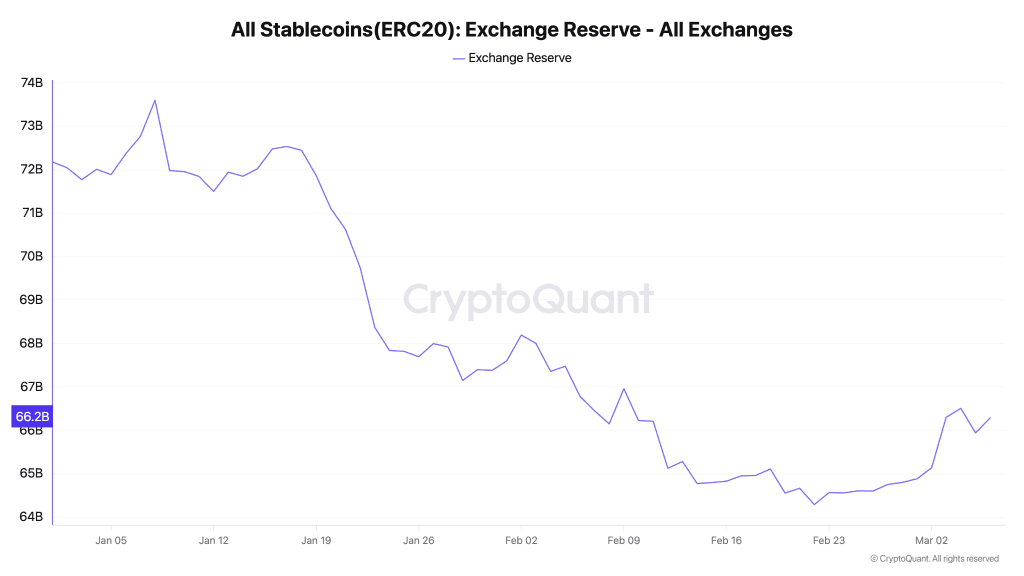
Source: CryptoQuant
This further suggests that traders are preparing to deploy funds in anticipation of future market opportunities. Historically, increases in stablecoin balances on exchanges precede large amounts of market activity. These balances represent purchasing power that can be rapidly redeployed into assets like Bitcoin and Ethereum.
Increasing stablecoin transaction volume is indicative of increased liquidity, which will likely provide the necessary boost for the next wave of buying pressure in the crypto market.
Also Read | Florida Senate Approves New Framework for Stablecoin Oversight





