Stablecoin yield is safe only when you can name who is paying you and verify it. Else, it’s a reckless bet.
In November 2025, a stablecoin called xUSD that had been quietly paying double-digit yield fell from a dollar to about 26 cents in a single day after its operator disclosed a $93 million loss from one outside fund manager. The yield looked fine until the money behind it was gone.
So yeah, stablecoins and the yield on it is not risk-free, and no honest source will tell you otherwise.
The risk runs from modest to severe depending on where the yield comes from, whether the code has been audited and tested, whether you keep custody of your funds, and how the rate is set.
More than $300 billion now sits in stablecoins (DefiLlama, mid-2026), and most of it earns its holder nothing, so earning on those dollars safely is worth getting right.
Below are the five checks to run first, the red flags that should stop you, and one option, sUSDS, run honestly through the same list.
Earning yield on stablecoins is not risk-free, but the risk varies widely and you can check for it before you commit a dollar.
Safety depends on four things: where the yield actually comes from, whether the smart-contract code has survived real use, whether you keep control of your funds, and how the rate is governed.
A yield from tokenized US Treasuries and a yield from a leveraged DeFi loop both quote a dollar return, and they carry very different risk underneath.
Here is the part most explainers skip. Since the GENIUS Act became US law in July 2025, a payment stablecoin issuer is barred from paying you interest simply for holding the coin, a point the Richmond Fed lays out plainly.
The dollar in your wallet pays nothing on its own.
Every cent of yield comes from a separate engine that puts that dollar to work, and that engine is the thing you are actually trusting when you earn.
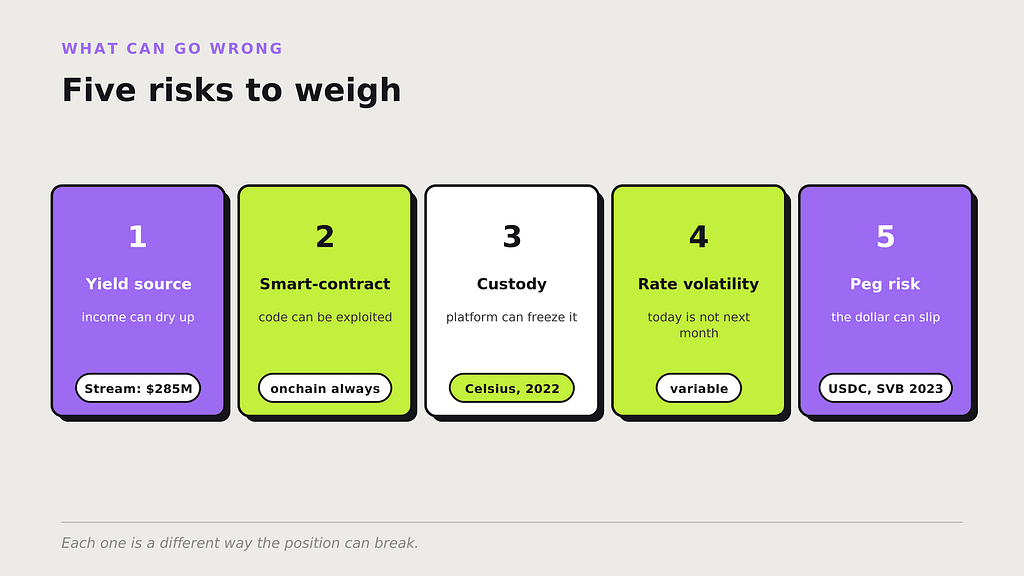
The main risks of earning yield on stablecoins are yield-source risk, smart-contract risk, custody and counterparty risk, rate volatility, and a depeg in the underlying coin.
These belong to the earning activity, separate from whether the coin holds its dollar; for the asset side, the companion piece on whether stablecoins are safe to hold covers backing and depeg history in depth.
The five risks, in plain terms:
Before you earn yield on stablecoins, run five checks: the yield source, the audit and track record, custody, rate behavior, and the backing.
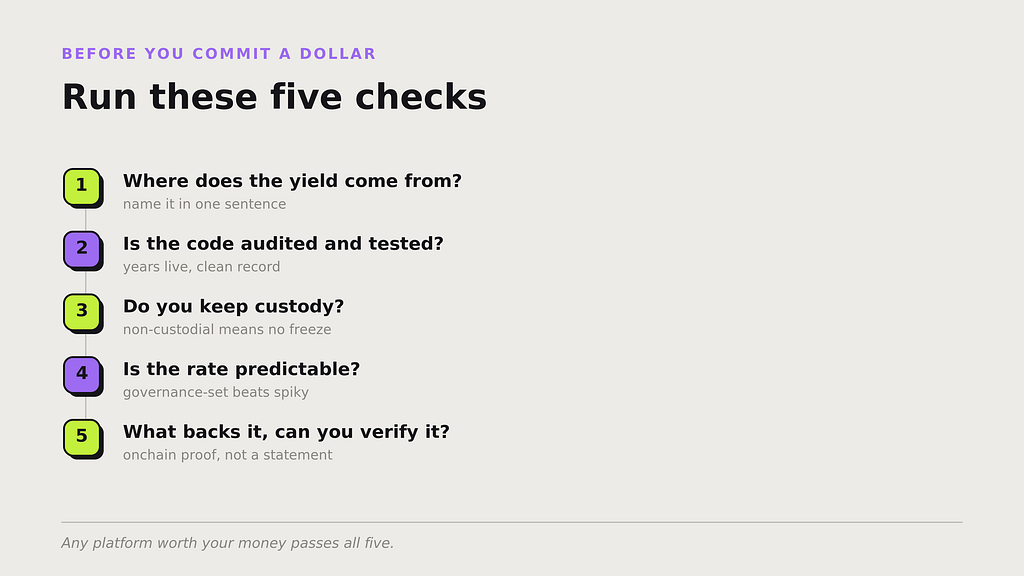
Each one targets a different way the position can go wrong, and any platform worth your money should pass all five.
Yield paid from real revenue, meaning lending fees, income from tokenized Treasuries, or protocol revenue, is more durable than yield paid in freshly minted incentive tokens.
For the full breakdown of durable versus subsidized sources, see where stablecoin yield actually comes from. If you cannot name the source in one sentence, find it before you trust it.
All onchain yield carries smart-contract risk, so you lower it by checking for audits, years in production, and a clean exploit record.
Newer or unaudited contracts have simply had fewer chances to fail in public. A protocol that publishes its own user-risk documentation is showing you the failure modes rather than hiding them.
Check whether you hold the asset yourself or hand it to a platform that holds it for you. Non-custodial means the asset stays in your wallet and no company can freeze it or lose it in a bankruptcy.
The 2022 collapses of Celsius, BlockFi, and Voyager all turned the same way: depositors who had handed over their coins became unsecured creditors waiting in line.
Custody is the risk most people never price until the withdrawal button stops working.
Check how the rate is set, because the mechanism tells you how it will behave. A governance-set rate that moves in deliberate steps is more predictable than one that spikes and crashes with borrowing demand or a promotional budget.
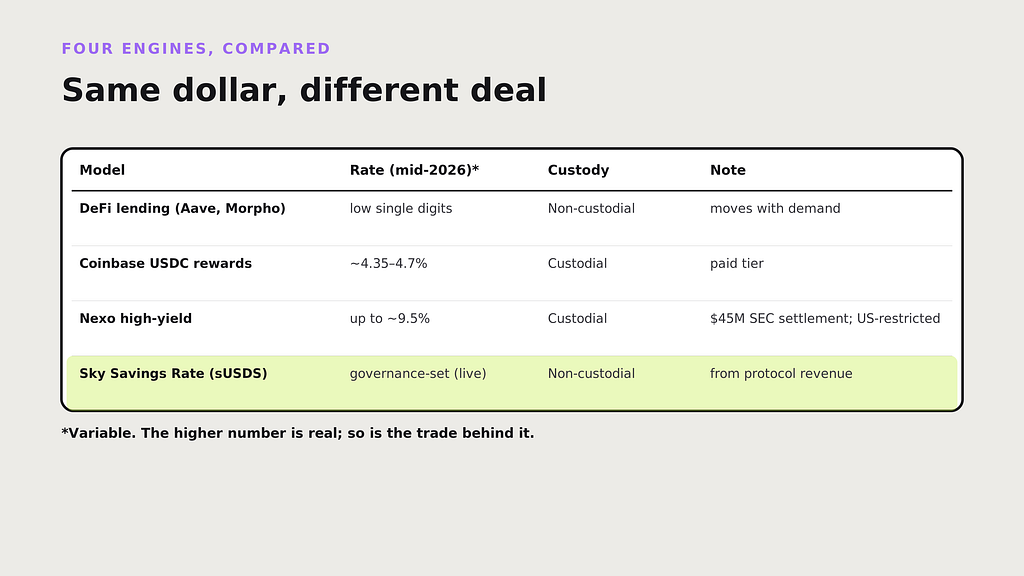
The main models on offer in mid-2026, with current ranges that are variable and worth verifying live:
The higher number is real, and if you want it, it is there. The question is whether you are taking a view on the funding cycle and the platform holding your coins, or choosing a diversified, governance-set rate you can verify yourself.
Check what stands behind the yield and whether you can inspect it. Diversified, overcollateralized backing you can see onchain is lower-risk than opaque or single-strategy exposure, because no single failure takes the whole thing down and you are not trusting a statement on faith.
If the only proof on offer is a quarterly attestation, that is your answer.
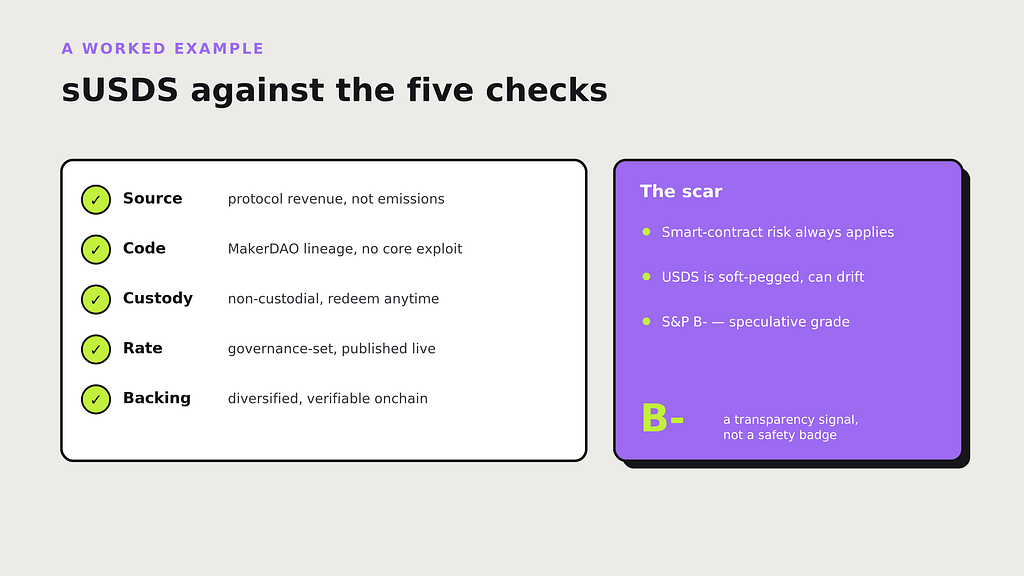
sUSDS is the yield-bearing form of USDS, and running it through the five checks shows what passing looks like.
The yield is the Sky Savings Rate, funded by Sky Protocol revenue across diversified sources rather than token emissions. The code traces its lineage to MakerDAO, one of DeFi’s longest-running systems, whose core stablecoin contracts have operated without an exploit.
You hold sUSDS non-custodially and can redeem it for USDS at any time, the rate is governance-set and published live, and the collateral is verifiable onchain rather than in a statement.
On the numbers, Sky Protocol reported record gross protocol revenue of $123.79 million and about $11.7 billion in USDS supply for the first quarter of 2026, which is the kind of real-revenue base the first check is asking for. USDS itself is overcollateralized and backed by a mix of crypto, USDC reserves, and tokenized US Treasuries.
Now the scar, because the favorable parts only mean something next to the honest ones. Smart-contract risk always applies. USDS is soft-pegged and can trade slightly off a dollar. And in August 2025, S&P Global assigned Sky Protocol a B- issuer credit rating, the first full agency rating for a DeFi protocol. B- is a speculative grade, so read it as a transparency signal rather than a safety badge.
Sky also offers stUSDS, an expert-tier token that takes on real risk, including a possible haircut, for a higher return; it sits above sUSDS on the risk curve and is not a default. The Sky Savings Rate is variable and can change, so check it at the source before you act.
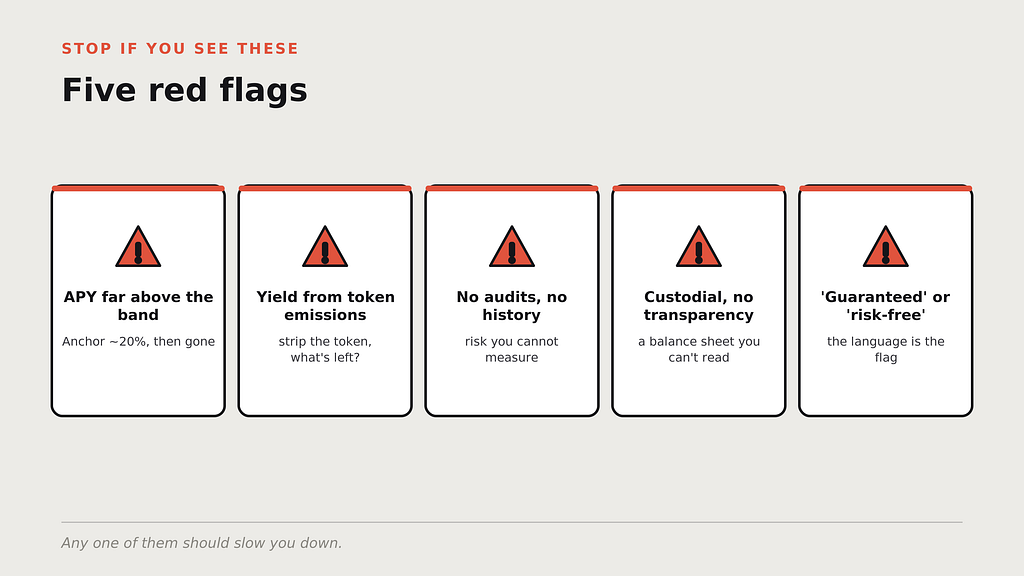
The clearest warning signs are easy to spot once you know them, and any one of them should slow you down.
Stablecoin yield is safe enough to be worth it only when you can name what is paying you and verify it, and reckless when you cannot.
Here is what I would do: keep custody, read the backing before the rate, and prefer a governance-set rate I can watch onchain over a higher headline number whose engine I cannot explain. The extra percent or two is rarely worth the strategy you cannot see.
If you want to start at the lower-risk end, converting USDC to USDS and holding sUSDS is a sensible first position, and curated Sky Vaults or a Fixed Yield maturity are there if you want a different shape of return.
Whatever you choose, check the live rate and the collateral first, then size the position to the risk you can actually name.
Is stablecoin yield safe? It is not risk-free, and safety depends on the yield source, the smart-contract code, who holds your funds, and how the rate is set. The risk ranges from modest to severe, so the right move is to check before you earn rather than assume.
What are the risks of earning yield on stablecoins? Five main ones: yield-source risk, smart-contract risk, custody and counterparty risk, rate volatility, and a depeg in the underlying coin. They are risks of the earning activity, separate from whether the coin holds its dollar.
What is smart contract risk? It is the risk that the code running a yield product fails or is exploited and you lose funds. Audits, years in production, and a clean exploit record reduce it, but they never remove it entirely.
How can I earn yield on stablecoins more safely? Run the five checks: confirm the yield comes from real revenue, confirm the code is audited and time-tested, keep custody, prefer a predictable governance-set rate, and verify the backing onchain. A beginner-friendly walkthrough of the steps is here.
What makes a stablecoin yield predictable? A rate set by governance that moves in deliberate steps, rather than one driven by minute-to-minute borrowing demand or a promotional budget that can be cut. A predictable rate can still change, since governance sets it.
What is the safest stablecoin yield? No stablecoin yield is risk-free, so judge by traits rather than labels. Lower-risk options tend to share the same profile: yield from real revenue, audited and time-tested code, non-custodial control, a governance-set rate, and backing you can verify onchain.
Is sUSDS safe and non-custodial? sUSDS is non-custodial, audited, diversified, and governance-set, which makes it lower-risk and predictable rather than risk-free. The Sky Savings Rate can change, smart-contract risk applies, and USDS is soft-pegged, so verify the current rate and collateral at financial.skyeco.com before committing.
Is a higher APY always riskier? Above the market band, usually yes, because the extra return has to come from somewhere. Terra’s near-20% and Stream’s double-digit loop both looked stable until the funding behind them failed.
Is Earning Yield on Stablecoins Safe? What to Check First (2026) was originally published in Coinmonks on Medium, where people are continuing the conversation by highlighting and responding to this story.





