Strategy doubled the size of its preferred-stock repurchase program to $2 billion Tuesday as Michael Saylor’s Sept. 8 recovery benchmark arrived with STRC still short of its $100 stated value.
The board’s decision extends a campaign that was approaching the limits of its original $1 billion authorization after seven weeks of increasingly large purchases.
Data from STRC.live showed that STRC entered Tuesday around $97 to $98, leaving the variable-rate preferred roughly 2% below the level Strategy has spent much of the summer trying to restore.
Sept. 8 had emerged as an informal milestone after Saylor compared STRC’s latest recovery with the roughly 70 trading days the security initially needed to climb from its $90 offering price to $100.
Instead, Strategy reached the date by expanding how much capital it can commit to the repair.
Strategy’s move comes as its STRC purchases pushed the buyback campaign deeper into territory management had initially expected to avoid as STRC approached par.
Between Aug. 31 and Sept. 7, the company acquired 1.81 million STRC shares for $176.3 million, implying an average price of about $97.36. Cumulative spending since July has now reached roughly $811.5 million.
Without this latest increase, only about $188.5 million would have remained under the original $1 billion authorization. The new ceiling leaves Strategy with $1.19 billion available across its preferred-stock repurchase program.
The spending pattern has moved in the opposite direction from the framework management laid out when the intervention began.
Strategy initially planned to buy more aggressively when STRC traded well below $100, where repurchases offered better economics, before reducing its presence as the discount narrowed and outside demand took over.
STRC had fallen near $71 before the campaign began. Strategy spent $25 million in the first week at an average of $86.52, followed by weekly purchases of $81.2 million, $108.6 million, $132.2 million, $136.4 million, and $151.8 million as the preferred climbed closer to par. The latest $176.3 million purchase is the largest yet.
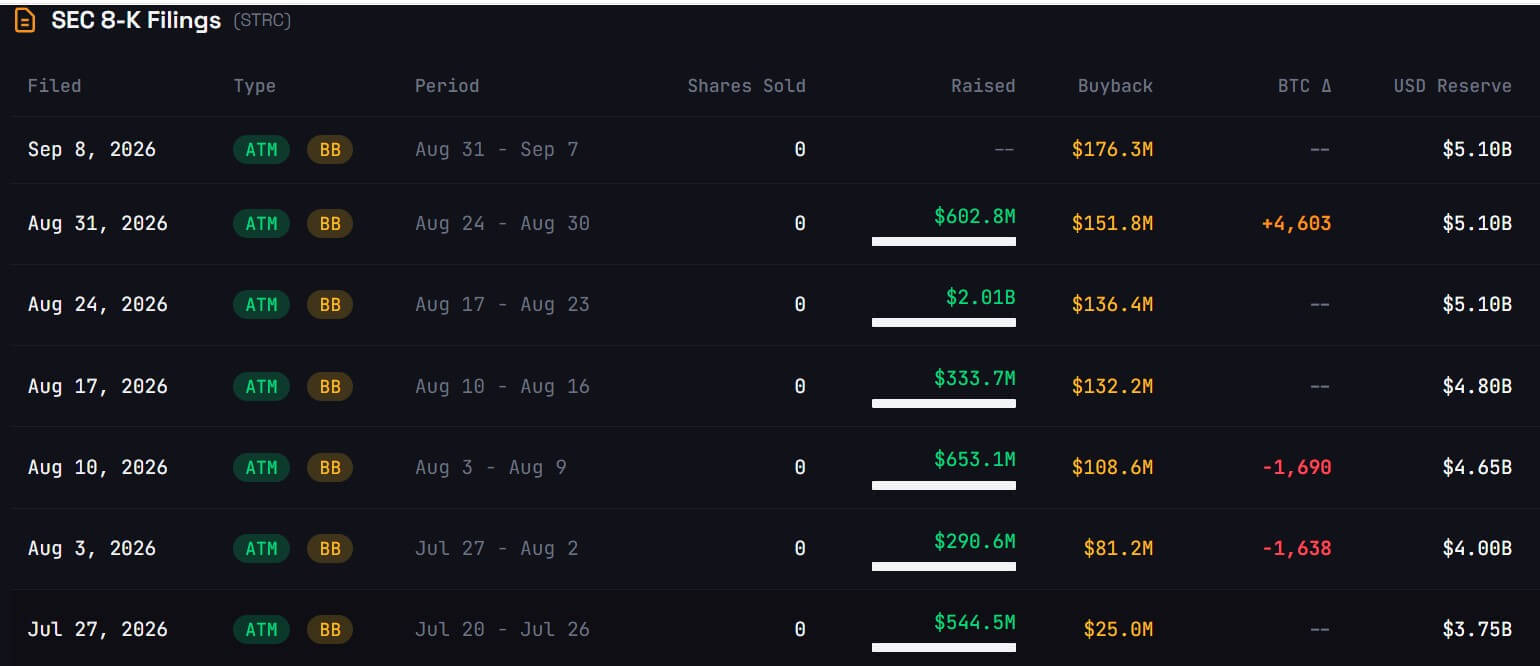
That means the dollar cost of supporting STRC has continued rising even as the discount Strategy is buying has collapsed from more than 13% during the opening week to less than 3%.
Each share retired below stated value removes $100 of preferred capital along with the associated dividend obligation at a discount, an advantage that diminishes as STRC approaches par.
The expanded authorization gives Strategy considerably more room to continue making that trade even after the original program has been more than 80% consumed.
Meanwhile, the latest intervention has also produced a sharp reversal from the capital allocation Strategy displayed only one week earlier.
During the previous reporting period, the company raised $602.8 million through MSTR sales, spent $151.8 million repurchasing STRC and still directed $369.7 million toward 4,603 Bitcoin.
That purchase ended a roughly two-month pause in Bitcoin accumulation and suggested Strategy could once again finance both its preferred-stock obligations and expansion of the asset at the center of its treasury strategy.
However, the combination lasted only one week.
In the latest week, the Saylor-led company sold no shares through its at-the-market program between Aug. 31 and Sept. 7 and purchased no Bitcoin. The entire $176.3 million used for STRC repurchases came from its USD Cash balance.
That pool stood at $1.44 billion at period-end and has a broad mandate. Strategy says the cash can be used to acquire Bitcoin, increase its USD Reserve, manage its capital structure, and fund other Bitcoin treasury company purposes.
Its separate USD Reserve stood at $5.10 billion and is intended to support preferred-stock dividends and interest on outstanding debt.
The distinction puts the latest STRC spending into sharper focus. The buybacks are drawing from the same flexible liquidity pool Strategy can use to acquire more Bitcoin.
The company owned 845,050 Bitcoin as of Sept. 7, acquired for $63.73 billion at an average price of about $75,412.
But the past two weeks illustrate how STRC's struggles have altered the cadence of further accumulation. When fresh equity capital was available, Strategy funded both. Without MSTR issuance last week, STRC received the cash, and Bitcoin purchases stopped.
Strategy has a strong incentive to keep pushing STRC toward $100 because the security becomes far more useful once it can trade reliably around par.
STRC was designed as a perpetual funding vehicle whose variable dividend can be adjusted to encourage the market price to remain near its $100 stated value.
Strategy has also adopted a policy against issuing additional STRC below par, meaning the security cannot fully serve its intended financing role while it trades at a discount.
A sustained return to $100 would reopen that channel. Strategy could once again issue additional preferred shares to raise capital without relying as heavily on sales of MSTR common stock.
STRC has already shown the scale of capital it can attract. Its initial 2025 offering was expanded from an expected 5 million shares to more than 28 million after strong investor demand, ultimately raising about $2.52 billion.
The security has since grown to a market value of roughly $10 billion, making it Strategy’s flagship preferred-stock product and a key component of its broader capital structure.
That makes restoring STRC to issuance territory increasingly important.
Still, Saylor’s Sept. 8 marker was never a contractual deadline, and STRC has recovered sharply from its May lows to within a few dollars of par.
But the board’s decision to double the repurchase authorization shows that the final stage of that recovery may require substantially more balance-sheet support than Strategy initially anticipated.
Nevertheless, the next test is how much of the additional authorization Strategy must deploy before outside demand can hold the security at the $100 par, allowing STRC to shift back from absorbing corporate capital to raising it.
The post Strategy doubles its stock buyback to $2 billion to pull its STRC shares back to $100 appeared first on CryptoSlate.





