Tagger (TAG) trades on 9 exchanges, but CoinMarketCap’s listed all-time low never happened. Full contract, holder, and liquidity breakdown inside.
Open Tagger’s page on CoinMarketCap today, and two numbers sit a few pixels apart, flatly contradicting each other. One says the all-time low was $0.053724, set on December 26, 2024. The other, right next to it, says the token is up 27,190% to 28,250% since that low. Do the arithmetic, and the second number requires a starting price near $0.0000037, not five cents.
That is not a rounding quirk. It is a genuine data error sitting on one of the industry’s most-cited price pages, and it happens to concern a token that just spent the past day moving double digits while listing on nine exchanges at once.
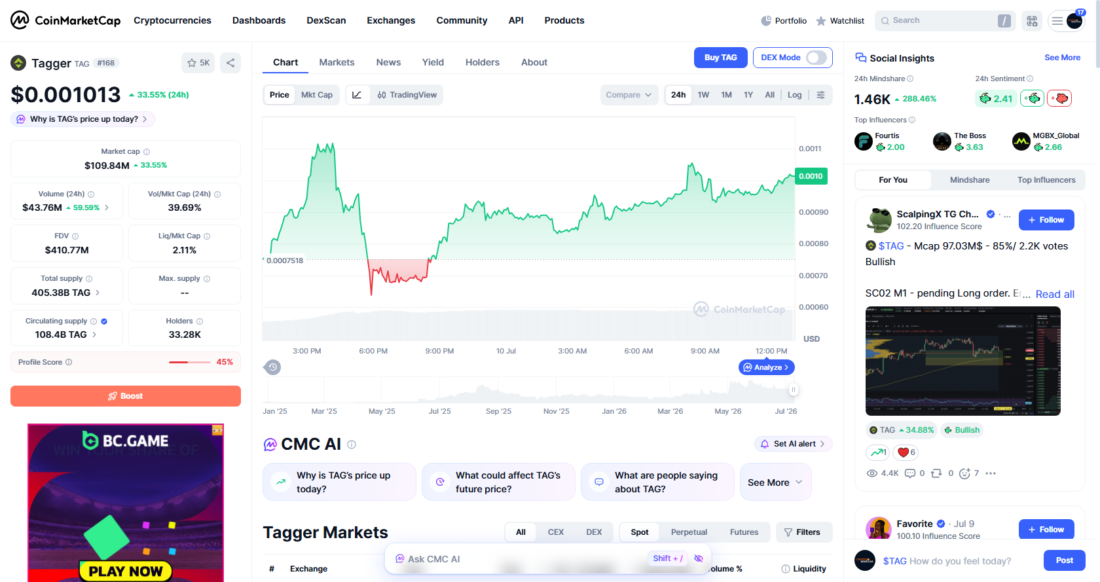
Tagger (TAG) on CoinMarketCap, July 10 2026: price near $0.00102-0.00105, market cap around $110-114M. Source: CoinMarketCap.
Tagger’s own tokenomics documentation states that its liquidity allocation, 20 billion TAG, was paired with $50,000 of BNB at launch. Divide one into the other and the seed price comes out near $0.0000025 per token. Not $0.053724.
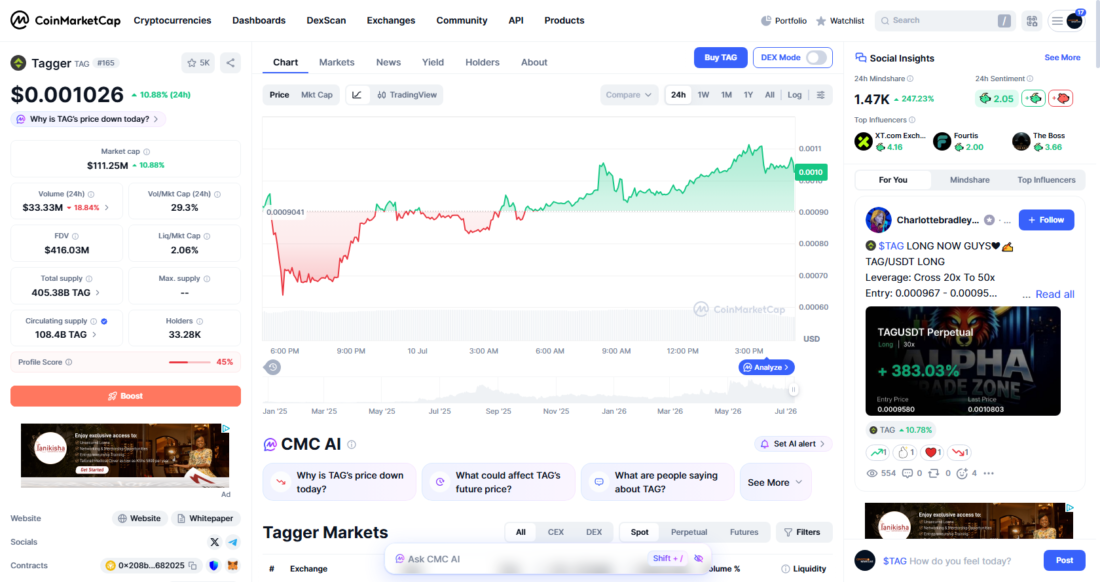
CoinMarketCap chart in All-time view: the labeled “0.053724” reference sits below the visible axis range, while the header shows a +27,271% all-time gain. Source: CoinMarketCap.
Total supply on chain has not changed since that seed. TaggerToken has no mint() function of its own, confirmed by reading the verified Solidity source rather than trusting an automated badge, so a five-cent print on day one would have implied a market cap north of $21 billion for a brand-new PancakeSwap listing launched through the four.meme platform. That never happened. The chart itself, viewed on the “All” timeframe, shows the token trading in a $0.0002-to-$0.0022 band across its entire history; the $0.053724 label sits off the visible scale entirely. Whatever fed that number into CoinMarketCap’s database, a decimal slip, a bad early tick, a mismatched feed, it was not a real trade. Anyone using that figure to judge how far TAG has fallen from its lows is working from a broken reference point.
The Markets tab tells a different, more verifiable story. TAG trades on Binance Alpha, Bitget, Gate, MEXC, BingX, BitMart, XT.COM, OrangeX, and Aster, alongside its original PancakeSwap v3 pool. Nine venues. None of them Binance’s main board, OKX, Bybit, Coinbase, or Kraken.
That is a wide but shallow listing footprint. Real, spread across real order books, but without the single dominant venue that usually anchors price discovery for a token this size. It also means a meaningful share of TAG’s daily volume happens on centralized exchanges whose order flow this research cannot see. The PancakeSwap pool, still the largest single venue by volume, processed roughly $21 million in 24 hours against $2.33 million in liquidity.
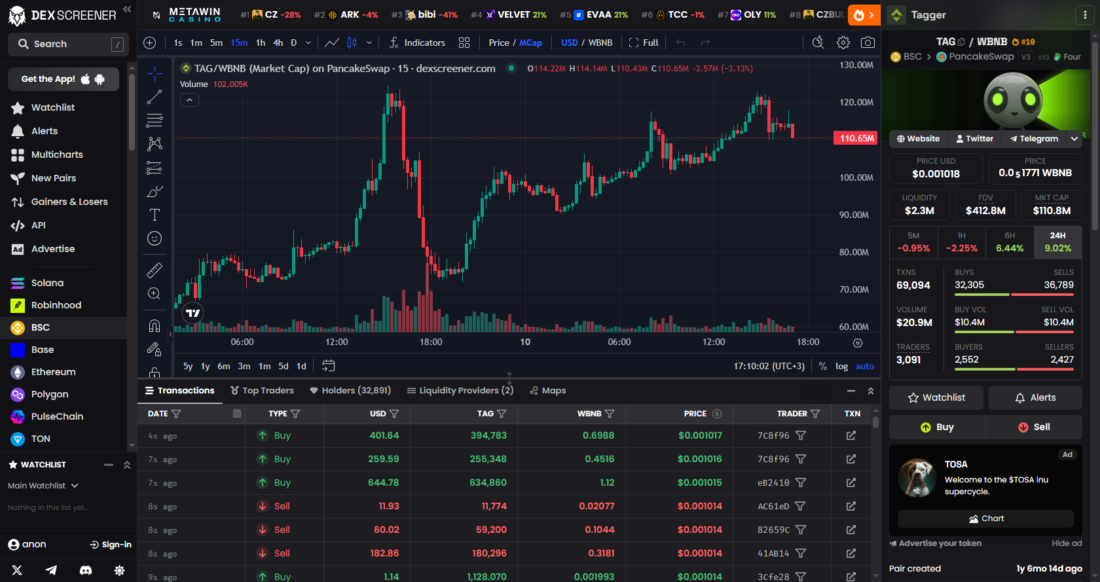
DEX Screener pool view for TAG/WBNB on PancakeSwap v3: $0.001018 price, $2.3M liquidity, 32,305 buys vs 36,789 sells in 24 hours. Source: DEX Screener.
Buy and sell counts leaned toward sells in every window checked, 43 to 48% buy share from five minutes out to twenty-four hours, while buy and sell dollar volume landed almost dead even, $10.4 million each side over 24 hours. That is a real pattern, more sell transactions than buys, similar total money on both sides, but it is not the tight, mechanical 50/50 split that usually flags wash-trading bots. Full breakdown below, pulled directly from DexScreener’s API.
| Timeframe | Buys | Sells | Buy % | Read |
| 5m | 63 | 82 | 43.4% | skewed toward sells |
| 1h | 793 | 894 | 47.0% | near-parity, mild sell lean |
| 6h | 5,838 | 6,301 | 48.1% | near-parity, mild sell lean |
| 24h | 32,335 | 36,840 | 46.7% | skewed toward sells |
None of the coverage a trader finds elsewhere tells them what happens the moment they try to size into TAG. This does, checked directly against a live DEX aggregator rather than estimated from liquidity depth.
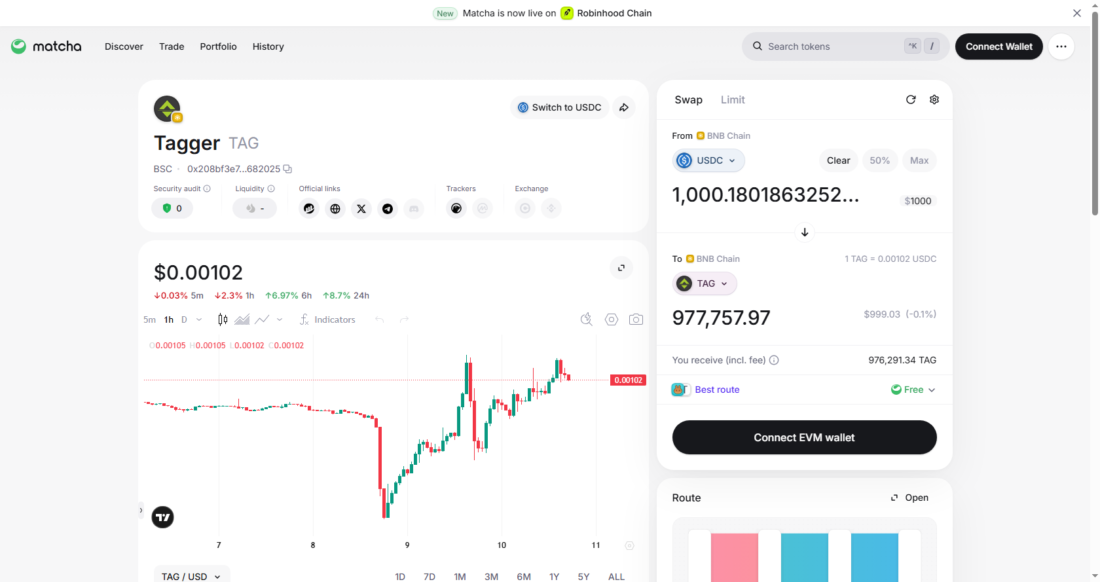
$1,000 buy quote on Matcha: -0.1% price impact. Source: Matcha (0x aggregator).
A $1,000 buy moves the price by a tenth of a percent. A $10,000 buy costs 0.69%. Both are trivial. The number that matters sits at $100,000: an 8.75-to-9.40% price impact, enough that the interface itself throws a Price Impact Warning before letting the trade proceed. Selling shows a similar curve, from -0.39% at $1,000 down to -7.25% at $100,000.
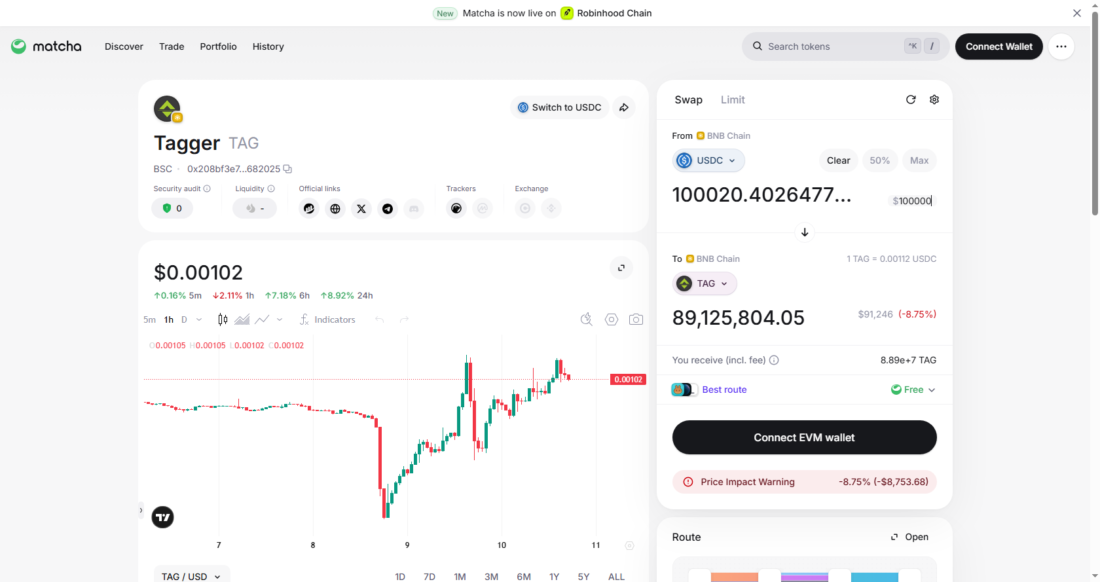
$100,000 buy quote on Matcha: -8.75% to -9.40% price impact, Price Impact Warning triggered. Source: Matcha.
For context, $2.33 million sits in the primary pool against a $110 million-plus market cap, a Liq/Mkt Cap ratio of roughly 2%, half the 5% level this research treats as comfortably liquid. Below $10,000, TAG trades cleanly. Above roughly $50,000-$100,000 in either direction, the token cannot currently absorb size without material slippage. That is a fact about depth, not a forecast.
Running the contract through honeypot.is returns a verdict of HONEYPOT DETECTED, headline text reading “RUN THE F*** AWAY.” Two other independent scanners disagree. DexScreener’s Quick Intel (GoPlus) and Matcha’s own security panel (also Go+-powered) both report zero buy or sell tax and no honeypot flag.
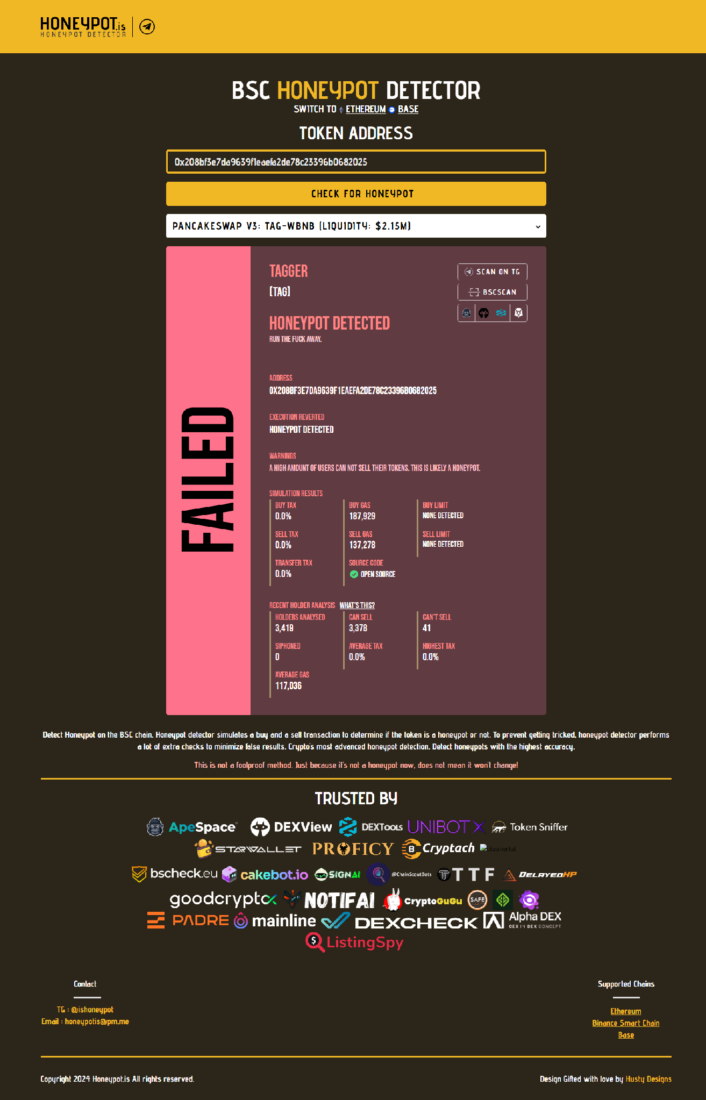
honeypot.is result for TAG: headline “HONEYPOT DETECTED,” but simulation results show 0% buy/sell tax and holder analysis shows 3,378 of 3,419 sampled holders successfully sold. Source: honeypot.is.
The contradiction sits inside honeypot.is’s own report. Below the alarming headline, its Simulation Results list a 0.0% buy tax and 0.0% sell tax. Its Holder Analysis, sampling 3,419 real wallets, found that 3,378 of them, 98.8%, successfully sold, with zero tokens siphoned and 0% average tax. A tool cannot simultaneously prove that almost every real holder can exit cleanly and claim the token traps sellers. One of those data points is wrong, and the supporting numbers, not the headline, line up with the other two independent scanners.
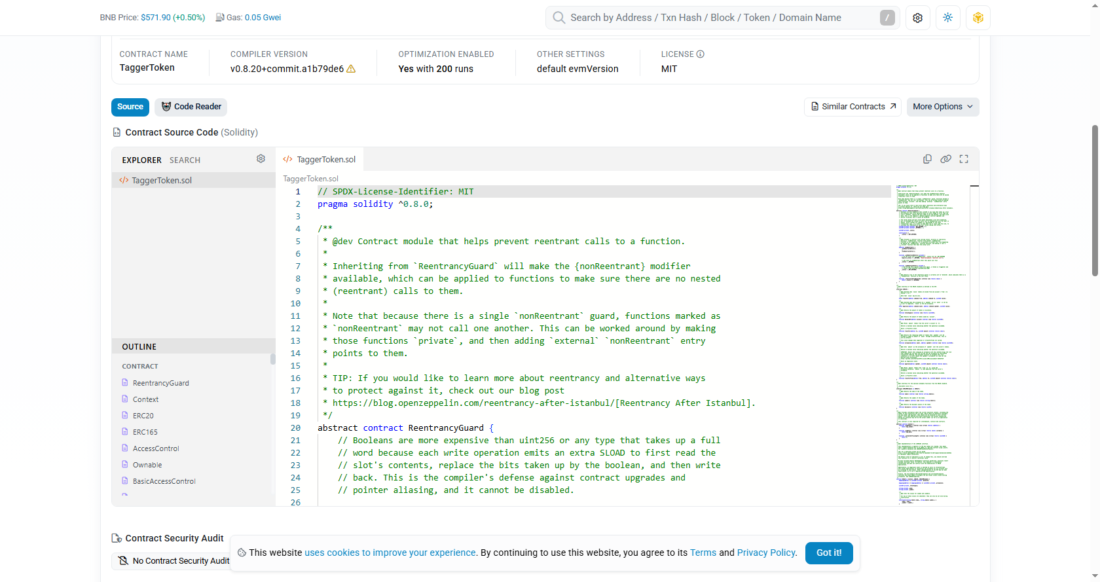
Reading the verified contract source directly settles it. TaggerToken launches with transfers fully restricted, MODE_TRANSFER_RESTRICTED by default in the constructor, reverting every transfer with “Token: Transfer is restricted.” A one-time launch() call flips that permanently to MODE_NORMAL. That switch has been thrown for a year and a half; every trade referenced throughout this article, the nine exchange listings, the DEX volume, honeypot.is’s own 98.8% successful-sell sample, happened after it. Whatever produced honeypot.is’s “execution reverted” result does not reflect the contract’s current, normal-operating state.
DexScreener’s scanner correctly reports no mint() function and marks the token “Mintable: No.” That check looks for a public function named mint. It would miss what the source code actually contains: a public claim() function that calls _mint() internally, gated only by a signature from a hardcoded SIGNER address, with no on-chain check against any total-supply ceiling.
BscScan Write Contract tab for TAG listing all 21 public functions, including claim(), launch(), setSigner(), and renounceOwnership(). Source: BscScan.
The contract declares a MAX_SUPPLY constant of 400 billion tokens. Neither claim() nor launch() ever references that constant. Current on-chain total supply already sits at 405,380,800,000, 5.38 billion above it, which is the clearest possible proof that the constant is decorative rather than enforced. Cross-checking against Tagger’s own tokenomics page shows why the current total lands exactly where it does: 300 billion for a Proof-of-Human-Work rewards pool, 85.38 billion tied to a pre-launch data-labeling claim campaign called Tag-to-Pump, and 20 billion for liquidity, summing to precisely 405,380,800,000. The documented math checks out today. Nothing in the code stops a future claim from checking out less well; that boundary exists only because the SIGNER key has, so far, chosen not to cross it.
The single largest wallet, per BscScan’s holder chart, is not a person. It is a Gnosis Safe multisig holding 296.5 billion TAG, 73.15% of everything in existence. That figure is not a mystery: it lines up almost exactly with the documented 300 billion Proof-of-Human-Work reserve, minus the roughly 3.48 billion (1.16%) already released since genesis.
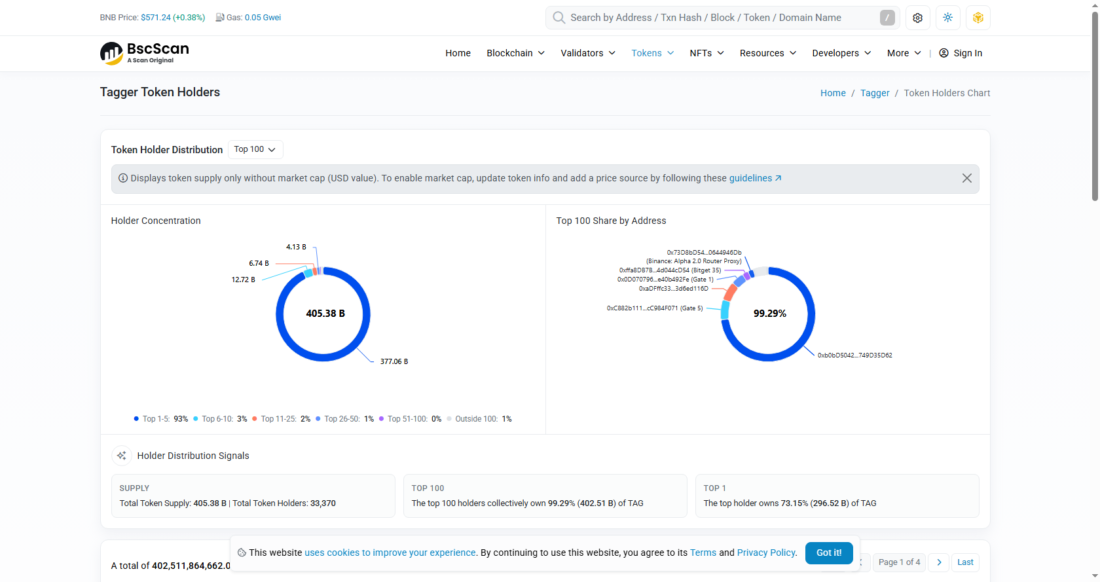
BscScan Top 100 holder chart for TAG: rank-1 Gnosis Safe multisig holds 73.15% of supply; top 100 hold 99.29%. Source: BscScan.
That reframes the concentration number. Top 100 wallets hold 99.29% of supply, a figure that would read as alarming on its own, but almost all of it traces to that one disclosed multisig plus a handful of labeled exchange wallets (two Gate addresses, a Bitget wallet, the Binance Alpha router) and the LP pool itself. This is not a case of dozens of hidden insider wallets quietly accumulating. It is one large, documented, slow-moving reserve, released so far at a pace of about one percent per year and a half, governed by a halving schedule tied to actual task completion rather than a calendar-based cliff.
The one wallet that does not fit a clean label is rank three: 0xaDFffc33…3d6ed116D, holding 6.52% of supply. It was funded 38 days before this research and currently sits on 21,051 BNB, worth roughly $12 million, plus $89.2 million spread across fifty other tokens. That balance sheet reads like a market maker or a professional trading desk, not a team allocation; it matches no line item in Tagger’s published tokenomics.
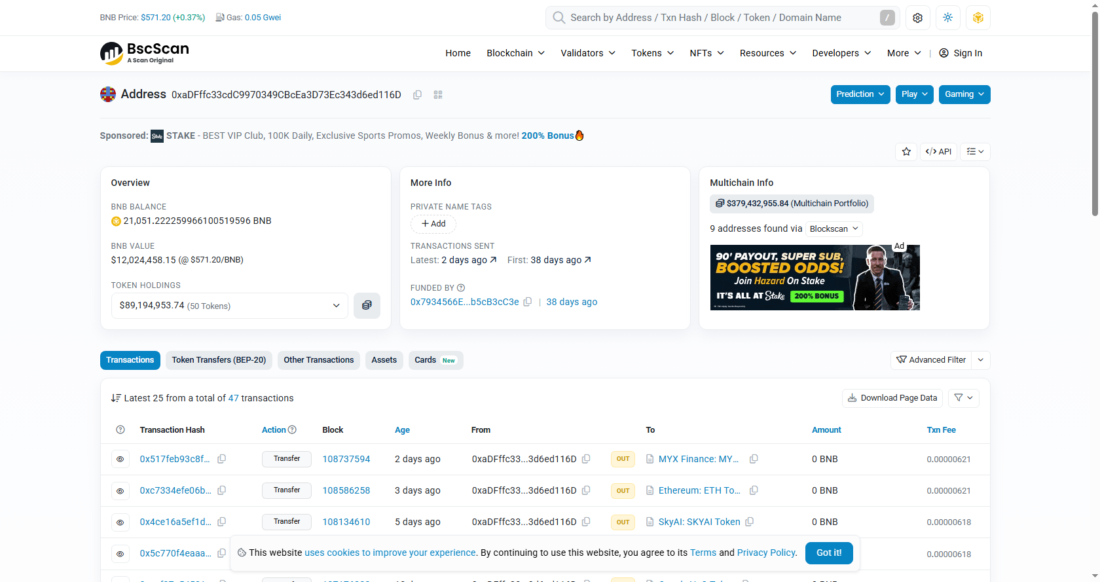
BscScan address overview for TAG holder rank 3: $12.0M BNB balance, $89.2M in other tokens, first transaction 38 days before research date. Source: BscScan.
Tagger’s team page claims the core group includes “professors and PhDs from MIT and the Technical University of Munich” and “former employees of JPMorgan Chase and Citibank.” Not one individual is named. No LinkedIn profile, no photo, no verifiable credential appears anywhere on the site or in the GitBook docs. A dedicated Audits page exists in the documentation’s navigation; clicking into it finds an empty stub with no content.
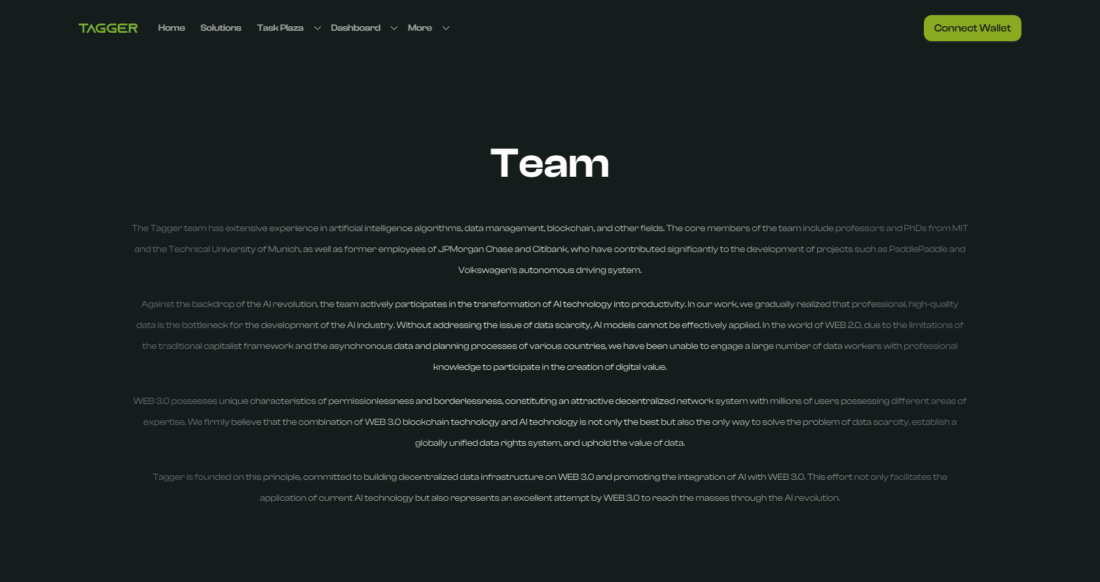
Tagger team page: describes MIT/Munich/JPMorgan pedigree with zero named individuals. Source: tagger.pro.
Set against that: the LP position is locked for ten years through a third-party locker contract, ownership has been renounced on-chain (owner address reads 0x0000…0000), and CertiK, an external auditor, has rated the project 4.1 out of 5, a rating that lives on CoinMarketCap rather than on Tagger’s own, empty audits page. A public GitHub search turns up no matching repository under Tagger’s name. DeFiLlama has no protocol page and no funding round on record. This is a project that locked its liquidity and renounced ownership, standard hygiene, while leaving its human side almost entirely undocumented.
Among the roadmap items, GitBook’s roadmap page stops cold at “2025 Q2,” last updated a year ago, nothing scheduled for the period this article covers. The one concrete, dated, currently-live item comes from a different source entirely: Bitget’s “$TAG Simple Earn” staking product, offering up to 25% APR across 7- and 30-day terms, running May 23 through August 21, 2026. Tagger’s official account reposted the announcement in May, and the window has not closed.
Three things worth tracking: whether the Safe multisig’s 296.5 billion-token reserve continues releasing at its current slow pace or accelerates; whether the Bitget staking program gets renewed past its August 21 end date; and whether CoinMarketCap corrects its all-time-low figure now that the underlying math has been checked against three independent sources and does not hold up.
No comparable past catalyst was found for TAG. The token’s May 4, 2026 all-time high has no dated announcement attached to it in official channels or CoinGecko/CoinMarketCap news coverage, so no historical reaction pattern from a prior listing or unlock could be verified for comparison here.
Bull case, strictly from what was verified: nine live exchange listings including an active 25% APR staking product, a ten-year-locked LP position, renounced ownership, a CertiK rating, and a documented token-reward mechanism tied to real task completion rather than an insider cliff. Bear case, equally strict: a five-cent-supply-implied data error still live on the industry’s most-used price tracker, a signature-gated mint function with no on-chain supply cap, thin liquidity relative to market cap once a trade clears roughly $50,000, and a team that names no one behind claims of elite academic and banking pedigree.
The post Tagger Listed All-Time Low Never Actually Happened. appeared first on Live Bitcoin News.





