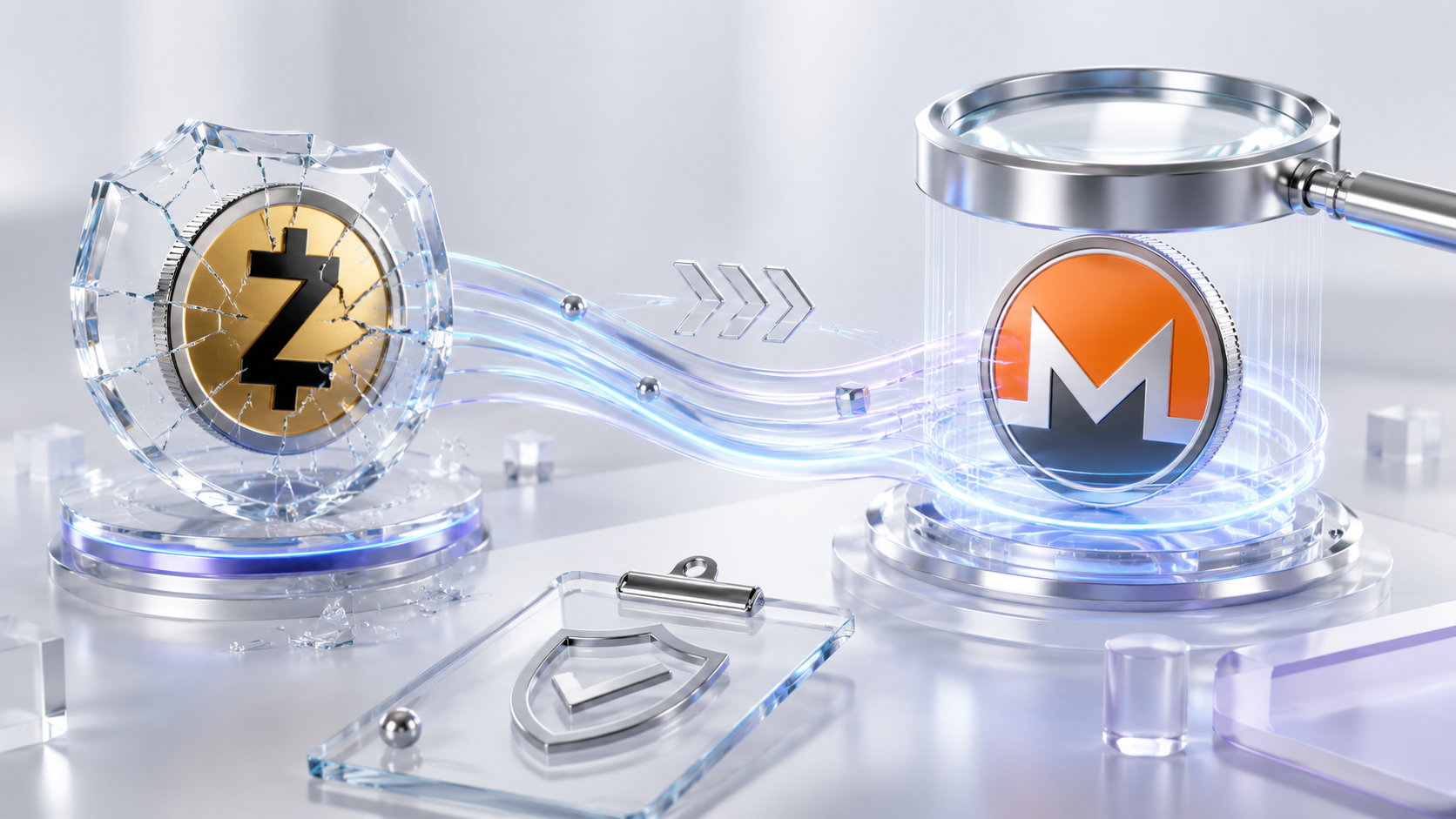
Taylor Hornby, the security engineer who found Zcash’s critical Orchard vulnerability, has added Monero to his audit queue after an AI-assisted review exposed one of the most serious privacy-coin flaws in years.
Hornby confirmed the next target after being asked whether Monero could receive the same type of review. His answer was direct: he would add Monero to his queue of things to audit. The statement does not mean a Monero vulnerability has been found. It means one of the researchers behind Zcash’s emergency patch now intends to examine another major privacy-focused cryptocurrency.
The timing matters because the Zcash incident was not a minor bug report. The Orchard counterfeiting vulnerability was discovered on May 29, 2026, during security research supported by Shielded Labs. Hornby used Anthropic’s Claude Opus 4.8 as part of a targeted review of the Orchard circuit, then disclosed the flaw to Zcash Open Development Lab engineers instead of exploiting it.
The Orchard bug struck at the heart of Zcash’s privacy design. Orchard is Zcash’s newest shielded pool, where transaction details are hidden through zero-knowledge proof technology. Shielded Labs said the flaw could have allowed unlimited, undetectable counterfeit ZEC inside Orchard, and that Orchard’s privacy properties mean there is no purely cryptographic way to prove from the pool alone whether it had been exploited before remediation.
The Zcash Foundation’s emergency upgrade gives the operational side of the response. Zebra 4.5.3 temporarily disabled Orchard actions through an emergency soft fork, while Zebra 5.0.0 activated NU6.2 to re-enable Orchard with the corrected circuit. The foundation said there was no evidence of unauthorized value creation, no known exploitation, no impact to user privacy, and no break in the total ZEC supply cap.
That distinction is important. The bug was patched quickly, and Zcash’s turnstile mechanism helped confirm the broader supply remained intact. However, the market still had to price a harder question: how much confidence should investors place in a shielded system after a flaw remained present from Orchard’s 2022 activation until the 2026 emergency fix?
ZEC’s reaction showed how sensitive that question became. The token later fell sharply as supply-assurance fears spread, with ZEC dumping about 35% after the AI-assisted Orchard flaw and Arthur Hayes exiting his ZEC position. The selloff was not only about the patch itself. It was about the gap between fixing a vulnerability and fully restoring confidence in a privacy system where historical verification is harder by design.
Monero is the obvious next name because it is the largest default-privacy cryptocurrency. Unlike Zcash, where users can move between transparent and shielded pools, Monero applies privacy by default. Its design uses ring signatures to obscure the sender, stealth addresses to protect the recipient, and RingCT to hide transaction amounts.
That does not mean Monero carries the same weakness as Zcash. The two networks use different cryptographic systems, different privacy assumptions and different transaction structures. Hornby’s audit queue is not a disclosure and should not be treated as evidence of a flaw.
Still, the market logic is clear. Zcash just showed that a privacy protocol can pass years of use and review while still carrying a critical circuit-level bug. Monero’s privacy model is different, but it also depends on complex cryptography that must preserve both confidentiality and monetary integrity at the same time.
The bigger story is the role of AI-assisted security research. Opus 4.8 was released on May 28, one day before Hornby found the Orchard flaw. Shielded Labs said he used the model alongside traditional research methods and a custom audit workflow, then produced a working local exploit.
That does not mean AI alone found the bug. It means an experienced researcher used a stronger model to move faster through a highly technical review. For privacy coins, that changes the audit environment. Old code, long-running assumptions and complex cryptographic circuits may now face a new class of review where expert humans use AI systems to search deeper and faster.
For Zcash, the next challenge is restoring supply confidence after the Orchard shock. For Monero, the challenge is different: a high-profile audit could strengthen its default-privacy narrative if no serious issues are found, or expose weaknesses the market has not priced in. Privacy coins are now entering a period where the strongest claim is not only that transactions are private, but that the privacy system can survive AI-assisted scrutiny.
The post Zcash Bug Hunter Adds Monero To Audit Queue After AI-Assisted Orchard Flaw appeared first on Crypto Adventure.





