Terra Classic (LUNC) remains one of the most controversial cryptocurrencies in the market. After the dramatic collapse of the Terra ecosystem in 2022, many investors still wonder whether LUNC can recover and whether the token could ever reach ambitious targets such as $0.01, $0.1, or even $1.
In this guide, we explore realistic Terra Classic price predictions for 2026, 2027, 2028, and 2030. We also examine the factors that influence LUNC’s price, including token burns, community initiatives, market sentiment, and ecosystem development. Most importantly, we analyze whether a $1 valuation is mathematically possible given the current supply.
While Terra Classic still benefits from a dedicated community and ongoing burn programs, investors should understand both the opportunities and the significant risks before making any investment decisions. Read on to discover what could drive LUNC higher in the coming years and what challenges may stand in the way of a major recovery.
| Current LUNC Price | LUNC Price Prediction 2026 | LUNC Price Prediction 2030 |
| $0.000061 | $0.000275 | $0.025 |

Terra Classic (LUNC) is the original version of the Terra blockchain, a cryptocurrency network that once ranked among the largest projects in the digital asset market. The platform aimed to create a payment ecosystem powered by algorithmic stablecoins, with TerraUSD (UST) serving as its flagship product.
Everything changed in May 2022 when UST lost its peg to the US dollar. The stablecoin was designed to maintain a value of $1 through a relationship with LUNA, the network’s native token. However, intense selling pressure triggered a collapse that wiped out billions of dollars in market value within days. As investors rushed to exit the ecosystem, the supply of LUNA exploded, causing its price to crash almost to zero.
Following the crisis, the Terra community approved a blockchain fork. The newly created chain became Terra 2.0, while the original network continued operating under the name Terra Classic. At the same time, the original LUNA token was renamed Terra LUNA Classic (LUNC).
Today, Terra Classic operates as a community-driven blockchain. Independent validators, developers, and token holders manage the network through decentralized governance. The community focuses on reducing the massive token supply through burn initiatives, improving network functionality, and rebuilding confidence in the ecosystem. Although Terra Classic no longer holds the dominant position it once enjoyed, it remains one of the most actively discussed recovery projects in the cryptocurrency market.
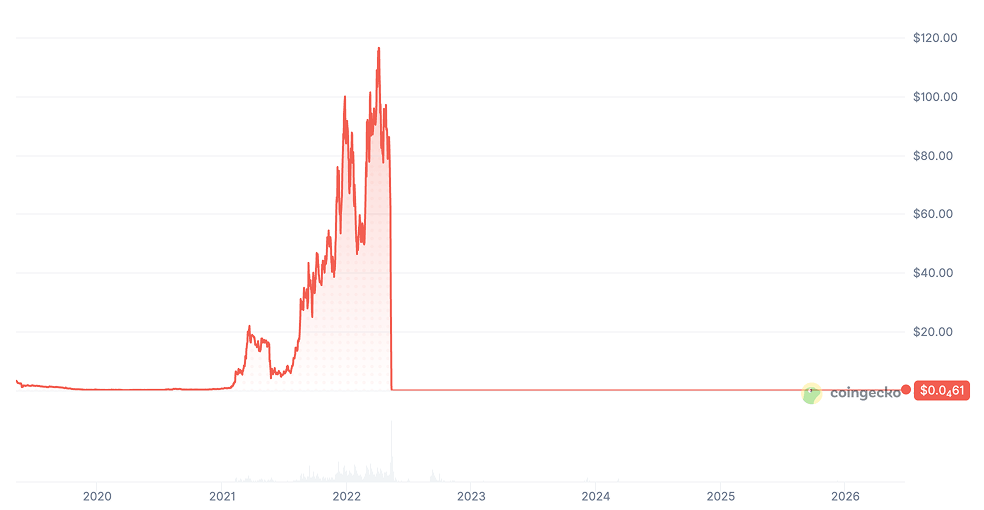
CoinGecko, June 24, 2026
Several factors influence the price of Terra Classic (LUNC). Unlike many established cryptocurrencies, LUNC’s future depends heavily on community activity, token supply reduction, and overall market confidence. Because the project experienced a historic collapse in 2022, investors closely monitor every development that could affect its recovery potential.
The most important factors include:
The token burn strategy remains one of the most important elements of the Terra Classic recovery plan. A token burn permanently removes coins from circulation, reducing the total supply over time. The LUNC community introduced a tax burn mechanism that destroys a small percentage of certain on-chain transactions. In addition, several exchanges have supported off-chain burns by allocating part of their trading fees to burn programs.
Today, more than 450 billion LUNC tokens have been burned, although the circulating supply still remains above 6,4 trillion coins. This highlights the scale of the challenge facing the project.
While burns can help create scarcity and improve market sentiment, they are unlikely to produce dramatic price increases on their own. For meaningful appreciation, Terra Classic also needs stronger ecosystem growth, higher network activity, and sustained investor demand alongside continued supply reduction efforts.
Unlike many blockchain projects, Terra Classic survives largely because of its dedicated community. Following the 2022 collapse, developers, validators, and token holders continued working on the network through a decentralized governance system. Community members regularly vote on proposals that influence development priorities, staking policies, and burn initiatives.
Social media platforms such as X, Reddit, Telegram, and Discord play a major role in maintaining engagement. News about burns, exchange support, and ecosystem upgrades often generates significant discussion and trading activity.
Community-driven momentum has helped keep Terra Classic relevant years after the collapse. However, market sentiment can change quickly, especially during periods of broader cryptocurrency weakness. Grassroots support provides an important foundation, but long-term success will depend on whether the community can attract new users, developers, and real blockchain activity rather than relying solely on speculation and social media enthusiasm.
| Year | Minimum Price | Maximum Price | Average Price | Price Change* |
| 2026 | $0.00005 | $0.0005 | $0.000275 | +350% |
| 2027 | $0.00006 | $0.0015 | $0.00078 | +1,180% |
| 2028 | $0.000055 | $0.0015 | $0.00077 | +1,160% |
| 2030 | $0.0001 | $0.05 | $0.025 | +41,000% |
The outlook for Terra Classic in 2026 remains highly dependent on token burns, community activity, and overall cryptocurrency market conditions. Forecasts from DigitalCoinPrice and PricePrediction suggest that LUNC could experience moderate growth if the project continues reducing supply and maintaining investor interest.
Conservative Scenario ($0.00006-$0.0001)
This scenario closely follows the DigitalCoinPrice forecast, which projects LUNC trading between approximately $0.00006 and $0.0001 throughout 2026. In this case, burn programs continue, but ecosystem growth remains limited and market demand stays relatively weak.
Moderate Scenario ($0.0001-$0.00017)
A stronger crypto market and continued exchange-supported burns could push LUNC toward the middle of the PricePrediction range. Investors would likely reward consistent supply reduction and improved network activity.
Optimistic Scenario ($0.0002-$0.00026)
PricePrediction’s most bullish 2026 forecasts reach approximately $0.00026. This scenario would require major burn milestones, rising trading volumes, and a favorable market environment. While possible, it would likely require significantly stronger demand than the project currently experiences.
Overall, the moderate scenario appears the most realistic, while the optimistic scenario depends heavily on the successful execution of the community’s long-term recovery strategy.
The years 2027 and 2028 will be critical for Terra Classic. By this stage, investors will expect tangible results from years of token burns and network rebuilding efforts.
2027 Conservative Scenario ($0.00006-$0.00012)
DigitalCoinPrice projects LUNC mostly between $0.00006 and $0.00013 during 2027. This scenario assumes modest ecosystem activity, gradual burns, and limited adoption growth.
2027 Moderate Scenario ($0.00012-$0.00023)
PricePrediction forecasts values ranging from roughly $0.0001 to $0.00023. Continued community engagement, improving sentiment, and steady supply reduction could support this outcome.
2027 Optimistic Scenario ($0.00023-$0.0003)
For LUNC to move beyond existing forecasts, the project would need accelerated burns, stronger exchange participation, and a broader crypto bull market. Such a move would require demand growth that exceeds current expectations.
Looking ahead to 2028, PricePrediction forecasts a potential range between $0.00009 and $0.00025, while DigitalCoinPrice remains more conservative at approximately $0.00005 to $0.00009.
The difference highlights uncertainty surrounding long-term adoption. If cumulative burns remove a meaningful percentage of supply and market conditions remain favorable, LUNC could gradually trend toward the higher end of these projections. However, supply reduction alone will not be enough without sustained ecosystem development.
By 2030, Terra Classic’s success will depend on whether it can remain relevant in an increasingly competitive blockchain industry. The project will need both substantial supply reduction and genuine utility growth to justify significantly higher valuations.
DigitalCoinPrice forecasts LUNC between approximately $0.0001 and $0.00015 by 2030. This represents a relatively conservative outlook that assumes steady but limited progress.
Conservative Scenario ($0.0001-$0.00015)
This scenario reflects the DigitalCoinPrice forecast and assumes gradual burns, stable community support, and modest ecosystem activity.
Moderate Scenario ($0.0002-$0.0005)
PricePrediction projects a range of roughly $0.00021 to $0.0005. This outcome would require continued burn initiatives, stronger investor confidence, and sustained growth across the broader cryptocurrency market.
Optimistic Scenario ($0.0005-$0.001)
A move beyond current forecasts would require extraordinary progress. Supply would need to decline significantly, network activity would need to expand, and Terra Classic would need to compete successfully against established smart-contract ecosystems.
Even by 2030, the circulating supply is likely to remain the biggest obstacle. While meaningful gains remain possible, long-term appreciation will depend on balancing aggressive supply reduction with real-world adoption and utility growth.
Many investors continue to ask whether Terra Classic can eventually reach $1. While the idea is appealing, the numbers tell a very different story.
LUNC currently has a circulating supply of roughly 6.5 trillion tokens. If each token were worth $1, Terra Classic would have a market capitalization of approximately $6.5 trillion. For comparison, that would be significantly larger than the market value of most publicly traded companies and several times larger than the entire cryptocurrency market today.
To make a $1 price remotely realistic, the circulating supply would need to fall dramatically. Even after hundreds of billions of tokens have been burned, the supply remains measured in trillions. Most estimates suggest that more than 99.9% of the current supply would need to disappear before a $1 valuation becomes mathematically plausible.
As a result, the overwhelming consensus among analysts is that LUNC reaching $1 is effectively impossible under current conditions. Smaller price increases remain possible, but a $1 target would require an unprecedented supply reduction and extraordinary demand growth.
Terra Classic may appeal to investors who are comfortable taking significant risks in pursuit of potentially high returns. The project still has an active community and ongoing burn programs, but it also faces serious challenges related to supply, competition, and long-term adoption.
For long-term investors seeking stability and predictable growth, stronger blockchain projects may offer a better risk-to-reward profile. However, short-term traders and speculative investors may find opportunities during periods of increased market interest.
Overall, LUNC should be treated as a high-risk speculation rather than a core portfolio holding. Most investors should consider limiting exposure to 1-3% of their total cryptocurrency portfolio to manage risk effectively.
Buying Terra Classic (LUNC) is relatively straightforward, even for beginners. The token is available on several major cryptocurrency exchanges, including Binance, KuCoin, and Kraken. However, if you want to exchange crypto without creating an account, StealthEX offers a simple wallet-to-wallet solution.
Follow these steps to buy LUNC through StealthEX:
Step 1: Visit StealthEX and select the cryptocurrency pair you want to exchange, such as ETH to LUNC
Step 2: Enter the amount you want to swap. The platform will automatically calculate how much LUNC you are expected to receive.
Step 3: Click the exchange button and enter your Terra Classic wallet address. Always double-check the address before proceeding.
Step 4: Send your cryptocurrency to the deposit address generated by StealthEX. Make sure you send the correct asset on the correct blockchain network.
Step 5: Wait for the transaction to be confirmed. Once the exchange is completed, your LUNC coins will arrive directly in your wallet.
For long-term storage, many investors use Terra Station, Trust Wallet, or a Ledger hardware wallet. Hardware wallets generally provide the highest level of security because they keep private keys offline and away from potential online threats.

LUNC may recover part of its value if token burns continue and the community remains active. However, a return to its all-time high near $119 is effectively impossible due to the massive increase in circulating supply after the 2022 collapse.
Long-term forecasts vary widely. Most optimistic projections suggest LUNC could reach fractions of a cent by 2040 or 2050. However, predictions become increasingly unreliable over such long timeframes and depend heavily on supply reduction.
The burn mechanism alone is unlikely to push LUNC to $1. Reaching that level would require more than 99.9% of the current supply to be removed while demand grows dramatically. Most analysts consider this scenario unrealistic.
Terra Classic currently has a circulating supply of approximately 6.5 trillion tokens. Although hundreds of billions of coins have been burned, the remaining supply is still extremely large compared to most major cryptocurrencies.
LUNC still has an active community, ongoing development efforts, and regular burn initiatives. While the project faces significant challenges, it may continue operating as a speculative community-driven blockchain with limited but meaningful growth potential.
Follow us on Medium, X, Telegram, YouTube, and Publish0x to get StealthEX.io updates and the latest news about the crypto world.
Don’t forget to do your own research before buying any crypto. The views and opinions expressed here are solely those of the author.
LUNA LUNC price prediction Terra Terra Classic




