The architecture of decentralized exchanges has undergone a structural transformation since the introduction of the Automated Market Maker model. Uniswap v2 and v3 established a standard for programmable liquidity that enabled the growth of on-chain trading volume from marginal figures to trillions of dollars.
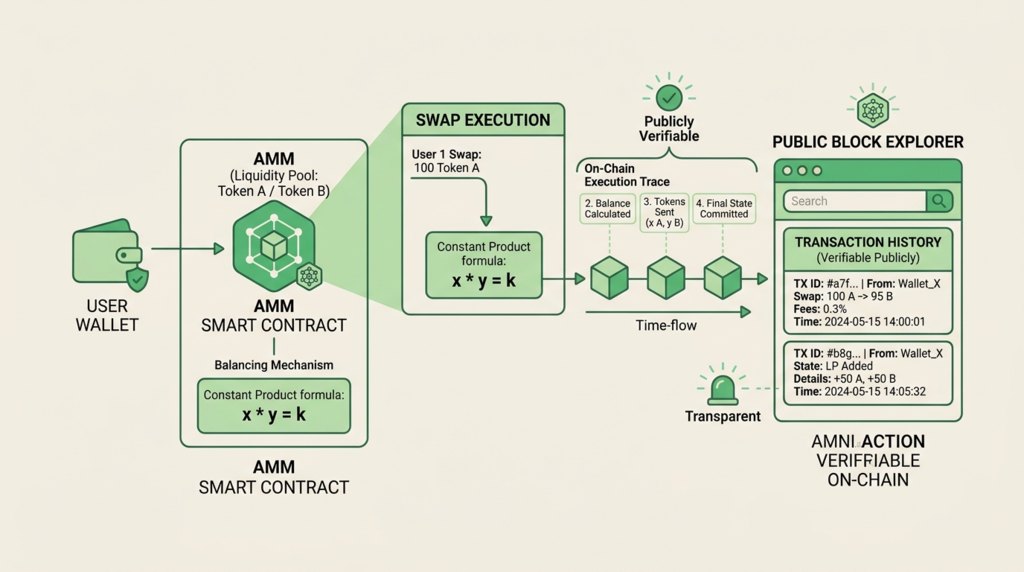
However, the AMM model imposes structural costs that manifest as slippage on large orders, impermanent loss for liquidity providers, and vulnerability to MEV extraction. The x*y=k price curve determines that the effective price of a trade depends on the order size relative to the pool size, disproportionately penalizing traders executing significant volumes.
Intent-based systems have emerged as a response to these limitations. In contrast to the imperative approach of AMMs, where the user specifies the complete execution path —including the liquidity pool, slippage tolerance, and gas payment— the intent model adopts a declarative approach: the user signs an off-chain message specifying a desired outcome, without detailing the execution method.
The implementation of the intent model presents architectural variations among leading protocols. UniswapX, launched in beta in 2023, operates through a Dutch auction mechanism per individual order. When a user submits an intent, the protocol sets a starting price slightly above the user’s minimum acceptable price and decrements it linearly over a typical window of 30 to 60 seconds.

Fillers monitor the auction and execute the order at the moment when the auction price exceeds their execution cost. Competition among fillers tends to produce early executions within the window, generating prices above the user‑established minimum.
CoW Protocol adopts a distinctly different architectural approach via batch auctions. The system collects intents over a discrete time window and settles them jointly in a single on-chain transaction. Solvers —professional actors with bonded collateral and DAO approval— compete to propose the optimal solution for each batch. This model enables direct matching of opposing intents (Coincidence of Wants), which bypasses liquidity pool fees and reduces on-chain gas consumption.
Adoption data indicates a growing penetration of the intent-based model in decentralized trading volume. By mid‑2026, CoW Protocol, UniswapX, and Across constituted the three largest intent‑based systems, collectively processing billions of dollars in monthly volume.
CoW Protocol reached cumulative volume exceeding 80 billion dollars by mid‑2026. In 2025, the protocol recorded 87 billion dollars in annual trading volume, more than double the 40.2 billion processed in 2024.
UniswapX reports that approximately 80% of its swaps have settled at a price superior to the user’s initial quote, with MEV that would have been extracted by sandwich attacks redirected as price improvement. Within the Ethereum ecosystem, an estimated 40% of DEX volume transits through intent‑based protocols such as CoW Swap, UniswapX, and 1inch Fusion.
The adoption of the ERC‑7683 standard in 2025 has extended the intent model from single‑chain trading to cross‑chain transfers and bridging. This standard, co‑authored by Uniswap Labs and Across Protocol, establishes a common format for different protocols to express and fulfill intents across multiple blockchains. The Open Intents Framework, based on ERC‑7683, provides a modular toolkit to standardize and simplify cross‑chain intent development on Ethereum, addressing fragmentation among Layer 2 solutions.
Following Across’s solver network migration to the standard in Q3 2025, ERC‑7683 orders accounted for 88% of Across’s total volume, with over 70 protocols adopting the standard. The concept of a “bridge” as a separate entity disappears for the end user, who simply expresses a transfer intent between chains.
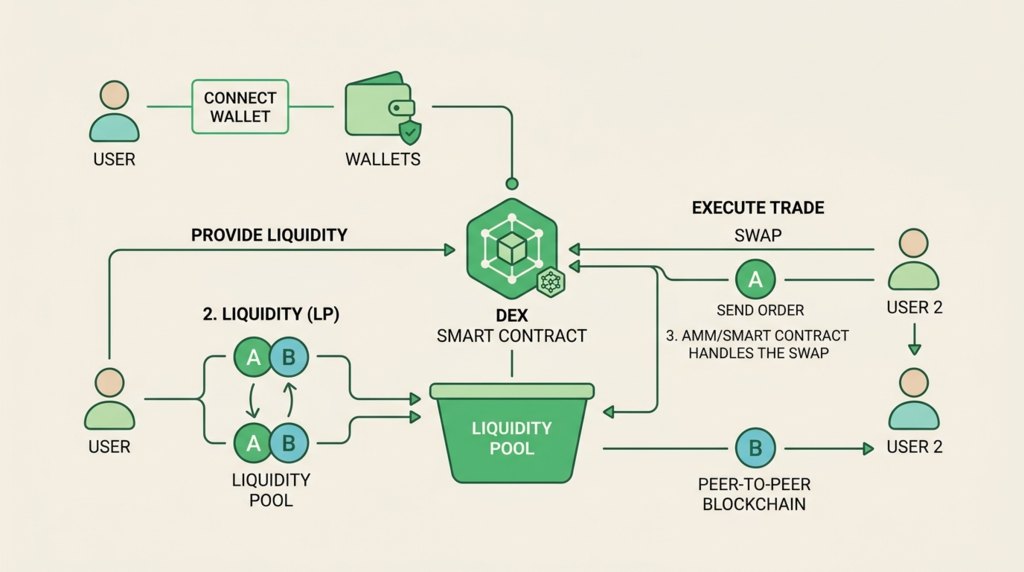
The transition toward intent‑based systems introduces centralization risks that were not present in the AMM model. The financial threshold for building a competitive solver limits the number of market participants, generating a natural consolidation toward an oligopoly.
Data from 2026 indicates that 3 to 5 market makers (Wintermute, GSR, Auros, Flow Traders, Selini) fill the vast majority of solver volume. The “DEX” label operates as a user experience wrapper, while the actual settlement venue is the solvers’ inventory.
An analysis from July 2026 on CoW Protocol’s reward reform (CIP‑74) found that the change reallocated trading value by order size and increased volume‑weighted solver concentration (the Herfindahl‑Hirschman Index rose from 0.176 to 0.241). This empirical evidence suggests that reforms designed to optimize reward allocation can unintentionally further consolidate market power among the largest capitalized solvers.
In the AMM model, execution is publicly verifiable on‑chain. In the intent model, the execution route and the exact terms of the transaction are determined by the winning solver, introducing informational asymmetries between the user and the executor. The user signs an intent without visibility into the liquidity source, the margin captured by the solver, or the routing methodology employed.
Intent‑based systems face liveness risks that do not affect AMMs. If solvers are unavailable or cannot execute intents correctly and in a timely manner, the system can experience operational paralysis. The reliance on a limited set of solvers creates a single point of failure in the execution layer. Unlike AMMs, where liquidity is permanently available in pools, intent systems require solvers to be active and capitalized to fulfill orders.
Intent capture risk emerges when rewards are concentrated exclusively on gross performance, favoring vertically integrated and highly capitalized market makers. This phenomenon leads to operational centralization where a handful of dominant solvers acquire levels of control that can compromise the system’s neutrality.
The AMM model distributed the cost of liquidity provision among LPs and the execution cost among traders. The intent model shifts execution risk to solvers, who assume gas costs, slippage risk, and the responsibility of finding the optimal liquidity route. This risk transfer has a cost that manifests in the spread that solvers incorporate into their quotes —typically 1 to 5 basis points on major pairs— and in the market concentration that naturally emerges.
A practical recommendation for users, based on order size and nature, reflects this market segmentation: for orders below $100,000 on a single chain, UniswapX or CoW Swap; for stable transfers between Layer 2s, Across; for cross‑chain routes with multiple hops, 1inch Fusion+; for large orders with possible partial execution, CoW Swap.





