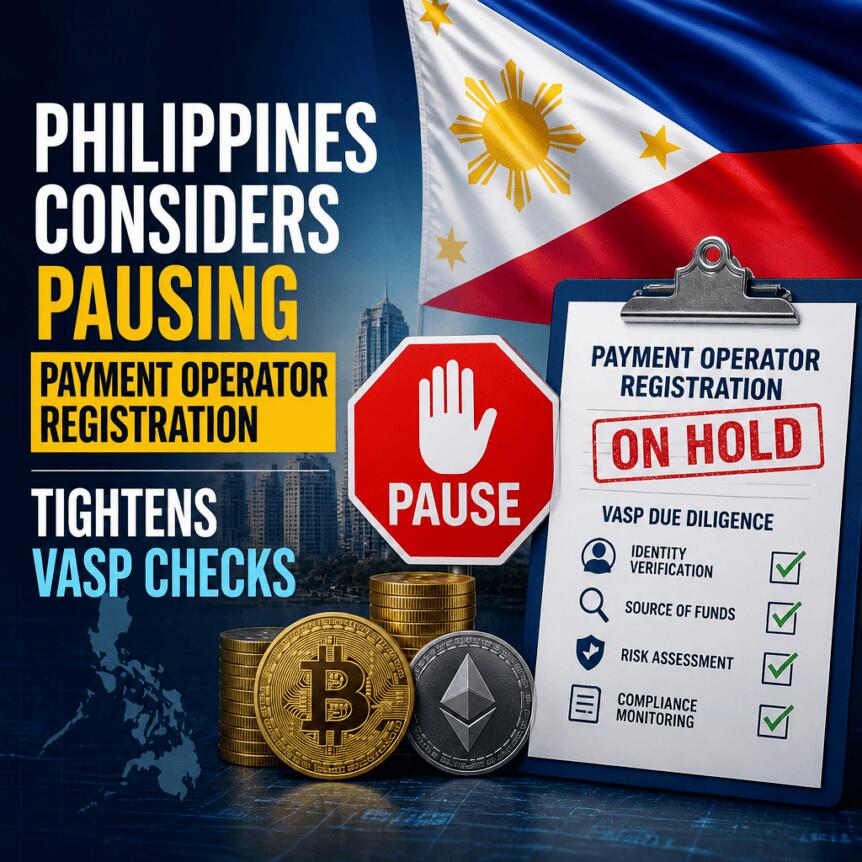
The Bangko Sentral ng Pilipinas (BSP) has proposed a temporary pause on new registrations for payment-system operators as part of a broader effort to tighten integrity and risk controls around payments connected to virtual asset service providers (VASPs). In a draft circular released for consultation, the central bank also outlined stricter requirements for BSP-supervised institutions when merchant acquisition involves regulated crypto-related businesses.
While the proposal is still subject to feedback and finalization, it signals the regulator’s intent to slow down parts of the payment authorization pipeline and to tighten how regulated VASPs are routed into payments and settlement processes in the Philippines.
In the draft circular, the BSP states that it will suspend acceptance and processing of applications from entities seeking to operate payment systems. The regulator said the move is intended to allow a “holistic review” of its taxonomy and licensing framework for payment-system oversight.
Importantly, the suspension would not necessarily erase earlier applications. According to the draft, applications submitted before the pause could still be evaluated, but the BSP would delay any approval or denial decision until the 12-month review period concludes.
The proposal also introduces a practical constraint for market participants: entities would be barred from beginning activities that require payment-system operator registration unless the BSP authorizes them through other channels. That means applicants and related service providers may face timing uncertainty even if they have already passed initial steps in the process.
Beyond the operator-registration pause, the BSP’s draft circular focuses on how payments are structured when BSP-supervised institutions offer merchant acquisition services that involve VASPs. The central bank proposes that such relationships must be handled through direct merchant arrangements with regulated VASPs.
Under the draft, these arrangements would come with enhanced due diligence and ongoing monitoring obligations. The BSP also points to additional risk-based controls, including transaction and settlement limits, aimed at reducing exposure in payment flows linked to virtual asset activity.
For investors, traders, and payment-adjacent businesses, this shift matters because it targets the mechanics of how crypto-related counterparties enter payment rails—not just licensing status. If implemented as drafted, it could affect onboarding processes for merchants, payment service providers, and any intermediary layers that currently sit between VASPs and merchants.
The BSP’s enhanced requirements would apply to VASPs, but the draft clarifies that the obligation is tied to entities that are licensed, registered, or authorized by the BSP, the Philippine SEC, or another authority. In other words, the rules appear designed for counterparties that have already obtained some form of regulatory recognition, rather than treating all crypto activity as equivalent.
The circular also places VASPs in the broader category of businesses subject to scrutiny under the BSP’s integrity and control approach. The draft lists VASPs alongside other sectors such as gambling businesses, gaming providers, adult-oriented businesses, and money service businesses—suggesting a risk-assessment framework that groups activities by perceived operational and compliance sensitivity rather than by industry alone.
The classification has implications for compliance programs: institutions providing merchant acquisition will likely need to revisit their vendor and counterparty screening policies and ensure they can demonstrate heightened controls for the relevant categories.
The draft circular would take effect 15 days after publication if finalized. The BSP is currently accepting feedback, and Cointelegraph reported reaching out to the BSP for more information without receiving a response before publication.
Readers and market participants should watch for two outcomes as the consultation progresses. First, whether the BSP’s 12-month pause remains unchanged in scope or duration, and whether it introduces clarifications on how pending applications will be handled during the review window. Second, how the final text implements the direct merchant-arrangement requirement and what “enhanced due diligence,” monitoring, and limits will look like in practice for BSP-supervised institutions working with regulated VASPs.
This article was originally published as Philippines Considers Pausing Payment Operator Registration, Tightens VASP Checks on Crypto Breaking News – your trusted source for crypto news, Bitcoin news, and blockchain updates.





