It’s Becoming a Decision Engine
For years, a card did one simple thing:
You swipe.
Money moves.
That’s it.
But something is changing.
Quietly.
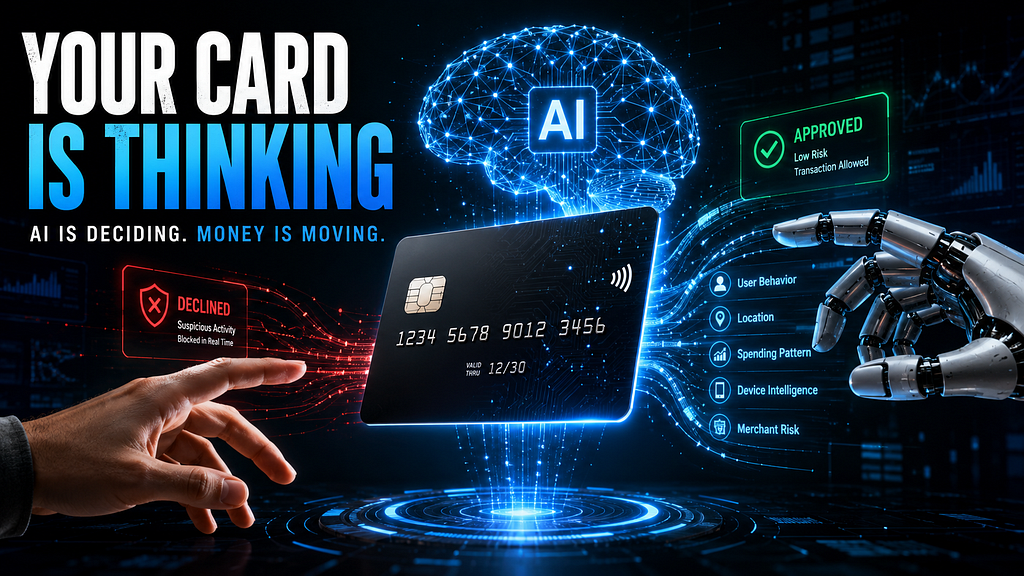
When AI integrates with Cards-as-a-Service…
the card stops being passive.
It starts making decisions.
Cards-as-a-Service (CaaS) already transformed fintech.
It allowed companies to:
Instead of building infrastructure…
you plug into it.
That alone was powerful.
But AI adds something deeper:
intelligence on top of infrastructure.
Let’s remove the hype.
AI in cards doesn’t mean a “smart card.”
It means smarter systems behind it.
For example:
In simple terms:
The card starts understanding usage, not just processing it.
Here’s where things get interesting.
Before AI:
After AI:
So instead of:
“Did this payment happen?”
The system asks:
“Should this payment happen?”
CaaS already made cards programmable.
You could:
But AI makes this dynamic.
Now:
It’s no longer:
rules you set once.
It’s:
rules that learn.
This is where things start to feel different.
AI agents can now:
A new model is emerging:
cards designed for machines, not humans.
These cards:
Think about that.
We’ve moved from:
Humans using cards
to
systems using cards on behalf of humans
From the outside, nothing changes.
You still:
But underneath:
The experience feels smoother.
Because the complexity is hidden.
More intelligence means more data.
To work well, AI systems need:
Which raises real questions:
Because when AI declines a transaction…
it’s not always clear why.
CaaS makes launching cards look easy.
AI makes them feel smart.
But behind that simplicity:
As one insight puts it:
The complexity doesn’t disappear — it shifts from technical to operational.
And AI accelerates that shift.
This is the part most people miss.
Cards-as-a-Service was never just about issuing cards.
It was about:
controlling the last mile of money movement
AI strengthens that control.
Because now, control isn’t just:
It’s also:
We’re moving toward a system where:
Not in theory.
In practice.
And slowly, this becomes normal.
When your card declines a payment in the future…
or approves one instantly…
Ask yourself:
Did I decide that?
Or did the system decide it for me?
AI doesn’t change what a card is.
It changes what a card does.
From:
A tool that executes your decisions
To:
A system that helps make them
And once that shift happens…
you’re no longer just spending money.
You’re interacting with a system
that is quietly deciding
how money should move.
What Happens When AI Meets Cards-as-a-Service was originally published in Coinmonks on Medium, where people are continuing the conversation by highlighting and responding to this story.





