
The compilation, spearheaded by crypto analyst Kashif Raza, presents a range of analyst targets running from $75,000 (via Elliott Wave projections) up to $450,000 (per Fundstrat forecasts). According to Raza’s summary, the median of all forecasts sits at $201K.
This outlook arrives amid a broader debate about Bitcoin’s post-halving trajectory and resonates with ongoing price momentum as bitcoin price today hovers near $118,500 (on October 2, 2025) — implying a potential upside of roughly 69 %.
The wide variety in predictions underscores Bitcoin’s volatility and how diverging methodologies lead to dramatically different outcomes. Some platforms lean conservative, while others adopt aggressive valuations grounded in institutional flows and macro themes.
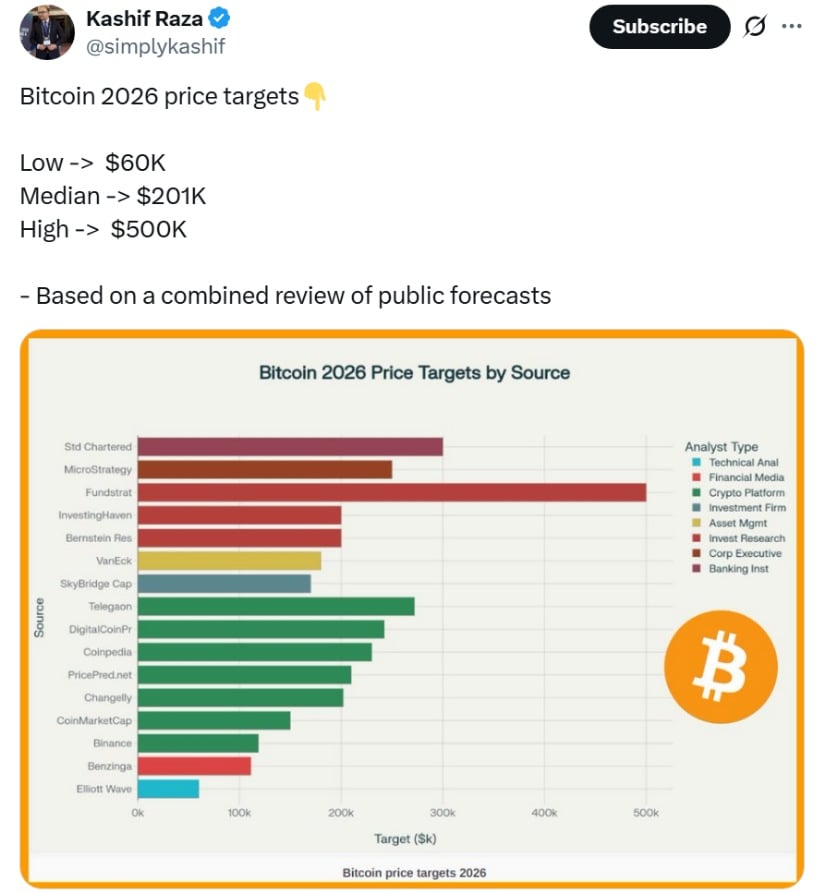
Bitcoin’s 2026 price forecasts range from $60K to $500K, with a median target of $201K based on aggregated public analyst projections. Source: Kashif Raza via X
Raza’s report visually clusters forecasts into groups—crypto exchanges, research firms, banks—to highlight differences in approach and risk tolerance.
Echoing this dispersion, a recent Reddit thread sparked debate over the “forecast gap” between bullish and cautious analysts, reinforcing that bitcoin predictions remain far from consensus.
Bitcoin halvings—events that reduce the new supply of BTC rewarded to miners—have historically preceded sharp price rallies. For example:
These cycles lend weight to the idea that supply-side constraints, coupled with demand, can produce outsized returns.
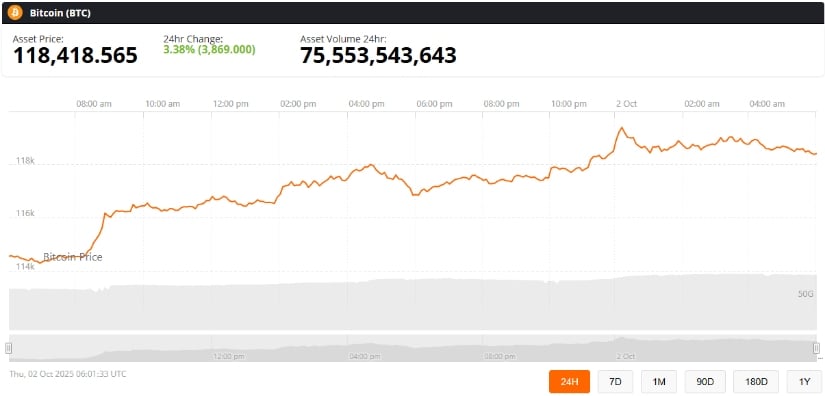
Bitcoin (BTC) was trading at around $118,418, up 3.38% in the last 24 hours at press time. Source: Bitcoin Price via Brave New Coin
The 2024 halving, however, had a rocky start. Some analysts labeled the initial months as the “worst-ever” post-halving stretch, citing early declines and ETF outflows. Over time, though, Bitcoin regained strength, climbing approximately 86% to approach $119,000 (as of October 2025).
This recovery suggests that key price surges may come later—potentially during late 2025 or into 2026—if historical post-halving patterns persist.
In October 2025, Bitcoin’s momentum appears reinforced. Rising above $118,000, BTC initiated what many market watchers call an “Uptober” rally—October’s historically strong performance window for crypto assets.
Analysts point to factors such as dollar weakness (amid a U.S. government shutdown), rising ETF demand, and positive seasonal trends. Some experts expect October and Q4 to deliver strong gains, citing historical averages.
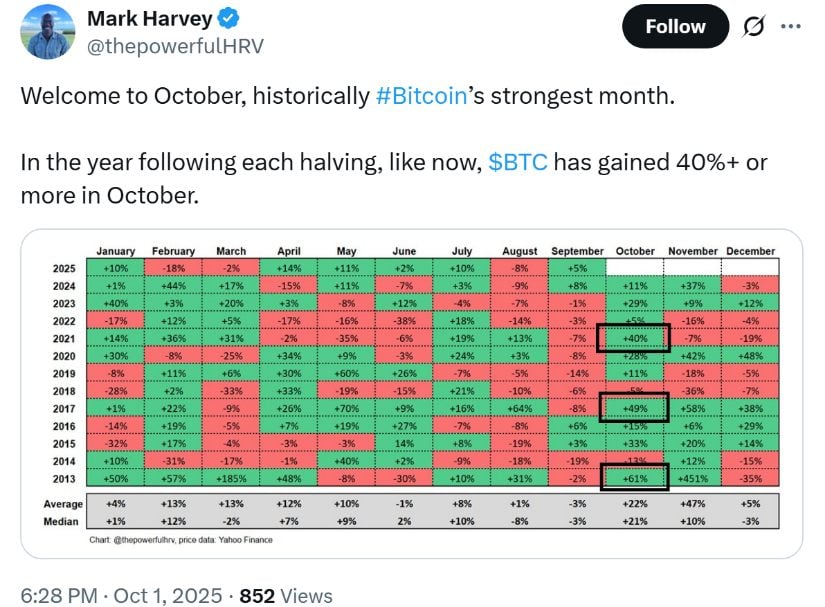
October has historically been Bitcoin’s strongest month, with post-halving years typically delivering gains of 40% or more. Source: Mark Harvey via X
New data indicates that the Stablecoin Supply Ratio (SSR) is flashing “buy”—a sign that stablecoin liquidity is poised to fuel crypto inflows.
At the same time, long-term BTC holders continue to accumulate, now holding over 298,000 BTC in accumulation addresses—another bullish signal according to on-chain analysis.
These metrics suggest that some of the infrastructure and sentiment needed for a sustained rally may already be building.
While historical patterns and current indicators align around the possibility of a strong bull cycle, skepticism is warranted.
Analysts pinning a $201K median target are not signaling certainty, but painting a scenario grounded in combined sentiment, models, and optimistic macro assumptions. The aim is not precision, but a reference point—something that captures both ambition and caution in the 2026 outlook for bitcoin price forecast.
As market conditions evolve in Q4 2025 and beyond, that median will face stress tests. Whether BTC can rally from ~$118K toward that symbolic number will depend on continued adoption, regulatory clarity, and macro stability.





