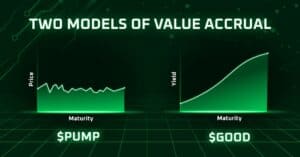
The crypto landscape has evolved significantly after the lessons of “DeFi Summer” in 2020, where many projects relied on inflationary token emissions, resulting in over 1.8 million tokens dying in 2023 alone. It taught a brutal lesson: sky-high APYs funded by printing tokens out of thin air inevitably lead to a death spiral. Investors learned the hard way with the collapse of Terra/Luna and Celsius that if a project isn’t a real business, it’s a ticking time bomb. As a result, the market has shifted towards valuing sustainable models.
This evolution has spotlighted a paradigm known as “Real Yield.” As detailed in in-depth research by CoinLaunch, projects gaining long-term traction are often those that generate real revenue and share it with token holders. This means income derived from business activities, such as Pump.fun’s fees from token launches, rather than token emissions. This principle is also discussed by experts at Zeebu and the CFA Institute as a move beyond pure speculation.
Pump.fun, the launchpad at the center of the pump fun solana ecosystem, is a powerful revenue generator. As of August 14, 2025, the platform has generated over $724 million in cumulative revenue. On the surface, this makes its token, $PUMP, appear attractive. However, applying the professional analytical framework by CoinLaunch raises an important question: how efficiently does the platform’s success translate into value for individual $PUMP token holders?
This analysis will examine the Pump.fun model, explore its value accrual mechanisms, and contrast it with goodcryptoX ($GOOD) — a project with a different economic design.

To assess a project’s sustainability, we can use a framework similar to that of a venture capitalist. The CoinLaunch framework provides six key areas for analysis:

Let’s apply this framework to the pump fun token.
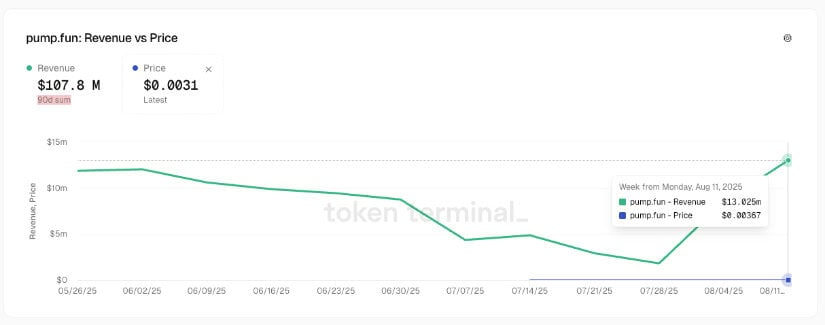
While Pump.fun’s revenue is substantial, its token model utilizes an indirect approach to value distribution. The platform’s success in the pump fun crypto space is undeniable, but as on-chain data from Dune Analytics shows, its operational success and token holder value are two distinct topics.
Source: TokenTerminal
Value Accrual & Sharing Mechanism: An Indirect Approach. A key feature of the model is that platform revenue does not flow directly to $PUMP holders as a dividend or yield. Instead, the model relies on token buybacks. While the team deposited millions in SOL to Kraken for buybacks, the token experienced an 11.85% post-listing drop, illustrating that such mechanisms can be influenced by broader market forces. Though revenue remains high, as tracked by DefiLlama, our analysis suggests this model is less direct in delivering value to holders compared to a pure revenue-sharing model.
Token Growth Potential: A High Initial Valuation. The unofficial Pump.fun coin launched with an alleged FDV of over $6.6 billion, a figure available on platforms like CoinGecko. From an analytical standpoint, a high initial valuation can present a challenge for significant future price appreciation. It is a mathematical near-impossibility for it to achieve a 10x (current level of USDC) or even a 5x growth (current level of TRON and Lido) from this level without real utilities.

Source: CoinGeko
Ecosystem Exposure: Concentrated on a Single Narrative. The platform’s business model is primarily focused on the meme coin narrative on the Solana blockchain. This concentration presents a long-term risk. As seen in this Dune comparison dashboard, the 80% drop in Pump.fun volume and revenue in July, corresponding with a cooling of meme coin hype and competition from platforms like LetsBonk.fun, highlights this sensitivity.

Source: DuneAnalytics
Revenue Distribution: A Wide Holder Base. The large number of token holders means that the impact of mechanisms like buybacks is distributed across a very wide base. Any potential future implementation of a direct revenue share would similarly be divided among a large number of participants.
Now, let’s analyze goodcryptoX ($GOOD), a project with a different design philosophy.
goodcryptoX is an established trading platform with 400,000 users and over $5 billion in processed volume, primarily via its CEX-focused app. The project’s key innovation is bringing its suite of CEX-grade algorithmic trading bots to the DEX world, including strategies like DCA, Grid, and Trailing Algos across five major chains.
This utility-driven approach resulted in a 9.3x growth in DEX volume from March to July, with further catalysts like perpetuals trading on the roadmap.
Let’s analyze the $GOOD token through the same framework:
| Metric | Pump.fun ($PUMP) Model | goodcryptoX ($GOOD) Model |
|---|---|---|
| Brand Recognition | Very High, Dominant Market Position | Growing, Established User Base |
| Value Accrual Mechanism | Indirect (Team Buybacks) | Direct (50% Rev-Share) + Buy & Burn |
| Token Growth Upside (FDV) | ~$6.6B+ (Limited Upside) | ~$25M (High Growth Potential) |
| Ecosystem Exposure | Concentrated (Dependent on Solana Meme Coins) | Diversified (Multi-chain, low direct competition, diverse product)
) |
| Demand on Revenue | High (Widely Distributed) | Low (Initially Concentrated) |
| Current Yield | None (Speculative Price Action) | ~100% APY (Based on Historical Data) |
Pump.fun is a highly successful product that has demonstrated strong revenue generation. Its token model is designed around indirect value accrual through buybacks, aligning holder success with the platform’s overall market perception and growth.
In contrast, goodcryptoX and its $GOOD token offer a different philosophy — one based on direct participation in the platform’s cash flows. This model is built on tangible utility, a diversified product offering, and a commitment to sharing a significant portion of its revenue directly with token holders.
The choice between these models depends on a participant’s individual strategy and what they look for in a token. One represents exposure to a dominant brand’s market performance, while the other offers a stake in the revenue of a growing utility-focused business. As the market matures, both models will likely find their place, but for those specifically seeking direct, sustainable yield, the differences are clear.
Disclaimer: This article is for informational purposes only and does not constitute financial or investment advice. All figures are illustrative and based on historical data, which is not indicative of future results. Please conduct your own thorough research and consult with a professional financial advisor before making any decisions.