The era of purely speculative crypto cycles is giving way to something far more interesting: a stark divergence between “need-based” and “hype-based” adoption.
If you look purely at the surface-level charts of global crypto activity for the first quarter of 2026, you might assume the market is just experiencing a standard cold snap. Global retail crypto activity hit USD 979 billion in Q1 2026, marking an 11% year-over-year decline and the second consecutive quarter of contraction.
But if you look closer, the macro-driven slowdown — triggered by global tariff uncertainties, a strong US dollar, and high real yields — uncovers a profound shift in why and where people are using digital assets.
Crypto adoption is fracturing along the fault lines of the global monetary system. Developed financial hubs are pulling back, while emerging economies under economic stress are treating crypto not as a casino, but as essential infrastructure.
Here are the critical macro shifts and deep-dive narratives shaping global crypto adoption right now.
The traditional narrative says that a rising tide lifts all boats, and a crypto winter freezes everyone equally. Q1 2026 proved that theory dead wrong.
When macroeconomic tightening hits, retail investors in developed markets face higher opportunity costs. As a result, speculative capital flows back into traditional markets. You can see this clearly in the steep year-over-year declines among major financial hubs:
Meanwhile, nations facing capital controls, restricted banking access, or domestic currency volatility showed remarkable resilience. For these populations, crypto functions as a shadow dollar system.
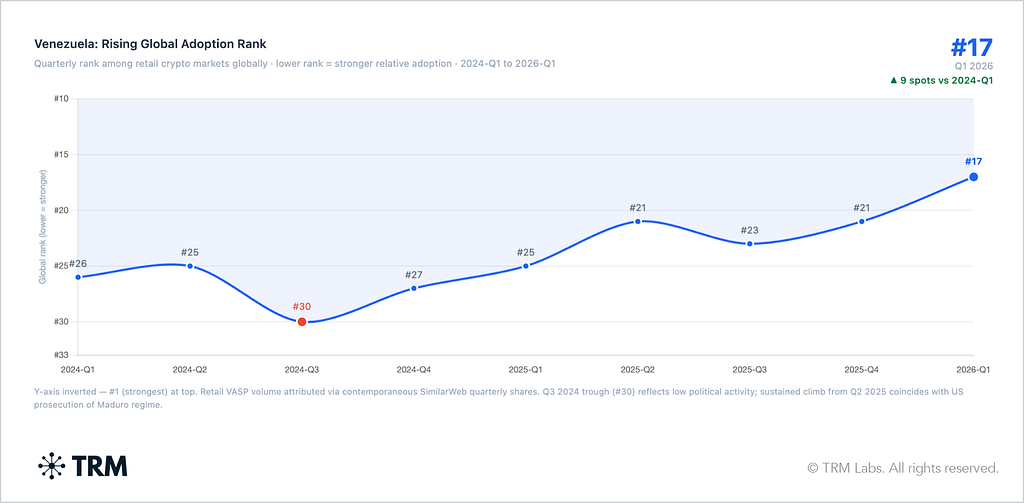
Nowhere is the “necessity over speculation” model more visible than in Venezuela. Ranking #17 globally with USD 17.9 billion in retail volume, the country continues to climb adoption rankings despite an incredibly turbulent geopolitical climate.
In Venezuela, crypto isn’t about trading the latest meme coin — it is about basic financial survival.
According to TRM’s analysis of live Binance P2P order books, an astonishing 90.2% of all active listings for Venezuelan Bolívar (VES) fiat pairs are denominated in USDT
Three deep structural forces make stablecoins the de facto retail settlement mechanism in the region:
While the US dollar remains the undisputed king of on-chain liquidity, early signs of currency diversification are beginning to bubble up on European rails.
Between January 2025 and March 2026, EUR-denominated stablecoins exploded 12-fold in volume, skyrocketing from USD 69 million to USD 777 million per month.
Granted, at less than 0.3% of total global crypto volume, Euro stablecoins are still a drop in the bucket. However, their sudden hockey-stick growth is highly strategic, driven by two primary catalysts:
On the flip side of the compliance spectrum, Iran’s crypto ecosystem highlights the evolving battlefield of international sanctions and state-linked digital finance.
In early 2026, the US Treasury shifted its focus to service-layer infrastructure, directly sanctioning localized crypto platforms like Zedcex and Zedxion for facilitating transactions tied to state entities. Hit by a combination of intense enforcement, wartime infrastructure disruptions, and frequent internet outages, Iranian crypto volumes collapsed by 59% from their 2024 peaks. Monthly exchange inflows shrank from USD 2.1 billion down to USD 510 million.
Yet, even under extreme pressure, the ecosystem persists through a bifurcated reality:
If Q1 2026 taught us anything, it’s that looking at crypto through a single global lens is a mistake.
The industry has matured past the point where a Bitcoin price drop means adoption has stopped. Instead, we are looking at an increasingly fragmented, localized ecosystem. Moving forward, the growth of digital assets won’t just be dictated by code or hype — it will be driven by local monetary policy, regional regulatory clarity like MiCA, and pure, unadulterated economic necessity.
What are your thoughts?
The New Rules of Crypto Adoption was originally published in Coinmonks on Medium, where people are continuing the conversation by highlighting and responding to this story.





