The exchange lands four weeks before the mandatory signaling window of BIP-110 opens around August 7, with miner support still below 1%. What reads on the surface as a dispute about JPEG data on the blockchain has become the clearest public lesson in how Bitcoin governance actually works, and who gets to change the rules of a system designed to resist change.
BIP-110, formally the Reduced Data Temporary Softfork, is a proposal to change Bitcoin’s consensus rules for one year to restrict how much arbitrary, non-financial data a transaction can carry. It would cap OP_RETURN outputs at 83 bytes, limit data pushes to 256 bytes, and invalidate the transaction formats used by Ordinals-style inscriptions, while leaving all monetary transactions and pre-existing coins untouched. The proposal emerged as a reaction to Bitcoin Core version 30, which relaxed the long-standing OP_RETURN relay limit in late 2025, and it activates either through 55% miner signaling or through a mandatory mechanism that begins in August whether miners agree or not. That second path is what creates the chain-split risk at the center of the dispute.
Few people can claim authority over what Bitcoin is supposed to be, and Adam Back is on the short list. His hashcash proof-of-work design, built in 1997 to fight email spam, is one of the handful of works cited in Satoshi Nakamoto’s white paper, and Satoshi contacted him directly in Bitcoin’s earliest days. He has spent nearly three decades in cypherpunk networks and co-founded Blockstream, the infrastructure firm employing several Bitcoin Core contributors. When the spam debate needed an arbiter with credentials on both sides, it got one: the man who invented the original anti-spam mechanism is telling the anti-spam fork to stand down.
That biography is what makes his framing sting. Back wrote on X that he hates spam “with a passion,” and that hashcash itself came out of that hatred. His objection to BIP-110 is not that its supporters are wrong about the problem. It is that they misunderstand the system they are trying to protect.
Stripped of its length, Back’s post makes one structural claim. The decentralization that makes Bitcoin censorship-resistant money necessarily means no participant can impose preferences on others. A consensus rule that invalidates transactions some users find distasteful is, in his words, “at its most basic a quest to police other people,” and the network’s immune system treats it accordingly. The same property that stops a government from filtering Bitcoin transactions stops BIP-110 supporters from doing it too. There is no version of the network where only the filters you like are possible.
On the filter fork topic.
I don’t usually have time, but this morning listened to one of the twitter spaces from earlier in the week, with some well meaning relative bitcoin newcomers, that humanized them, and their concerns and thoughts for why they thought that made it…
— Adam Back (@adam3us) July 11, 2026
His second point concerns process rather than principle. Bitcoin’s development runs on an IETF-style technical consensus in which no change passes without surviving scrutiny from hundreds of developers and protocol reviewers. That change resistance is not an obstacle to Bitcoin’s mission, Back argues, it is the protection of it, and BIP-110 failed the process: in an earlier post he was blunter, writing that the proposal “breaks multiple things” and lacks both technical and ecosystem consensus. The conclusion follows the logic of permissionlessness to its end. Supporters are free to fork, nobody can stop them, and the main chain is equally free not to follow.
Michael Saylor’s reply reframed the stakes in three sentences. “There are 110 things more dangerous to Bitcoin than spam,” the Strategy chairman wrote on X, arguing that “BIP 110 turns a spam dispute into a consensus change that would invalidate some currently valid, fee-paying transactions. That precedent is the danger.”
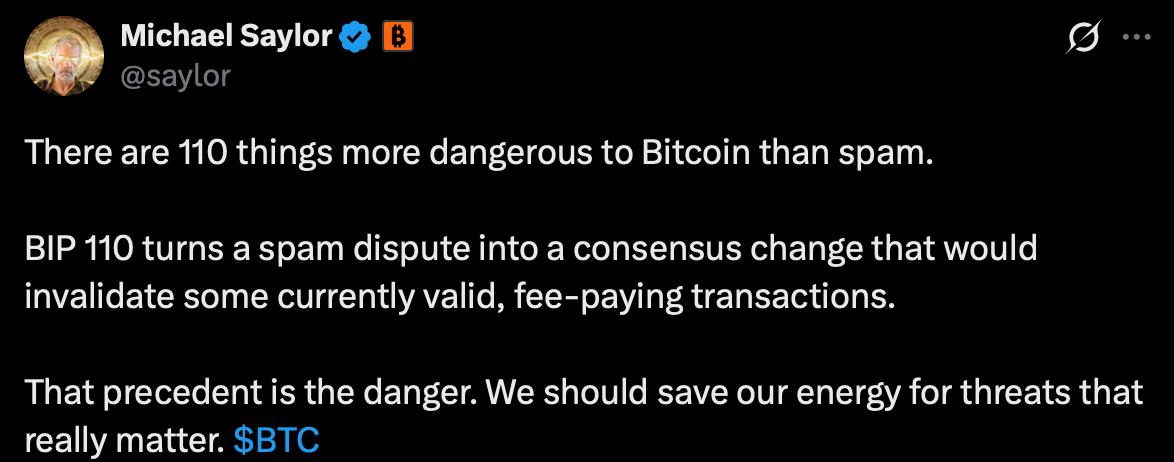
The precedent argument matters more coming from him than from a developer. Strategy holds the largest corporate Bitcoin treasury in existence, and the entire institutional thesis rests on the assurance that validly acquired coins and valid transactions cannot be retroactively disfavored by a rule change. A consensus mechanism that once invalidated fee-paying transactions because a faction disliked their content is a consensus mechanism that could, in principle, do it again with different targets. For the holders Saylor represents, that assurance is the product.
Beneath the rhetoric, the signaling data has been unambiguous. Miner support stood near 0.31% in late June, against the 55% threshold the proposal set for orderly activation. The Ocean pool produces most signaling blocks, no major pool has committed, and F2Pool has refused outright. Because BIP-110 also carries a user-activated mandatory mechanism beginning around block 961,632, enforcing nodes could start rejecting non-signaling blocks in August regardless, which is where the chain-split risk lives: a minority chain running the new rules, surviving or fizzling based on whether exchanges and users assign it any economic value.
The underlying grievance is real, and dismissing it entirely would misread the moment. Non-financial data on the chain has grown since Bitcoin Core v30 relaxed the OP_RETURN relay limit in late 2025, and a meaningful group of node operators sees that as drift from money toward database. What the past six months demonstrated is the difference between having a grievance and having consensus. Bitcoin changes when thousands of independent operators choose to run the change, and on every measurable axis, they are choosing not to.
August resolves the question mechanically. Either signaling shifts dramatically in the next four weeks, or the mandatory window opens with a fraction of the network enforcing rules the majority ignores, producing at most a low-hashrate side chain and at least a demonstration, one more time, that Bitcoin’s hardest feature to fork is its inertia.
The information provided in this article is for informational purposes only and does not constitute financial, investment, or legal advice.
The post Bitcoin Heavyweights Reject Fork Proposal Ahead of August Deadline appeared first on Coindoo.





