The Exchange-Traded Funds (ETF) industry is shaking up, but this time, it’s for all the right reasons. Brian Daly, Director of the SEC’s Division of Investment Management, made a striking admission: the regulator “did a poor job” handling cryptocurrency ETFs and announced a major shift in how it will approach complex financial products moving forward.
What does this mean for the market, investors, and upcoming innovations like private asset ETFs (e.g., SpaceX shares) or prediction markets? Let’s break down the key takeaways.
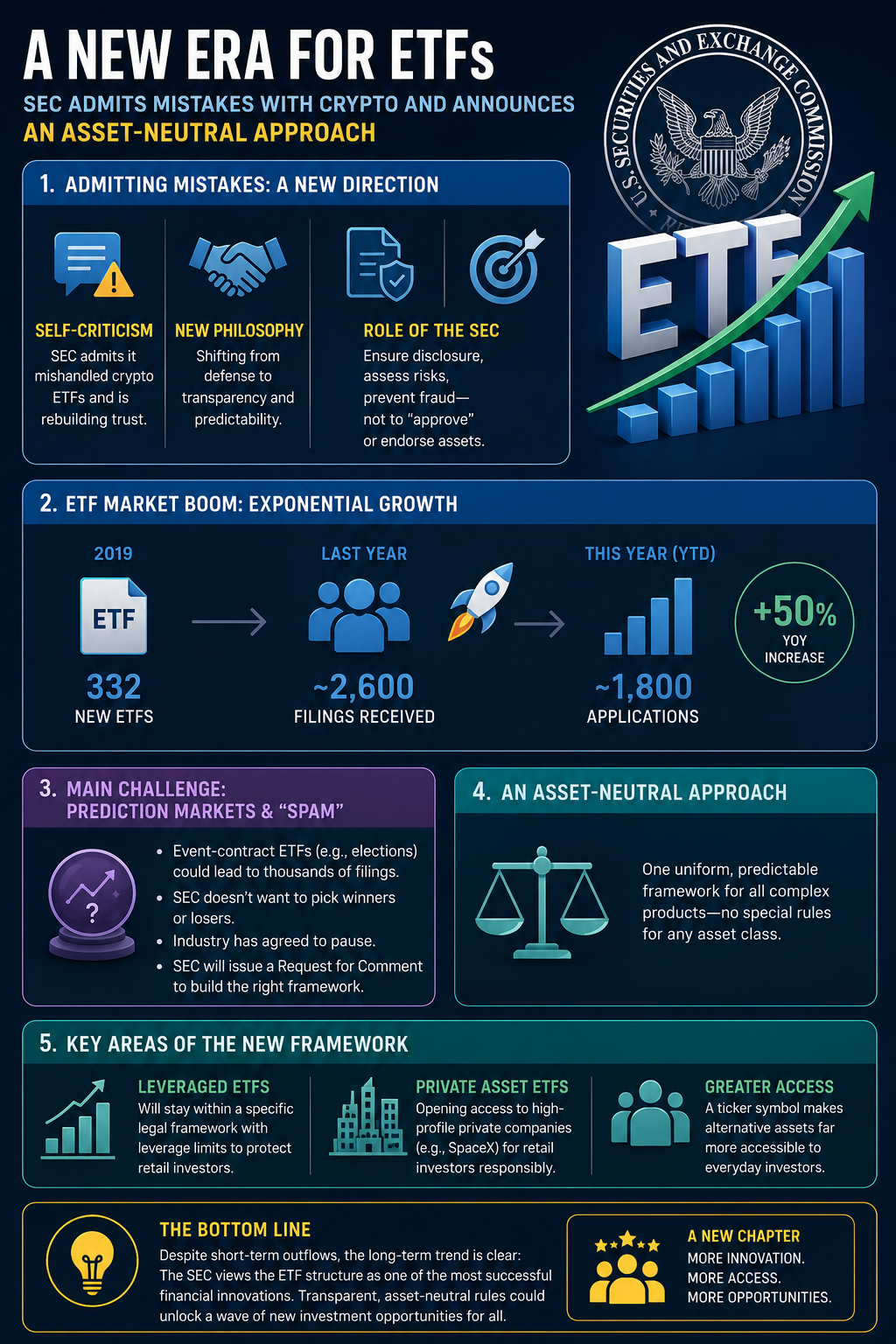
For the past few years, the relationship between the SEC and the crypto industry felt like a battlefield — marked by endless lawsuits, prolonged delays, and regulatory uncertainty that eroded market trust.
Now, the Commission is officially pivoting:
The ETF market is experiencing unprecedented exponential growth, putting immense pressure on regulatory capacity:
A hot-button topic in the interview was event-contract (prediction market) ETFs, such as those tied to election outcomes.
The SEC’s primary fear isn’t the underlying asset itself, but a bureaucratic avalanche. Theoretically, a single sponsor could file up to 5,000 applications to cover every single Senate, House, or political event. Because the SEC doesn’t want to play arbiter on which prediction markets are “good” or “bad,” the industry has agreed to pause. The regulator is preparing a formal Request for Comment to gather feedback from exchanges, issuers, and financial advisors to build a proper framework
Instead of reacting piecemeal by creating a “special rule for crypto” or a “special rule for prediction markets,” the SEC wants to implement an asset-neutral framework. This will provide a uniform, predictable standard for all complex products.
This new framework will cover several major areas:
Even though spot Bitcoin ETFs previously faced local headwinds — experiencing their worst month on record for outflows in June — the macro trend remains clear.
The SEC views the ETF structure as one of the most successful financial innovations in history. By transitioning to transparent, asset-neutral rules, the regulator might just unleash a wave of brand-new investment instruments that retail investors could previously only dream of.
What are your thoughts on the SEC’s new approach?
A New Era for ETFs: SEC Admits Mistakes with Crypto and Announces a New Approach was originally published in Coinmonks on Medium, where people are continuing the conversation by highlighting and responding to this story.





