The global financial landscape shifted early Sunday morning as marathon diplomatic sessions between the United States and Iran failed to produce a lasting peace agreement. After 21 hours of intense negotiations in Islamabad, Pakistan, the temporary optimism that had recently pushed the $Bitcoin price toward yearly highs has evaporated.
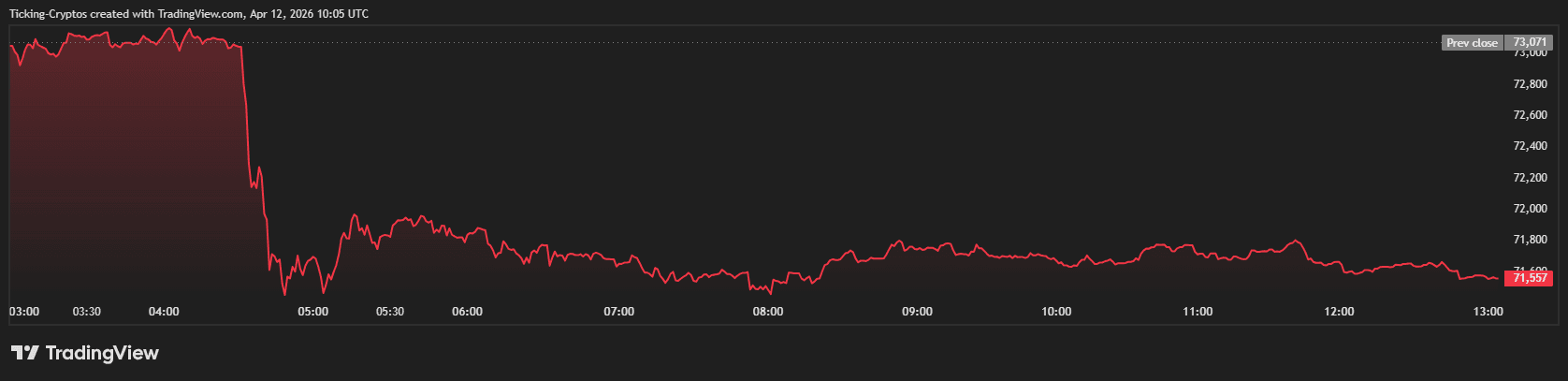
Crypto prices decreased primarily due to the breakdown of high-stakes negotiations between US Vice President JD Vance and Iranian officials. This failure ended the brief "ceasefire rally" that had seen Bitcoin surge past $73,000 earlier this week. As the "Risk-Off" sentiment returned to global markets, Bitcoin retraced from its peak of $73,000 down to approximately $71,500 within hours of the official announcement.
Geopolitical instability has historically acted as a double-edged sword for digital assets. While Bitcoin is often touted as "digital gold," its current price action reflects its status as a high-beta risk asset. The failure in Islamabad has led to:
A retracement in this context refers to a temporary reversal in the direction of Bitcoin's price. Following the news of the initial two-week ceasefire on April 7, BTC gained over 5%. However, the inability to turn that ceasefire into a permanent deal caused a "bull trap," where the price hit $73,000 before falling back to the $71,500 support zone.
The ripple effect was felt across all major trading pairs. As Bitcoin slipped, other assets followed:
| Metric | Peak (Ceasefire Hope) | Current (Talks Failed) | Change |
|---|---|---|---|
| Bitcoin ($BTC) | $73,057 | $71,589 | -2.01% |
| S&P 500 Futures | 5,240 | 5,185 | -1.05% |
| Crude Oil (WTI) | $78.50 | $84.20 | +7.26% |





