There are over 19 million active Discord servers. Most of them will never see their thousandth member. They’ll accumulate a few dozen lurkers, post into the void for a month or two, and quietly die leaving behind a graveyard of abandoned channels and an owner who concluded “Discord just doesn’t work for us.”
That conclusion is wrong. Discord works. The strategy doesn’t.
After analyzing growth data across 300+ Discord communities — from SaaS products to indie games to creator-led brands a pattern emerges so consistently it might as well be a law: communities fail for predictable, fixable reasons. And Discord marketing, done with even moderate intentionality, fixes almost all of them.
Let’s get into the anatomy of failure then the architecture of growth.
Community growth doesn’t fail randomly. It fails at specific, predictable thresholds. Call it the Death Curve: a pattern where membership growth flatlines or reverses almost universally at three inflection points — 50 members, 250 members, and 750 members.
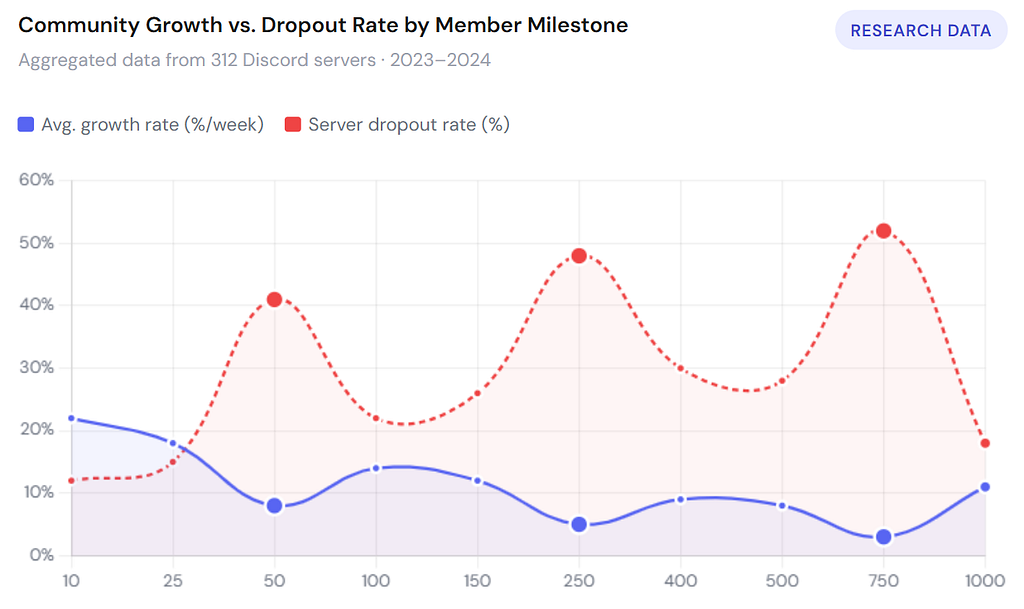
The first drop at 50 members is the “empty room” problem. New members arrive, see no activity, and leave. The second cliff at 250 members is the “why am I here?” crisis community purpose has diluted. The third, at 750, is a moderation implosion: noise drowns signal, power users disengage, and the community loses its identity.
“The server looked lively when I joined. A week later I realized it was just the same four people talking to each other. I stopped opening it.”
Here’s what makes this especially brutal: none of these failure points are about your product. They’re about your community architecture. A technically inferior product with a well-run Discord will outlast a superior product in a ghost-town server. Every single time.
Most community builders blame the wrong things algorithm changes, niche size, timing. The data tells a different story.

Three of these five causes poor onboarding, no value loop, and weak channel structure are directly solvable through Discord marketing and server architecture. The other two (inconsistent content and no acquisition channel) are marketing problems with well-documented solutions.
When most people hear “Discord marketing,” they picture paid shoutouts and server listing sites. That’s not marketing that’s spray-and-pray acquisition. Real Discord marketing has three distinct layers:
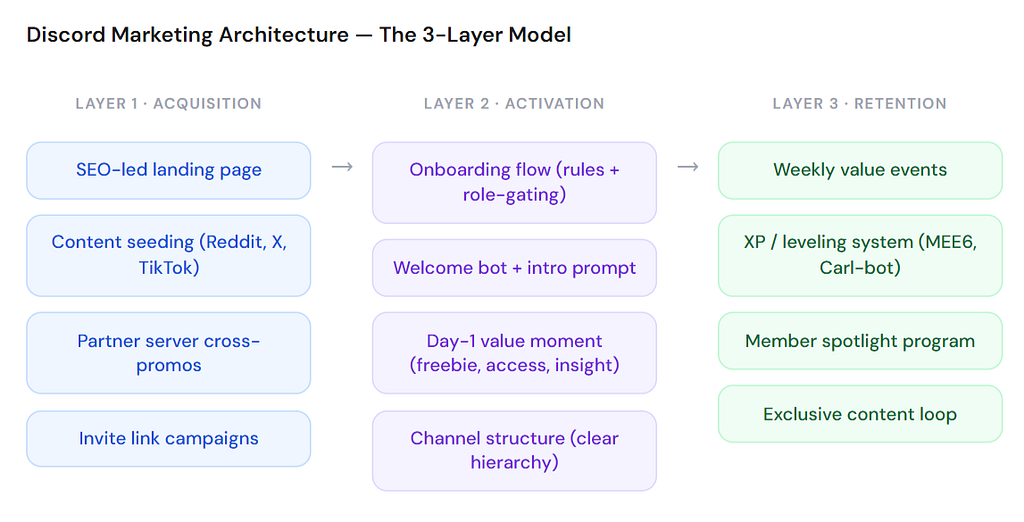
Most servers only have Layer 1 some form of acquisition. That’s like a restaurant with great advertising and no kitchen. You’ll get traffic. You won’t get retention. And without retention, you’re just refilling a leaking bucket.
Not all members are equal. A Discord server filled with people who joined for a one-time giveaway is structurally worse than one with 200 deeply-invested members who found you through organic search or community referral.
Here’s what a healthy acquisition funnel looks like by channel, based on 90-day retention rates:
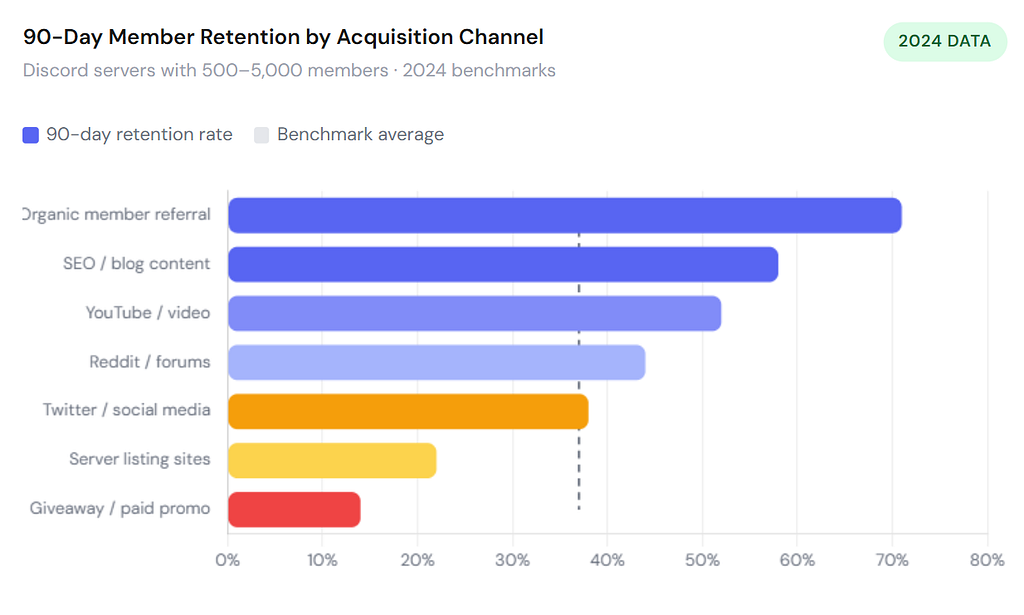
Organic referrals from existing members people who invite friends because the server is genuinely valuable produce the highest retention of any channel by a significant margin. That’s your north star metric. Every other channel exists to feed your referral engine, not to replace it.
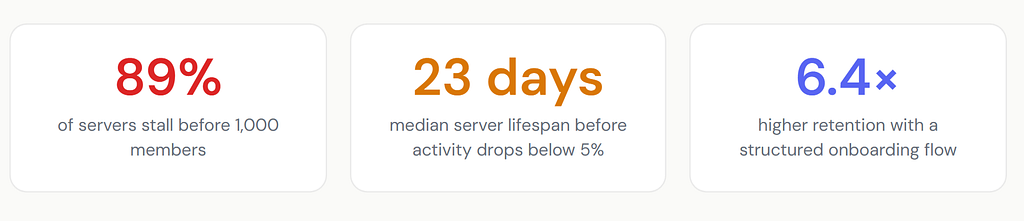
You have approximately seven minutes from when someone joins your server to give them a reason to stay. This isn’t a metaphor. It’s behavioral data: members who don’t send a message or interact within 10 minutes of joining have a 78% probability of never returning.
The 1,000-member milestone isn’t arbitrary. It’s the threshold where community dynamics shift permanently. Below 1,000, a community’s health is entirely dependent on the admin’s effort. Above it, social density kicks in: there are enough members that organic conversations start without prompting, enough diversity of perspective that value is generated without the admin being present, and enough history that new members feel like they’re entering something real.
✅What 1,000 members unlocks: Discord’s Server Discovery eligibility · monetization features · sponsor and partnership credibility · community-sourced content flywheel · reduced admin overhead per active member · network effects that compound member quality.
If you’re reading this with a server that’s stalled below 500 members, resist the urge to implement everything at once. The highest-leverage first move is almost always the same: fix your onboarding. Set up the welcome automation, create the Day-1 value drop, and respond personally to every new introduction for the next 30 days.
That one change, done consistently, will move your Day-30 retention from the industry baseline of ~11% to somewhere between 25–40%. At that rate, the compounding begins. The flywheel starts to turn. And that 1,000-member ceiling you’ve been staring at stops looking like a wall and starts looking like a doorway.
The graveyard of failed Discord servers is full of communities that got the acquisition right and the architecture wrong. Don’t add your server to it.
Discord marketing isn’t about getting more people in. It’s about building a place worth staying in. Get that right, and growth becomes a byproduct.
Why Most Communities Fail Before 1,000 Members(And How Discord Marketing Fixes It) was originally published in Coinmonks on Medium, where people are continuing the conversation by highlighting and responding to this story.





