The listing decision is the most underrated variable in prediction markets. Here is what happens when it moves from a committee to a smart contract.
Every prediction market you have ever traded had a gatekeeper.
Someone decided the question was worth listing. Someone decided the wording. Someone decided when it settles.
That decision is invisible to the trader. It is also the single largest constraint on what the category can become.
Here is how invisible. During the 2026 World Cup final, one venue concentrated the outcome into a single deep book while another spread the same event across dozens of separate contracts. Same match. Same result.
Two completely different maps of it, because two different listing desks made two different calls.
Traders reacted to prices. The prices were downstream of a decision nobody voted on.
So consider what happens when that decision disappears.
Prediction markets are having a moment. According to a Pew Research Center analysis of data from The Block, combined monthly global volume on Kalshi and Polymarket climbed from under $5 billion in September 2025 to roughly $24 billion by April 2026.
July 2026 set a fresh record of $50.6 billion across the major venues, according to The Crypto Times.
Now the uncomfortable part.
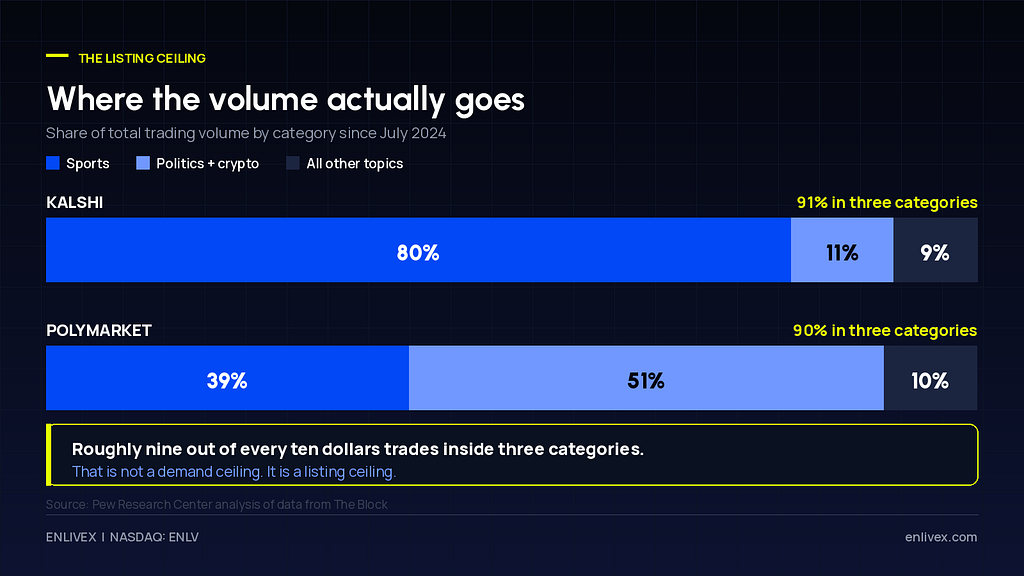
That same Pew Research Center analysis found that since July 2024:
Three categories. Roughly nine out of every ten dollars.
That is not a demand ceiling. It is a listing ceiling. Curated venues list what clears legal review and what is expected to attract liquidity quickly. Everything else never reaches a screen.
Permissionless market creation means the right to list an event contract is written into the protocol rather than granted by a committee.
In practice it comes down to four properties:
Rain, the decentralized prediction markets protocol on Arbitrum, was architected around precisely this.
According to the Rain Foundation, developers, communities, companies and AI agents can launch custom forecasting applications, public or private markets, and localized experiences across all languages without centralized approval.
The comparison used in Rain’s own launch materials is the clearest one available.
Curated venues behave like a streaming service with a commissioning budget. Permissionless infrastructure behaves like a video platform where anyone uploads.
One optimizes for quality control. The other optimizes for coverage.
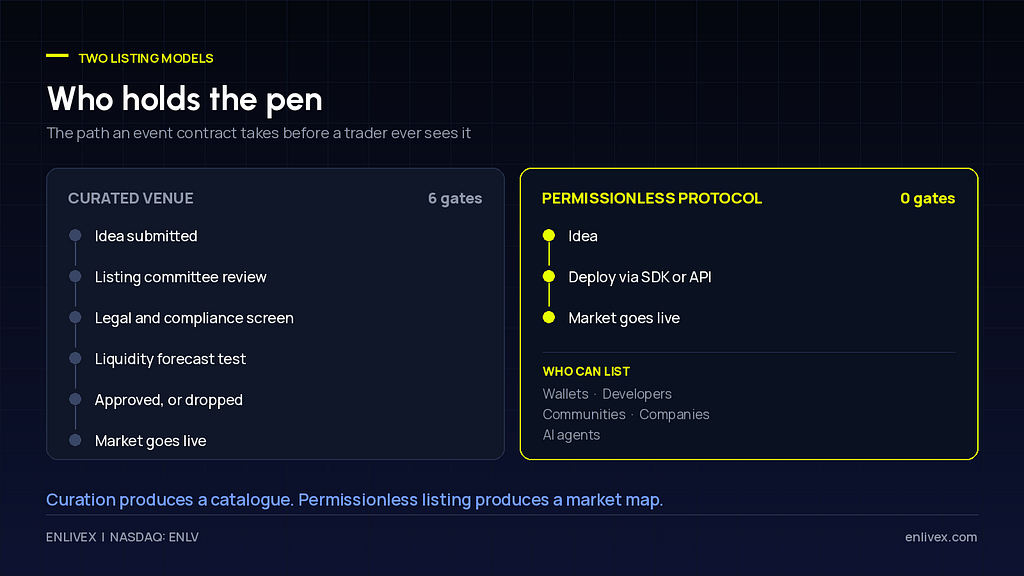
Curation produces a catalogue. Permissionless listing produces a market map.
The instinctive answer is retail traders. The more interesting answer is everyone else.
Open listing rights change the identity of the market creator, and four groups matter here:
That last one is not narrative decoration. Rain’s own materials name AI agents alongside developers and communities as launch-capable participants.
Once market creation is an API call, an agent scanning a news feed can list a market faster than a human can write the ticket.
Private markets deserve their own line. A gated forecasting market inside an enterprise is not a trading product at all. It is a decision tool.
That category simply cannot exist on a venue where every listing requires public review.
Here is why open listing took this long to arrive.
Listing a market is trivial. Settling one is not. Somebody has to determine what actually happened, and that somebody has to be fast, impartial, and expensive to corrupt.
Manual settlement does not scale into a long tail. If every niche market requires a human committee, permissionless listing collapses under its own operating cost.
Rain layers the problem instead. According to CoinGecko, public markets are resolved by an Olympus AI oracle agent, while creators of private markets act as the resolver.
Contested outcomes escalate through an arbitration mechanism, with human oracles as the final backstop.
The design point is worth stating plainly. Automated resolution is what makes permissionless listing economically viable. Without it, the long tail is a cost centre. With it, the long tail becomes inventory.
Automated resolution is what makes permissionless listing economically viable.
This is the moment the conversation stops being about protocol architecture.
Enlivex (Nasdaq: ENLV) describes itself as a quality longevity company powered by a prediction markets treasury. Its reserves are anchored in RAIN, the native token of the Rain protocol.
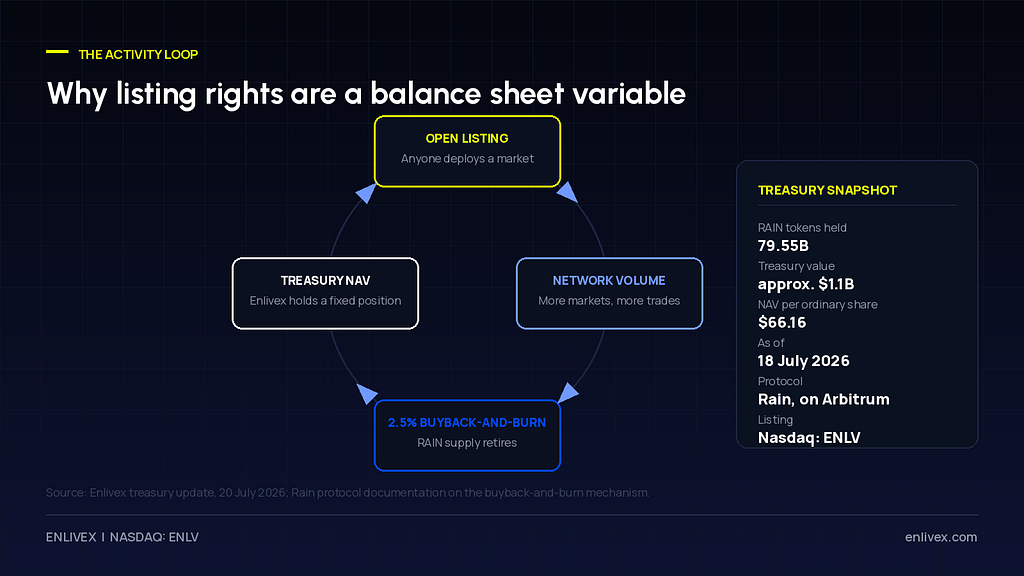
The mechanism linking protocol usage to treasury value is specific. According to Rain protocol documentation, 2.5% of protocol trading volume is used to buy back and permanently burn RAIN. Usage reduces supply.
Which turns market creation into a balance sheet variable. The integrated model is built on exactly that link.
More listable topics leads to more markets. More markets leads to more trades. More trades routes more fees into buyback-and-burn.
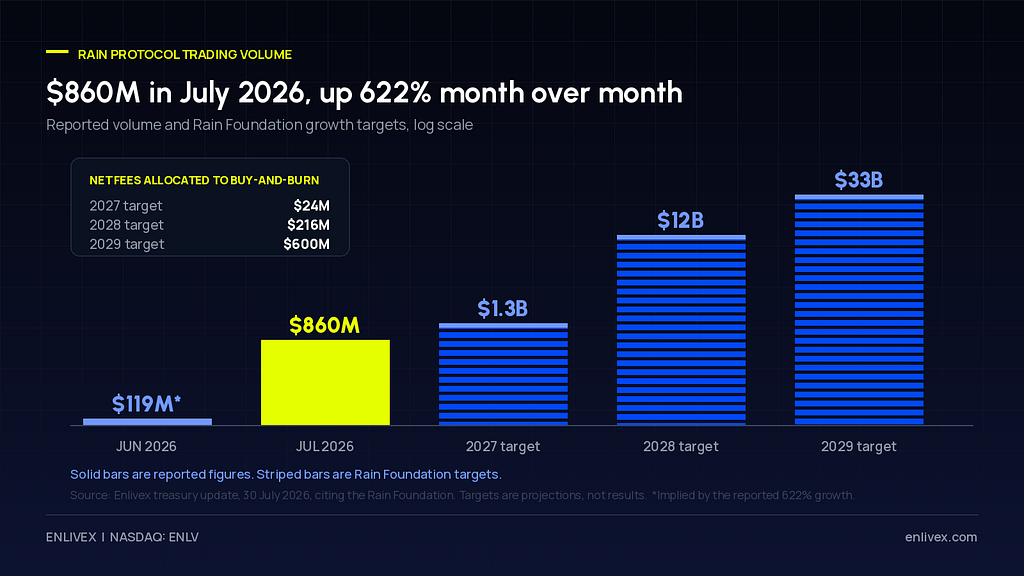
The recent numbers are where this stops being theoretical. According to Enlivex’s July 30, 2026 treasury update:
Those forward figures are Foundation projections rather than results, and they are subject to conditions that may not hold. What they illustrate is the shape of the model, not a promise about it.
Zoom out to the treasury layer.
According to The Block, more than 200 public companies now operate some version of the digital asset treasury model, spanning roughly a dozen assets. The overwhelming majority hold a passive reserve asset and wait.
Enlivex holds something structurally different. According to the company’s July 20, 2026 update, it held 79,550,593,122 RAIN tokens valued at approximately $1.1 billion as of July 18, 2026, with net asset value per ordinary share of $66.16. Both figures are tracked on the company’s public market data dashboard.
The distinction matters for anyone comparing crypto treasury stocks:
Permissionless listing is what makes that second sentence possible. An asset appreciates when sentiment shifts.
Infrastructure compounds when usage expands, and usage expands fastest when nobody is rationing what can be listed.
Then there is the pricing signal. On July 28, 2026, Enlivex announced a $400 million private placement priced at $5.00 per share when funded in dollars or stablecoins, and $6.00 per share when funded in RAIN tokens, representing premiums of 17.4% and 40.8% to the prior close. The investor elected to fund in RAIN.
Two prices on one term sheet. The higher one attached to the protocol asset.
Meanwhile the clinical engine continues on its own timeline. Allocetra™, the company’s macrophage reprogramming therapy for age-related knee osteoarthritis, received Regenerative Medicine Advanced Therapy designation from the FDA in July 2026.
Two mechanisms, one Nasdaq structure, neither dependent on the other’s quarter.
Permissionless listing is not tension-free. Three worth tracking:
None of these are resolved. Anyone claiming otherwise is selling something.
For two decades, prediction markets were bounded by what a committee was willing to list. That boundary is now optional.
The question is no longer whether people want to price uncertainty. July’s $50.6 billion answered that. The question is who holds the pen when the list of things worth pricing gets written.
Whoever controls listing rights controls the map of what the world is willing to price.
So here is mine. What is the one market you would list tomorrow, if nobody could stop you?
Permissionless Market Creation Explained: What Changes When Anyone Can List a Prediction Market was originally published in Coinmonks on Medium, where people are continuing the conversation by highlighting and responding to this story.





