The market rewarded my idea. I just wasn’t there to collect it.
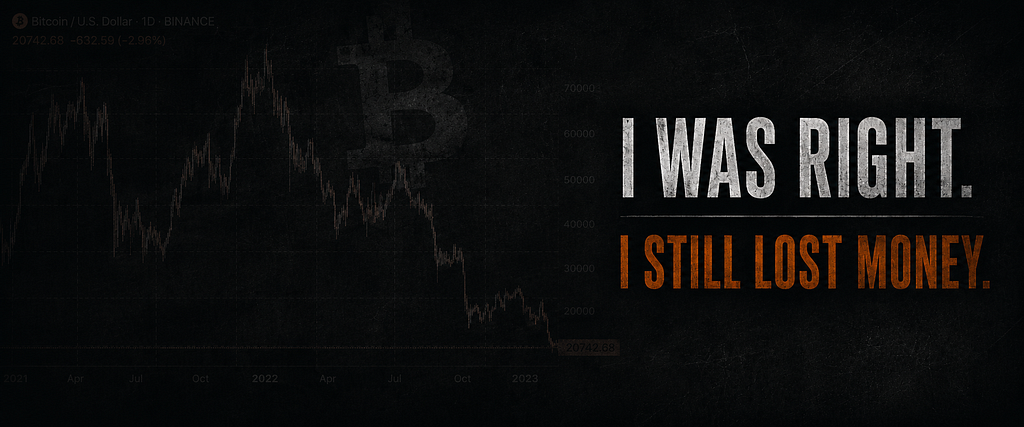
Bitcoin did exactly what I expected. I still remember staring at the chart. Not because I was surprised. Because I was right.
And somehow, I still lost.
The Trade
I had spent hours building the thesis. The level looked clean. The risk made sense. The setup was there. I entered the trade. The market moved against me almost immediately. Nothing dramatic. Just normal volatility.
But it felt bigger because I was watching every candle. Every red candle felt like proof I was wrong.
Every small bounce felt like relief. A few days later, I closed the position. Small profit. Not much.
But green is green, right?
That’s what I told myself. Then I kept watching. And watching. And watching.
The market continued moving exactly where I originally expected. The move wasn’t over. The thesis wasn’t broken. Nothing had changed.
Except I was no longer in the trade.
A week later, the opportunity I had exited would have returned several times more than I actually made.
That’s when it hit me.
The market rewarded my idea. I just wasn’t there to collect it.
I Thought Trading Was About Being Right
For a long time, I believed successful traders were simply better forecasters. They saw something others didn’t. They predicted the future more accurately. They found better entries. They had better indicators.
Better analysis. Better information.
Then I started reviewing my own trades.
A surprising pattern appeared.
Many of my losing trades weren’t actually bad ideas. Some of them eventually moved exactly as expected.
The problem wasn’t the prediction. The problem was everything that happened after the prediction.
The Things Nobody Talks About
Nobody opens a trading account thinking: “I need to learn how to hold a winning trade.”
Most people focus on entries.
Very few focus on staying in the trade. But that’s where the real challenge begins.
Can you sit through volatility?
Can you avoid moving your stop?
Can you avoid taking profits too early?
Can you stick to the original plan when emotions start screaming?
Those skills matter just as much as analysis. Maybe more.
The Market Doesn’t Pay For Predictions
This is the lesson that changed everything for me.
The market doesn’t pay you for being right.
It pays you for executing correctly.
A brilliant thesis with poor execution can lose money. An average thesis with disciplined execution can make money.
Prediction is only the invitation. Execution determines the outcome.
Why Being Right Can Be Dangerous
Being right creates confidence. Confidence creates bigger positions.
Bigger positions create emotional decisions.
Emotional decisions create mistakes.
Ironically, some of my worst trades came after some of my best market calls.
Not because my analysis got worse. Because my confidence got bigger.
The market has a way of punishing certainty.
The Shift
Eventually I stopped asking: “Was I right?”
And started asking: “Did I manage the trade well?”
That question changed how I looked at markets.
Because I can’t control the market.
I can’t control headlines. I can’t control volatility.
But I can control:
And those things matter far more than most traders realize.
Final Thoughts
Most traders spend years trying to become better analysts.
The best traders eventually become better managers.
Managers of risk.
Managers of emotions.
Managers of positions.
Because the goal isn’t to be right. The goal is to make money.
And those are not always the same thing. The market rewarded my idea.
I just wasn’t there to collect it.
I Was Right About The Market. I Still Lost Money was originally published in Coinmonks on Medium, where people are continuing the conversation by highlighting and responding to this story.





