Beyond AI hype and crypto speculation lies a deeper shift: intelligence, value and coordination are becoming programmable simultaneously — and our institutions are not ready.
Everyone is talking about artificial intelligence. Some are talking about decentralized finance. A smaller group is talking about digital governance.
The dominant narrative around AI has focused on productivity. AI drafts documents, summarizes meetings, generates code and answers questions. The dominant narrative around blockchain and decentralized finance has focused on money. Tokens, stablecoins, digital assets and alternative financial systems dominate the discussion.
Yet these narratives are incomplete.
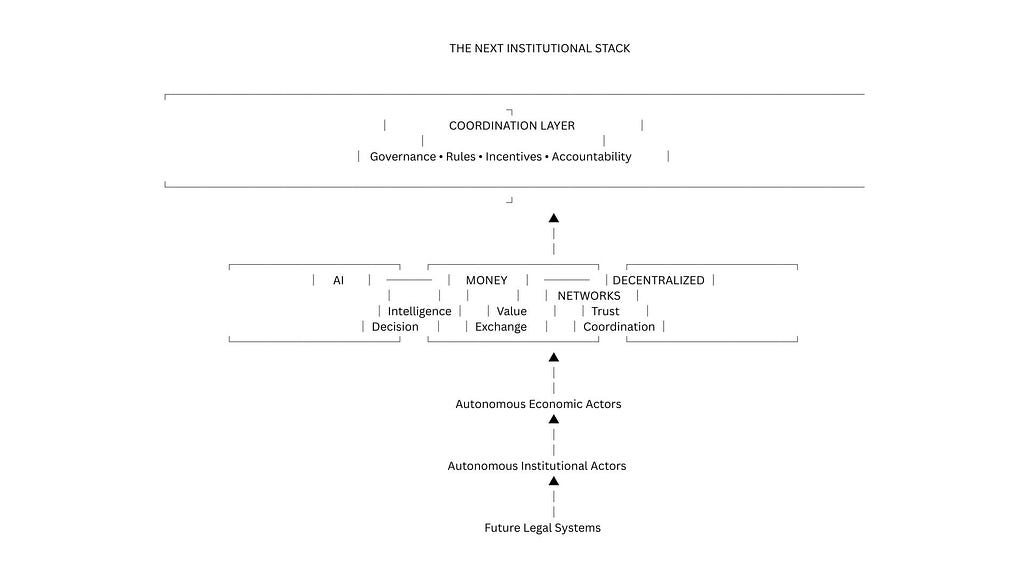
The deeper story is that three historically separate functions of society are becoming programmable simultaneously:
Intelligence
Value
Coordination
When intelligence becomes programmable, we get AI.
When value becomes programmable, we get digital assets and decentralized finance.
When coordination becomes programmable, we get decentralized networks and automated governance systems.
The convergence of these three developments is creating something far more important than a new technology sector. It is creating the foundations of a new institutional architecture.
For most of human history, institutions existed because they solved a simple problem.
Humans could not coordinate at scale.
Banks coordinated capital.
Governments coordinated collective action.
Courts coordinated dispute resolution.
Corporations coordinated production.
Every institution represented a solution to the limitations of human communication, trust and decision-making. Technology has historically improved institutions without fundamentally changing them.
The internet accelerated communication. Cloud computing accelerated information flows. Mobile technology increased access.
Artificial intelligence is different. For the first time, intelligence itself is becoming abundant.
At the same time, decentralized finance has demonstrated that financial coordination can occur through protocols rather than traditional intermediaries.
Together, these developments challenge one of the oldest assumptions in economics and governance: that humans must sit at the center of every significant decision-making system.
Much of today’s AI discussion still assumes AI remains a tool. That assumption may not survive the decade. An AI that can analyze information, evaluate options, execute transactions and adapt its behavior is no longer merely a productivity tool.
It begins to resemble an actor. Now connect that actor to programmable money. Give it access to wallets, payment rails and financial protocols. Then connect it to decentralized coordination systems.
Suddenly, intelligence can participate directly in economic activity. Not symbolically. Operationally.
This is the moment where the conversation changes. The future is not simply AI-assisted humans.
The future increasingly includes human systems interacting with autonomous systems. The implications extend far beyond finance.
Most technology revolutions begin as engineering challenges. Eventually they become governance challenges. The internet’s biggest problems today are not technical. They are social, political and institutional. AI appears headed down the same path.
The next generation of systems will not fail because they lack computational power. They will fail because society lacks governance mechanisms capable of managing autonomous decision-making at scale.
Consider the questions already emerging:
Who is accountable when autonomous systems make mistakes?
Who bears liability when AI agents execute harmful decisions?
How do institutions audit systems that continuously evolve?
How do regulators oversee actors that do not fit traditional legal categories?
These are not future questions.
They are present questions.
And they reveal an uncomfortable reality:
the limiting factor is no longer technology.
The limiting factor is institutional design.
One lesson from decentralized finance deserves wider attention. The greatest value often does not accrue to applications. It accrues to coordination layers. Protocols. Standards. Rules. Governance frameworks.
The same dynamic is emerging in AI. The next generation of competitive advantage may not come from building another chatbot or another legal research platform.
It may come from building systems that coordinate humans, machines, institutions and incentives more effectively than existing structures.
This is especially relevant for legal technology. The legal profession often frames AI as a tool for drafting, research or document review. Those use cases matter.
But they are not the strategic story. The strategic story is that legal systems themselves may become increasingly programmable.
Compliance systems that monitor continuously. Contracts that trigger automatically. Regulatory obligations translated into machine-readable logic. Governance frameworks capable of supervising autonomous actors. The future of legal technology may be less about legal software and more about institutional infrastructure.
The ultimate destination of this convergence is not autonomous finance. It is autonomous institutions. Today, institutions are collections of humans operating under rules.
Tomorrow, some institutions may become collections of humans and machines operating under shared governance frameworks. The most successful organizations will not simply deploy AI. They will redesign themselves around new forms of coordination.
The same will be true for governments, regulators, courts and professional services firms. The challenge is not replacing human judgment.
The challenge is determining where human judgment remains essential and where programmable systems outperform traditional structures. This is not a technological question. It is a governance question.
Every major economic transformation eventually produces new institutions. The industrial revolution produced modern corporations.
The nation-state era produced modern bureaucracies. The internet produced digital platforms.
The convergence of AI, programmable value and decentralized coordination may produce something equally significant.
A new institutional stack. One in which intelligence, value and governance become programmable layers interacting continuously.
Most commentary still treats AI, crypto and governance as separate conversations. They are not. They are components of the same emerging architecture.
The organizations, regulators and societies that recognize this first will have a profound advantage.
Because the defining question of the next decade may not be whether AI changes the world. It almost certainly will.
The defining question is whether our institutions evolve quickly enough to govern a world in which intelligence, value and coordination have all become programmable. That is not merely a technology challenge. It is the central governance challenge of the twenty-first century.
The Most Important Technology Story of the Decade Isn’t AI. was originally published in Coinmonks on Medium, where people are continuing the conversation by highlighting and responding to this story.





