Customers no longer compare their banking experience with other banks they compare it with the speed and convenience of every digital service they use. Whether it’s instant messaging, real-time order tracking, or same-day deliveries, expectations for financial transactions have changed dramatically.
To meet these expectations, some of the UK’s largest financial institutions are modernizing the way money moves across borders.
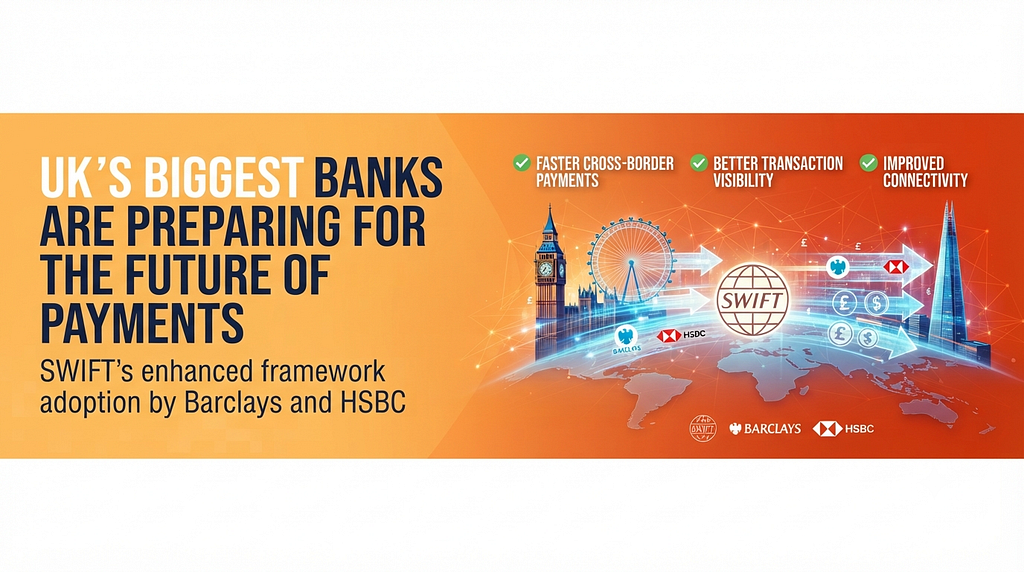
Major banks such as Barclays and HSBC are among the early adopters of SWIFT’s enhanced consumer payments framework, marking another important step toward a faster, more transparent, and more connected global payments ecosystem.
Cross-border payments have traditionally faced several challenges:
For businesses operating internationally, these inefficiencies can increase operational costs and create uncertainty. Consumers also expect international transfers to be as seamless as domestic payments.
Modern payment infrastructure is designed to solve these challenges.
SWIFT’s enhanced consumer payments framework builds on the organization’s global messaging network to improve how financial institutions exchange payment information.
Rather than simply moving payment instructions, the framework focuses on creating a more connected payment journey that improves speed, transparency, and consistency across participating institutions.
The initiative supports banks in delivering a modern payment experience without requiring customers to change how they bank.
Businesses increasingly rely on international suppliers, customers, and partners. Faster settlement helps improve cash flow, reduces waiting times, and supports more efficient global operations.
One of the biggest frustrations with international payments is the lack of transparency.
Enhanced payment tracking allows banks and customers to gain better insight into where a payment is in its journey, making it easier to resolve delays and improve customer confidence.
Payments rarely involve a single institution.
Improved communication standards enable participating banks to exchange richer payment information, helping reduce friction while supporting greater interoperability across the global financial ecosystem.
Modern consumers expect payment experiences that are fast, reliable, and transparent.
By upgrading payment infrastructure, banks can deliver services that better align with today’s digital expectations while improving customer satisfaction and trust.
The UK remains one of the world’s leading financial hubs.
As global commerce continues to expand, banks must support businesses that operate across multiple countries and currencies. Investment in payment modernization is no longer just a technology initiative — it has become a competitive advantage.
Banks that embrace modern payment frameworks can:
Early adoption also positions institutions to adapt more easily as new payment technologies, regulatory requirements, and customer expectations continue to evolve.
The modernization of payments extends far beyond faster transfers.
Across the financial industry, institutions are investing in cloud-native infrastructure, ISO 20022 messaging, API-driven connectivity, real-time payments, artificial intelligence, and advanced fraud prevention. Together, these innovations are creating a more resilient and intelligent financial ecosystem.
SWIFT’s enhanced consumer payments framework represents another important piece of this transformation, enabling banks to collaborate more effectively while delivering greater value to customers.
The future of payments will be defined by speed, transparency, interoperability, and security.
As leading UK banks continue investing in modern payment infrastructure, businesses and consumers stand to benefit from more reliable cross-border transactions and a smoother digital banking experience.
Payment modernization is no longer a vision for the future — it’s happening today.
Financial institutions that embrace innovation now will be better positioned to meet tomorrow’s demands and shape the next generation of global payments.
UK’s Biggest Banks Are Preparing for the Future of Payments was originally published in Coinmonks on Medium, where people are continuing the conversation by highlighting and responding to this story.





