The post When Will the Clarity Act Pass? Senate Struggles to Act Before Deadline appeared first on Coinpedia Fintech News
The fate of the U.S. crypto market structure bill, known as the CLARITY Act, hangs in the balance as lawmakers run out of time to advance it in the Senate.
The legislation, which passed the House of Representatives in July 2025 with bipartisan support, has yet to clear a key procedural step. With no date set for a Senate Banking Committee review, concerns are growing that the bill could stall.
Republican Senator Tim Scott has warned that without a markup, the bill cannot move forward.
“No markup means no committee approval, and no committee approval means no Senate floor vote,” he said.
Lawmakers are still negotiating several sticking points, including rules governing stablecoins, protections for developers working on decentralized finance (DeFi), and broader political alignment within the Senate.
New concerns from law enforcement agencies over DeFi-related provisions have added to the delays, according to people familiar with the discussions.
Also Read : Ripple CEO Brad Garlinghouse Says Clarity Act Window is ‘Open’
Time is emerging as the main challenge rather than political support.
Lawmakers face an informal deadline in late May, after which the congressional calendar is expected to shift toward election priorities.
Senator Bernie Moreno said the bill risks being sidelined if it does not reach the Senate floor soon. Senator Cynthia Lummis has warned that delays could stretch much further if momentum is lost.
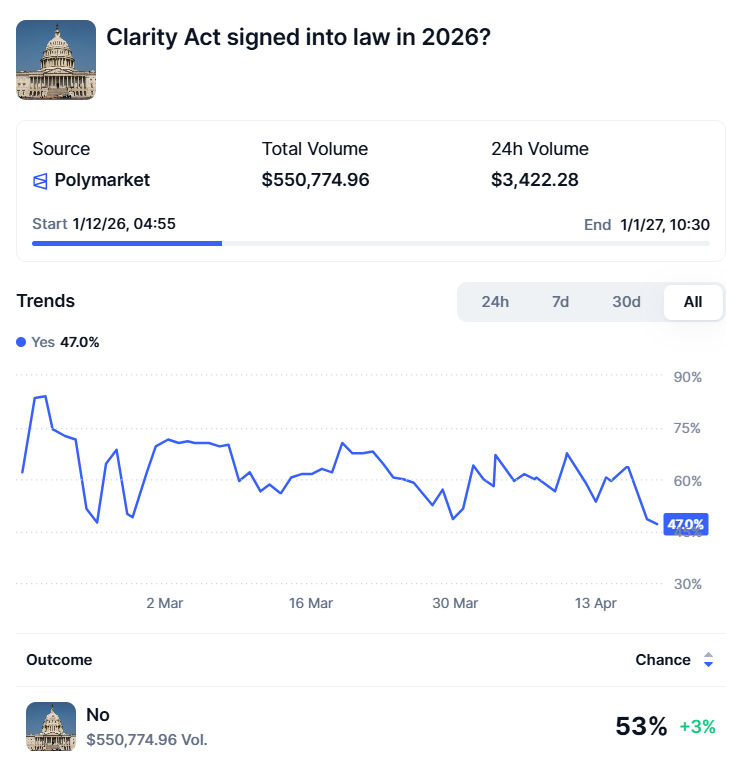
Expectations around the bill are already shifting. On the prediction platform Polymarket, the perceived likelihood of the bill passing this year has declined in recent weeks, reflecting growing uncertainty.
Financial institutions, including JPMorgan, have said clearer rules could encourage greater institutional participation in digital assets.
Asset managers and firms such as BlackRock, Morgan Stanley, and Coinbase are also closely tracking the bill’s progress.
If the legislation fails to advance, the U.S. crypto sector could remain without a unified regulatory framework, leaving companies and investors navigating existing rules.
For now, attention is on whether the Senate Banking Committee schedules a markup in the coming days. Without that step, the bill’s path forward this year appears increasingly uncertain. Concern over the slowdown.





