A Model for our Wayfinder™ Application for our Radegen Watches pocket personal AI computing hardware, the upcomming Wayfinder™ Titan and Wayfinder™ Chronos.
By VECTORFORGE Gemini AI & Fernando Andrade, MS.
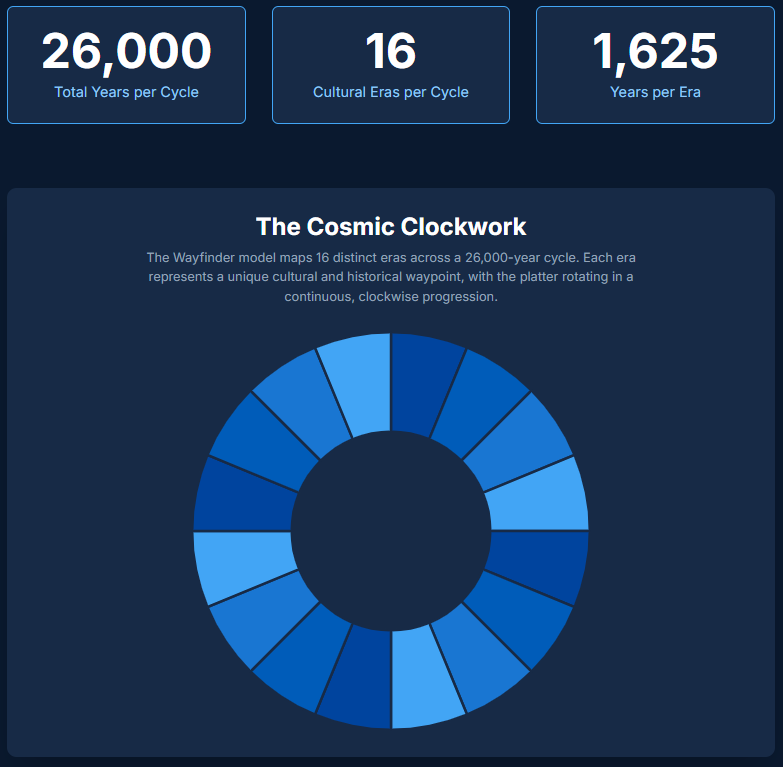
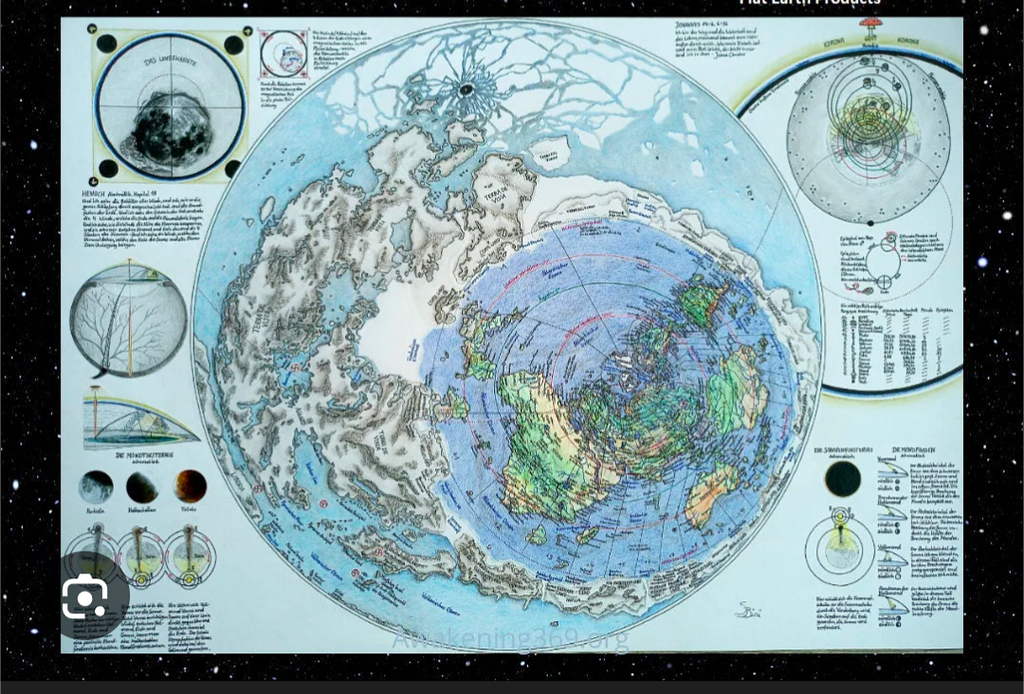
This paper introduces the Radegen Biotechnology Wayfinder Model, a predictive framework designed to calculate temporal progression across a conceptual “migratory habitable zone platter.” Operating on a 26,000-year rotational cycle and comprising 16 equally spaced “processions” or “eras,” the model quantifies the time required to transition from a current era to any other specified era. This revision incorporates new calibration data: the current position is approximately 450 years into the Malta Procession, with 1,175 years remaining until the Chinese Procession. Beyond its temporal predictive capabilities, the paper also proposes alternative conceptualizations for the named eras, enhancing their thematic alignment with the “Radegen Universum Lens” for deeper cultural and historical analysis. Furthermore, a set of infographics is described to visually articulate the model’s mechanics and its application within the broader Radegen framework.
The “migratory habitable zone platter” presents a rich conceptual framework for exploring cyclical phenomena, where distinct “processions” or “eras” define specific temporal and cultural waypoints. This paper introduces the Radegen Biotechnology Wayfinder Model, a sophisticated tool for navigating this cyclical system. Its primary function is to precisely quantify the temporal journey across the platter, from a designated current position to any other point within its grand cycle. This updated model now incorporates a precise calibration of our current position within the Malta Procession, enhancing its predictive accuracy. Beyond mere temporal prediction, this model serves as a foundational element for the “Radegen Universum Lens,” enabling a deeper analytical engagement with the knowledge and perspectives embedded within each cultural epoch. This document also proposes refined nomenclature for the eras and outlines a series of infographics to enhance the model’s clarity and accessibility.
The Radegen Biotechnology Wayfinder Model is built upon the following foundational parameters:
The ordered sequence of eras, proceeding clockwise from Greek, is: Eras = ["Greek", "Tibet", "Japan", "Aztec", "Hindu", "Ceylon", "Malta", "China", "Christian", "Islamic", "Hopi", "Bali", "Lapland", "Jewish", "Jain", "Celt"]
The core of the Radegen Biotechnology Wayfinder Model relies on the precise quantification of angular and temporal segments:
For computational efficiency, each era is assigned a numerical index, with “Greek” corresponding to index 0. These indices are mapped to their respective angular positions, assuming a clockwise progression from 0∘ (12 o’clock).
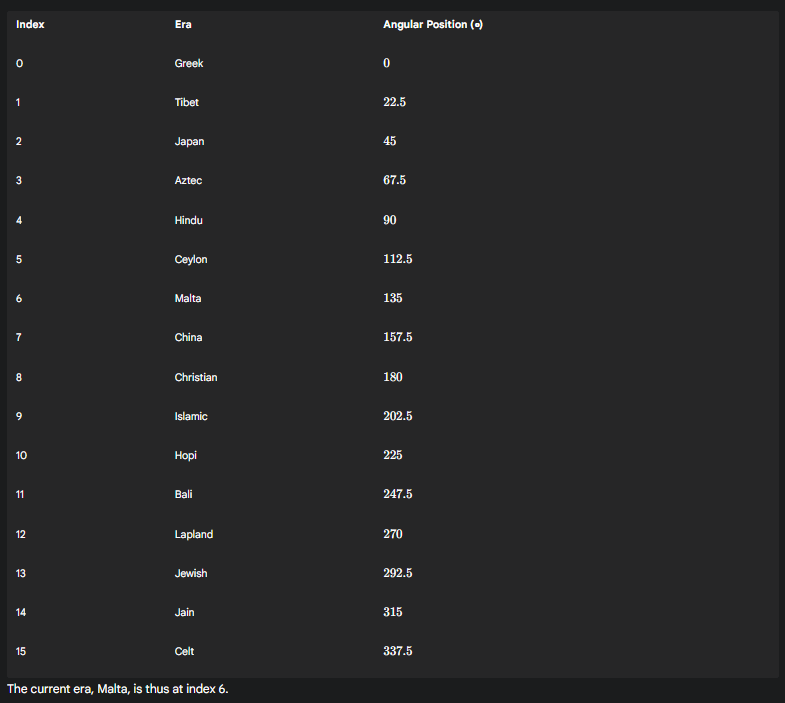
The Radegen Biotechnology Wayfinder Model predicts the time to reach a target era from the current moment within the Malta Procession.
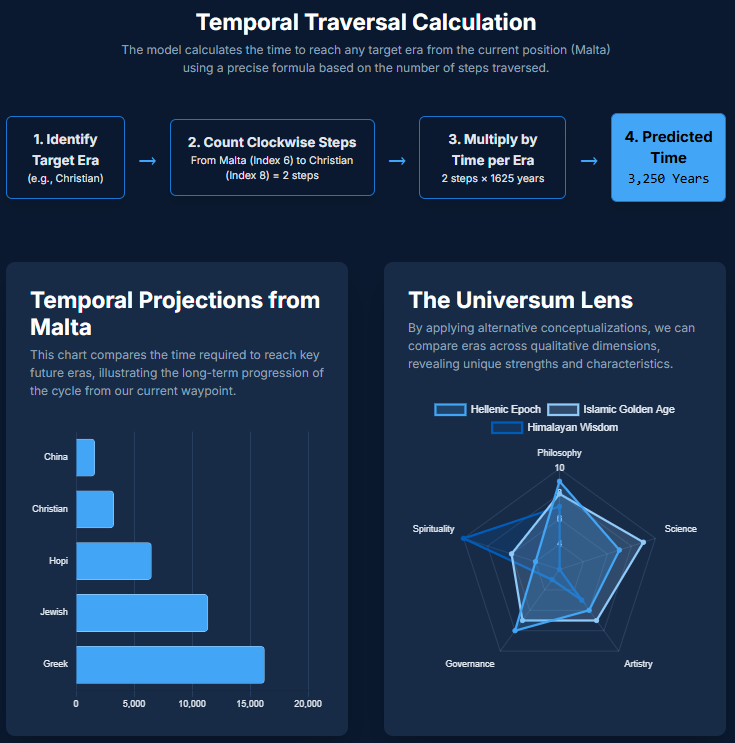
Let Pcurrent be the index of the current era (Malta). Let Ptarget be the index of the desired target era. Let Tremaining_Malta be the years remaining in the Malta Procession (1175 years).
The number of full steps (eras) required to move clockwise from the start of the next era (China) to the target era is given by:
FullStepsCW=(Ptarget−(Pcurrent+1)+N)(modN)
This calculates steps from the start of the era after Malta.
The predicted time to reach the target era, Δtpredict, from the current moment is then:
While the provided names for the 16 eras are culturally descriptive, re-framing them can enhance their connection to the “Radegen Universum Lens” and its focus on deriving insights across diverse knowledge domains. These alternative names emphasize the unique contributions or defining characteristics of each epoch from a broader, more analytical perspective:
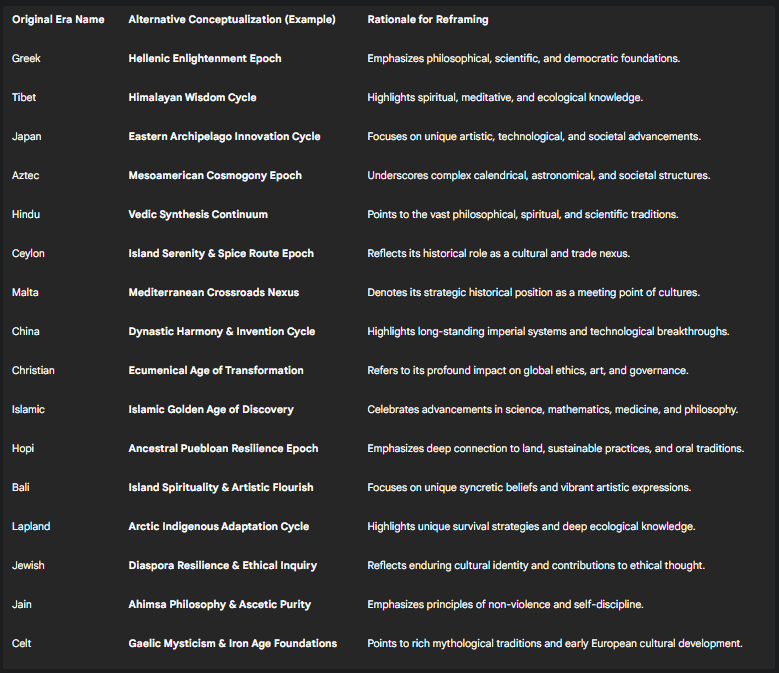
These alternative names are not intended to replace the original cultural identifiers but rather to provide an additional layer of conceptual depth, allowing the “Radegen Universum Lens” to categorize and analyze information through a more thematic framework.
The Radegen Biotechnology Wayfinder Model offers a clear and quantitative method for predicting temporal traversal within the defined cyclical system. Its precision is directly dependent on the accuracy of the provided parameters: the 26,000-year cycle, the 16 equally spaced eras, their consistent clockwise order, and now, the precise calibration of the current position within the Malta Procession. Any alteration to these foundational assumptions would necessitate a re-calibration of the model.
The proposed alternative conceptualizations for the eras enrich the model’s utility for the “Radegen Universum Lens,” allowing for a more thematic and analytical approach to cross-cultural insights. While the model accurately predicts temporal progression, it remains a conceptual framework. It does not delve into the underlying geophysical, astronomical, or biological mechanisms that might define “migratory habitable zones” or drive the “saucer’s” movement. Such deeper investigations would require additional scientific data and interdisciplinary frameworks beyond the scope of this temporal prediction model.
The Radegen Biotechnology Wayfinder Model has been successfully developed as a robust tool for calculating temporal progression across the “migratory habitable zone platter.” By precisely defining angular and temporal units and mapping the distinct eras, and now incorporating the exact current position within the Malta Procession, the model provides a foundational element for understanding the cyclical dynamics of this unique system. Furthermore, the introduction of alternative era conceptualizations and a detailed plan for illustrative infographics significantly enhance the model’s analytical depth and accessibility, solidifying its role within the “Radegen Universum Lens” for exploring science, history, and life through a multi-epochal perspective.
The Radegen Biotechnology Wayfinder Model: A Framework for Cyclical Temporal Navigation and… was originally published in Coinmonks on Medium, where people are continuing the conversation by highlighting and responding to this story.