
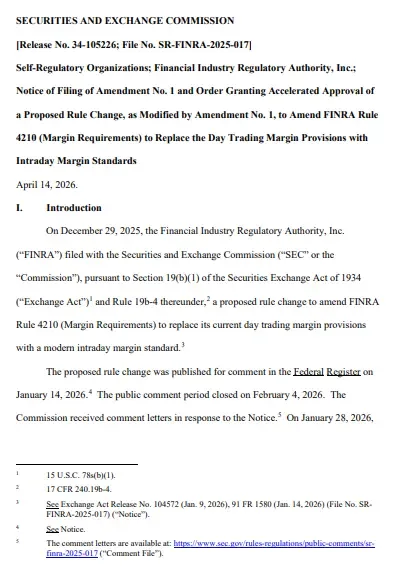
The Securities and Exchange Commission (SEC) has now approved a significant change in regulation that may revolutionize how retail investors engage in rapid trading transactions. On April 14, the SEC approved a FINRA proposal to repeal the current restriction requiring $25,000 worth of account equity for frequent day trading.
Also Read | ETHGas Commits $3 Billion Validator Liquidity Boost to EtherFi
The particular rule acted as a secure wall for quite some time. If a person made four or more day trades in five business days, then that person would be deemed a pattern day trader who must maintain a minimum of $25,000 in his/her account.
Otherwise, the trader would be stopped from trading further. This rule came into effect in the year 2001 after the bust of the dot-com bubble, Bull Theory wrote.
The upcoming update will see this restriction completely scrapped. The designation of “pattern day trader” will be dropped, thus making it easier for more investors to engage in trading short-term with little capital in their accounts.
Rather than an absolute level, the new system looks at risks in real time. The investors would be required to keep up with the equity in their accounts based on their current exposure in the market. The existing rules on margins would apply, although this system is far more adaptive and dynamic.
This change also caters to new trading methods such as 0DTE option trading, which is not covered by the existing model. There will be two approaches available for brokerage firms when dealing with the regulation: The first will involve preventing trades above the threshold through real-time analysis, while the other involves exposure analysis after each trading day.
Safety measures are also in place. Any accounts that consistently fall short of the margin requirements for five business days will be subject to a 90-day trading limitation on specific actions like selling securities short. Nevertheless, minor breaches of less than 5% of the account’s value or $1,000 will not result in penalties.
According to FINRA, the revision will enable investors to enjoy flexibility without ignoring the risks that might be involved. Additionally, it expects the amendments to reduce compliance expenses for brokerages.
Following the official announcement from FINRA, the new regulations will take effect 45 days later. Businesses will have up to 18 months to completely implement the changes if they require time to modify their systems.
Also Read | Avalanche Builds Strength: Bulls Target $10 Breakout Zone





