
The shift from GPT-4 to GPT-5 isn’t cosmetic. While previous models were generalists, broadly capable but occasionally brittle, GPT-5 is both specialized and strategic. Under the hood, OpenAI has introduced a multi-model routing system that mimics human-like decision making. In plain English? The system evaluates the complexity of a task and sends it to the best-suited model. Some queries get fast, low-latency answers; others are routed to a slower, more deliberate reasoning engine. It’s no longer just a model trying to be good at everything, it’s an orchestrated system of minds with distinct specialties, stitched together in real time.
And that’s what makes GPT-5 feel more human. When you ask it something hard, it pauses, just for a beat. It thinks. You can feel it deliberating. It’s subtle, but it’s the kind of nuance we associate with people, not software. There’s a composure to GPT-5, a sense of cognitive patience that gives it a different texture than its predecessors.
But what really sets GPT-5 apart isn’t just its mental horsepower, it’s the memory. Persistent memory, long requested and now fully operational, transforms the interaction model. GPT-5 can now remember facts about you, your tone preferences, your previous queries, and even project histories. For enterprise use, that means GPT-5 is no longer a chatbot, it’s your digital chief of staff. For consumers, it means you’re not starting from scratch every time. You’re building a relationship. The AI isn’t smarter because it knows more; it’s smarter because it knows you.
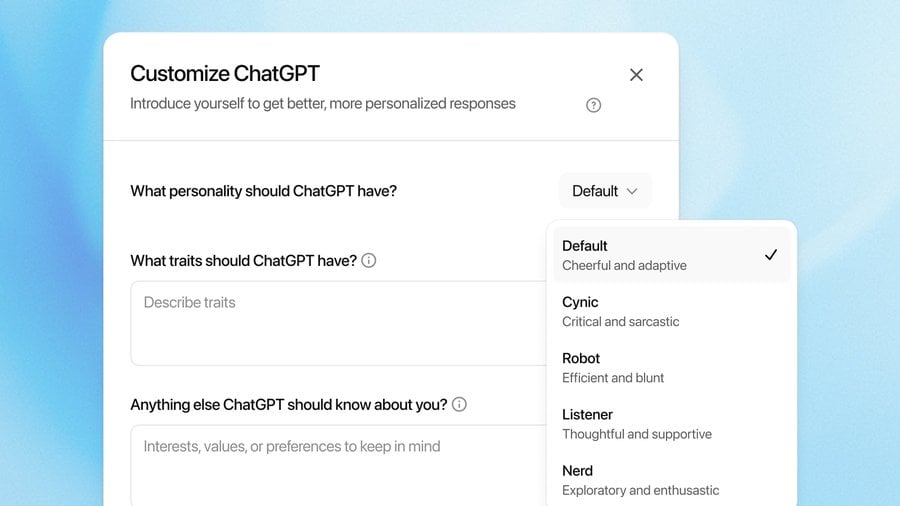
GPT-5 has several personalities you can select from, Source: X
This is also where OpenAI starts to look more like an OS company than an API vendor. GPT-5 arrives in four versions, standard, mini, nano, and a chat-optimized variant, each tailored for specific use cases. The mini and nano models are built for speed, edge devices, and cost-efficiency, opening up a world where intelligent agents can live not just in the cloud, but in your phone, your browser, your car. The full-fat GPT-5 model is more deliberate, more powerful, and noticeably more accurate, especially at reasoning, math, health questions, and, critically, code.
And yes, developers are going to have a field day. GPT-5 doesn’t just crank out snippets, it handles full-stack problems, uses tools effectively, and maintains state in complex chains of thought. It can manage prompts like a product manager, debug like a software engineer, and document like a technical writer. And when it does hit a limit, it gracefully degrades to lighter models without choking on the request. This modularity marks a philosophical shift: GPT-5 is not just a model, it’s a platform architecture.
Still, there’s no bombastic AGI announcement here, OpenAI is careful to draw a line. GPT-5 is a step forward, not the singularity. But it’s the kind of step that bends the curve. It doesn’t replace humans, but it does start to feel like a co-equal contributor. Not a tool. Not a pet. A partner. And that has consequences, technical, ethical, commercial.
We’re entering an era where intelligence is ambient. Where memory is persistent. Where conversations are ongoing. GPT-5 is the vanguard of that shift, not perfect, not omniscient, but startlingly close to something that feels alive in its coherence.





