There is a changing of the guard in the drinks industry – and Manchester brand Hip Pop is at the forefront of the trend.
Originally known as Booch & Brew, it all started back in 2019 in co-founder Emma Thackray’s kitchen.
“Kenny [Goodman], the other co-founder, has a real issue with IBS (Irritable Bowel Syndrome),” CEO Matt Bowler-Jones tells me for Founder Friday.
“Meanwhile Emma had discovered kombucha brewing – and its benefits for gut health – while living in the United States.
“They [and their partners] met when they were looking for childcare and started talking about this.”
Emma was the founder of Hello Pure, a nutritional supplements brand which was acquired in 2021, while Kenny is a serial entrepreneur.
“They said: Why don’t we do this?” continues Matt.
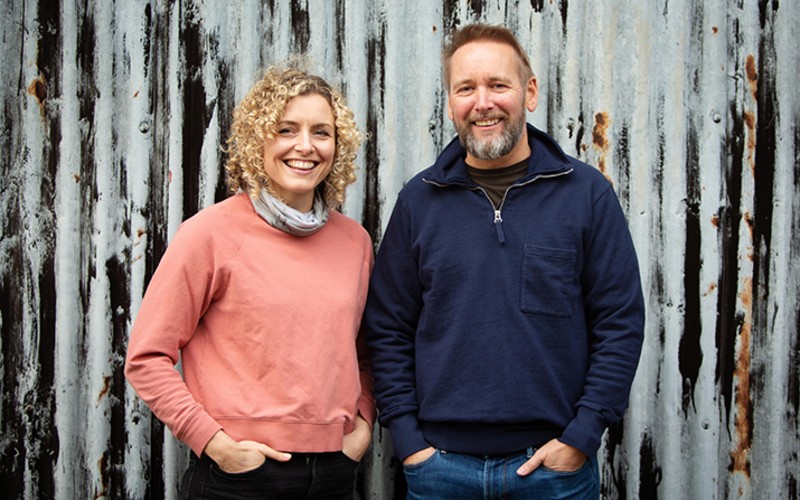
Emma began brewing small-batch kombucha recipes using real fruit and live cultures in jars in her kitchen in Altrincham.
Two years later the fermentation was moved to a farm in Cheshire and the business was renamed Hip Pop. By 2023, the microbrewery had taken up residence in the iconic railway arches on North Western Street in Manchester.
Today it has 10 canned drinks available: four sodas, four kombuchas and two kombuchas containing CBD.
On one of the hottest days of the year – while taking down a tent – I sampled the berries & cherries, pink grapefruit and ginger & turmeric flavours. All sodas, I found them delicious, refreshing and lightly fizzy.
Where did I buy them? A Sainsbury’s near Chester. But Hip Pop has expanded further afield than Cheshire.
“It’s just phenomenal. Around Manchester, everybody knows the brand; but we’re in every supermarket in the UK; we’ve got a big presence in Europe; we’re in restaurants and bars; we’ve got TikTok and Amazon; and we have DTC (direct-to-consumer) with our own website,” says Matt.
“We’re the only kombucha brewery in Europe which does it to this scale. We really do have a blended margin across the world.”
While the United States is on hold for now – due to the expensive logistics – Hip Pop has cracked Hollywood via a licensing agreement with the Supergirl movie, released last month, which sees the iconic superhero appearing on the berries & cherries and lemonade cans.
Founders Emma and Kenn are heads of product and growth respectively. Matt was brought in as CEO in 2025 to run the day-to-day operation.
Now in his fifties, he had spent the last dozen years at family businesses Baxters and Finlays in senior sales director roles after 17 years at Mars.
“I had nine years at Baxters and that was an education,” he grins. “Unlike at Mars, Audrey Baxter was very, very ‘in’ the business.
“She’s very entrepreneurial and acquisitive: she came into business back in 1989, when it turned over £50 million, and now it’s at £800m. She’s incredible.
“In sales at Mars, you know nothing about how anything’s made; whereas at Baxters, you know about capacity optimisation; the manufacturing; everything.
“When I left we’d done a cycle where in the last three years we’d doubled the EBIT percentage – it was really profitable for a traditional business.”
Finlays is an own-brand tea and coffee business which is owned by global multi-billion turnover group Swire. “They bought Finlays in 2000. if you go to a Sainsburys, all the roast and ground coffee, and all the tea, is Finlays,” explains Matt.
“When I went there, they were losing money – significant money – and had done for 10 years. I really enjoyed it: we just turned it around.
“We really did business with purpose: 45% of the tea in the UK is sourced from East Africa, from Kenya and Malawi – the poverty there is extreme.”
Finlays’ business with purpose pillars include ethical sourcing of ingredients; the building of community trusts; and zero-emission manufacturing via renewable energy sourcing.
A new challenge then presented itself.
“I knew Kenny and Emma already from Hip Pop through my wife, Rebecca [Oliver-Mooney],” says Matt. “She was commercial director at the Co-op and they came through The Apiary scheme she’d created.
“I’d also been drinking hip hop for like two, three years already via a subscription and it has such a clean, fresh taste, so I loved the brand.
“She said: ‘Why wouldn’t you try something like this?’ It’s so exciting. It’s different.”
Rebecca joined the company herself in February as strategy and insights director.
From Spinningfields to startup: meet founder behind rising star GAME FM
“A friend said to me that being a CEO is different because you’re involved in everything. And being a CEO is terrible because you’re involved in everything!” jokes Matt, who I am interviewing outside the company’s Bonded Warehouse office.
“I say that Hip Pop has left junior school and we’re now at secondary school: we’re in this big grown-up world.
“The business has doubled every year for the last three years, and we’re going to go again this year. It’s really exciting. The trends are all there. The market’s there.”
Now we’re in 2026, there is so much opportunity for a brand like Hip Pop compared with then it started out.
“Consumers want more than the big brand soft drinks now, as great as those businesses are,” explains Matt. “The whole [market] is changing.
“Sainsbury’s calls it the ‘mindful consumer’: people are very health-led now and aware of what they are putting into their bodies.
“Alcohol consumption in the UK has fallen massively. If you go to a supermarket now, you’ve got water and flavored water, but then there’s the stuff in the middle – soft drinks – and many people want something that is good for them.
“Emma will say: ‘If you want to be super healthy, drink water, that’s fine, don’t stop that – but if you want to have an alternative that’s actually good for your health [then drink Hip Pop].”
Kombucha is made by fermenting sweetened tea with a SCOBY (Symbiotic Culture of Bacteria and Yeast) which is a gelatinous disc composed of multiple layers of cellulose, a natural fibre produced by the bacteria in the culture.
As the SCOBY ferments the tea, it grows in size and thickness, creating new layers on top of the old ones – and these can be separated. Reproductions of Emma’s original SCOBY are still in use at Hip Pop’s microbrewery today.
However the drinks it produces are less acidic than traditional kombucha and contain only trace amounts of alcohol. “It’s like a sessionable version of kombucha,” is how Matt puts it.
The bricks-and-mortar retail vertical is expensive, says Matt, but is invaluable if done right.
“When you first get that listing, you’ve got to make sure you do it as sustainably as possible,” he says.
“There are category rules with shops – a customer has to make a margin of 40% or 50%, so you’ve got to make sure you’re not pulling down their margin; but you also need to make sure you’re not giving up 60% or 70%.
“You’ve got to have a pricing structure that’s right for that channel.”
Shelf space in a major supermarket can cost in the several thousands. “It’s an absolute premium. If you went to a Sainsbury’s, they’ll have 20,000 different products, but they’ve all got to work. And the volume mix has changed massively in the last three years – so that’s great for us.
“The number of stores you are in can be a vanity metric. If there’s 100 stores and you’re only in 10, but they’re the right 10, that’s brilliant – because your rate of sales starts to grow.
“If you’re in 100 stores and in half of them you’re selling nothing, that brand becomes a completely different conversation topic for the retailer.
“So whenever we go in, we always grow our distribution: we started off in 300 stores in Sainsbury’s 18 months ago and we’re now in six times that many.
“At the end of last year we were in 6,000 stores; now we’re in 14, 500, including international.”
So how does Matt dovetail with Emma and Kenny?
“When I was at Baxters, if you dared to say to Audrey ‘we need to get rid of this line’, she’d say: ‘Stop killing my children.’
“Kenny and Emma are the founders and so passionate… you’ve got to get people in the business that have a similar vested interest in what you do.
“But they know what they don’t know, which is such a powerful asset to have.
“We’re really tight. You have to be. We’re absolutely open and share everything across the business, so there’s no secrets. The beauty is you don’t have to seek permission – you can just go and fix any challenges around manufacturing, sales, whatever needs sorting.
“If we talk to HSBC, for example – they are really supportive of us – we go as a three all together.”
He adds: “We’re going through a series A [round of funding] now – and that’s like a second job!”
Matt is passionate about looking after the mental health of the company’s 28-strong workforce as well as the wider industry.
It comes from a very personal place. “We lost my brother to suicide last year.
“I’m a massive believer in healthy in mind, healthy in body. They’re closely linked.
“Rebecca runs an organisation called Raising the Glass, which is a platform supporting women and their allies in the drinks industry; and we’ve launched Hey Dan on the back of that as well, which talks about mental health and the things you can do [to look after it].
“Saying ‘hey’, not ‘hi’, makes it easy to be able to talk – you just stop for a moment and talk to people in a more collaborative way.
“You shouldn’t be ashamed of ‘business with purpose’ in terms of mental health… there’s a real commercial link and you shouldn’t apologise for that.
“If you have a really happy, settled, performing workforce who feel valued and open in terms of their mental health and physical health, you get better results, and the business performs better – and the better the business performs, the more money you can invest in the welfare of your workforce, which is really important.
“They’re interdependent, and there’s absolutely nothing wrong with that. It took me a while to get that to click in my head.”
Hip Pop came through the latest Ascend Scale Up Programme, run by GM Business Growth Hub.
“The knowledge you share on the programme is almost like a comfort blanket – because everybody has the same challenges,” says Matt.
“Over the last 15-20 years, Manchester has just gone stratospheric – it’s the fastest-growing city in Europe. And the community is fantastic.
“There’s just a vibrancy about it.”
Childhood friends raise $1m for Manchester startup BidScript
The post Hip Pop’s journey from kitchen kombucha to Supergirl appeared first on BusinessCloud.





