There is one image that defines Solana’s current moment better than any candlestick chart: a suspension bridge in the middle of the fog. On one side, an avalanche of headlines that brush against the surreal —Visa, Meta, PayPal, Stripe, and Mastercard building on its network; Goldman Sachs revealing million-dollar positions; BlackRock settling over half a trillion dollars on its financial rails—.
On the other side, a price that, stubbornly, refuses to take off, stuck below $100 as if it were asking permission to exist. It is hard to find, in the recent history of cryptocurrencies, a divorce as stark as the one between a network’s fundamentals and the value perception the market assigns to it. And it is precisely in that crack where the great question hides: are we facing a generational opportunity or a perfectly designed value trap?
I am not going to pretend neutrality. The person writing these lines has spent months observing the paradox with a mixture of amazement and disbelief. Every morning, the ritual is the same: to review on-chain data and corporate news and to feel that Solana has become Wall Street’s best-kept secret, while the retail investor continues to stare at the daily chart like someone contemplating a flat electrocardiogram.
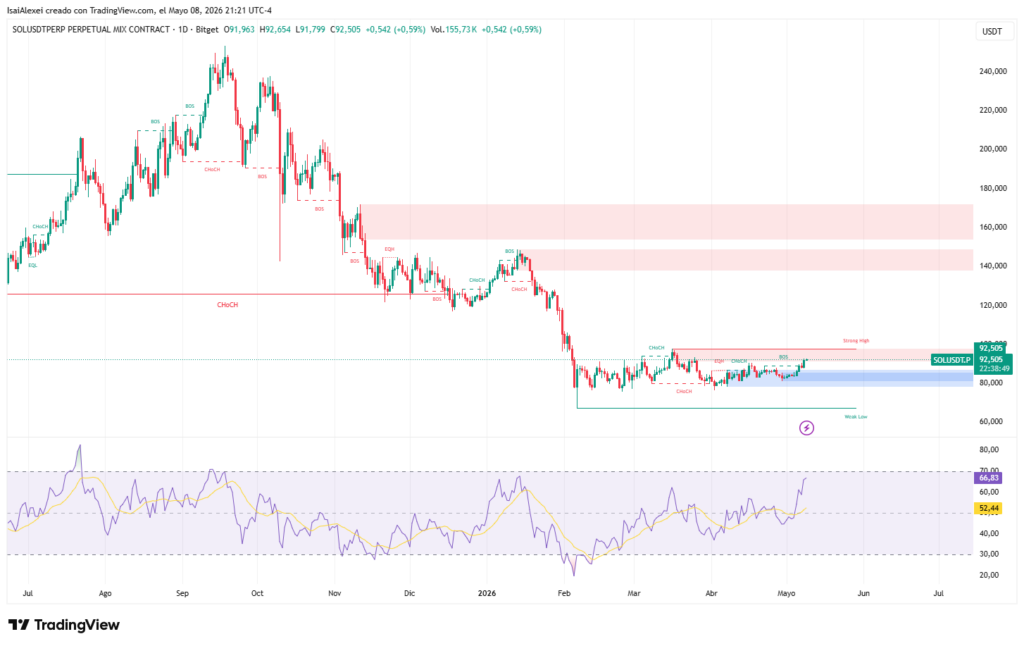
The narrative that has taken hold is that of a prolonged bearish trend, and technically it is not false: SOL is trading below its 20-, 50-, and 200-day moving averages, consolidating within a narrow range between $80 and $86 for weeks, with crucial support at $64 and a psychological resistance that has turned into a concrete ceiling at $100–$120. Any reasonably serious technical analyst will tell you that the asset is crying out for a catalyst or risks a final capitulation.
But what that technical analysis fails to explain is why on earth the traditional financial world has decided to move in a herd to a blockchain that, according to superficial indicators, would be in its darkest hours. Because what has happened in the first quarter of 2026 is unprecedented: Solana processed more than 10 billion transactions and recorded an economic value of $1.1 trillion, a quarter-over-quarter growth of 6,558%. Those are dizzying figures, typical of a network in a state of boiling activity, not of a project that is agonizing. And yet, there is the price, compressed like a spring.

This is where the columnist must set aside objectivity and point out the obvious: the market is getting it wrong. It has done so before with other assets and it is doing so now with Solana. The reason is more psychological than mathematical.
The average crypto investor, burned by the volatility of recent years and frightened by geopolitical tensions —Iran looming in the background, the macro environment staggering— has withdrawn liquidity and has especially punished those projects that do not offer immediate refuge. The flight of retail users is real: weekly active addresses plummeted from 5 million in February to 2.89 million, a 42% drop that chills the blood of anyone who only looks at the surface.
It is easy to see that number and conclude that interest is evaporating. It is easy to look at the chart and surrender to bearish inertia. But the easy road is rarely profitable.
While the ordinary investor abandons the network, smart money has been doing exactly the opposite. On March 17, 2026, the SEC did what many of us thought improbable: it classified SOL as a digital commodity, pulling it out of the regulatory swamp and granting it a passport to institutional respectability. Ten days later, the regulator approved 91 crypto-asset ETF applications, including spot Solana ETFs.
The effect was not long in coming: in less than two months, SOL ETFs surpassed $1 billion in assets under management and accumulated net positive flows that already hover around $900 million. A single trading day in April recorded $15.5 million in inflows. Those are not the numbers of a dying asset; they are the numbers of an asset that institutional money is patiently accumulating while the price remains depressed.
Goldman Sachs has revealed a position of $108 million in SOL. BlackRock’s BUIDL fund has already settled $550 million on the network. Fidelity, the asset management giant, has not limited itself to buying: it has launched its own validator, contributing to the chain’s security and decentralization.
They are not patrons or philanthropists: they are the most sophisticated wealth managers on the planet, and they do not put those sums on the table out of a summer whim. Their bet is structural, long-term, the kind of move that is not improvised in an analyst meeting but is cooked over months in investment committees. That the price of SOL does not yet reflect that endorsement is, simply, an anomaly.
And if we are talking about anomalies, it is worth looking at what is happening in the development ecosystem. Solana has displaced Ethereum as the chain that attracts the most new talent: 45% year-over-year growth in active developers has allowed it to reach 23% of the global blockchain builder market share.
For the first time in years, the narrative that “Ethereum is the only ecosystem with depth of human capital” breaks against the evidence that new projects prefer Solana’s high speed and nearly non-existent fees. Creativity does not understand price charts, and developers do not code while staring at the RSI. They build where they see a future, and they are building massively on Solana.

This torrent of talent is recapitalizing the network’s DeFi ecosystem silently but unstoppably. Total value locked has climbed to $55.86 billion, a multi-month high that contrasts with the anemia of the price. The phenomenon is not limited to speculation with memecoins, although that chapter always forms part of Solana’s market. I am talking about sophisticated products like Kamino Prime Market, which has already attracted more than $1 billion in real-world asset deployments.
The tokenization of treasury bonds and other traditional financial instruments is now a tangible reality: Solana hosts $2.7 billion in tokenized Treasury products, and its real-world asset market hit a new all-time high of $1.71 billion at the end of February. This is not a casino. It is the financial plumbing of the future, and it is running on Solana’s rails.
I confess that, as an opinion writer, writing this column produces a particular vertigo. The temptation of confirmation bias is strong, and I do not want to fall into the trap of ignoring the risks. It would be dishonest not to mention them. Competition from Ethereum and other layer-1s remains fierce; Ethereum still holds 53% of total DeFi TVL and will not give up ground without a fight.
The network’s reliability, although improved, still carries the stigma of past outages, and a new incident at a time of nascent institutional adoption would be devastating. The drums of geopolitical war and the possibility of a global macroeconomic shock could drag the entire crypto-asset space into a new winter without distinguishing between solid projects and houses of cards. And, of course, the technicals rule: a loss of the $80 level with volume could trigger the dreaded cascade of liquidations toward $68–$64, a move that would break the patience of even the most tempered investors.
But I write this article precisely because, even acknowledging those storm clouds, I believe the bearish thesis has expired. The market, anchored in the short term, is pricing Solana as if it were the same speculative asset of 2021. It is not. It is a financial infrastructure validated by regulators, blessed by ETFs, underpinned by payment giants, and embraced by the world’s largest asset managers.

The question is no longer whether Solana will survive the bearish trend, but how long it will take for the price to catch up with a reality that has already changed. My impression is that the outcome is near. If institutional buying pressure manages to break $100–$120 with conviction, the bearish dynamic will reverse explosively, leaving laggards chasing a train that has already departed.
If, on the contrary, macro fear prevails and the $64 support gives way, we will have to accept that not even the most solid fundamentals can tame Mr. Market when he insists on punishing. But that second scenario would require Goldman, BlackRock, Visa, and the SEC to be collectively wrong. And, with all due respect to technical analysis, I find it hard to imagine a miscalculation of that caliber.
I end with a personal confession. For years I was skeptical of the theses that pitted “fundamentals vs. price” as an excuse to justify any investment that never quite took off. Too many times I have seen assets with magnificent narratives collapse because the market was right and we fundamentalists were blind. But on this occasion, the magnitude of the divergence is so grotesque that it forces me to take sides.
The current bearish sentiment, fed by the drop in active addresses and the paralysis of the chart, is a wonderful distraction for those who know how to read behind the headlines. The story told by institutional order books, ETF flows, and enterprise deployments is that of adoption that does not look at today’s price, but at the value a decade from now. Solana is at a crossroads, yes. But crossroads are not only places of danger; they are also, and above all, places of decision.
And my decision, as a columnist and privileged observer of these convulsive times, is to assert that the bear cornering Solana today is nothing more than the guardian of what could be, paradoxes aside, the greatest buying opportunity this market has offered us in years.
After that, let each person act according to their own analysis and their own appetite for risk. Because in the end, in this business of investing, the most expensive opinion is not the one that is written, but the one we keep to ourselves.





