This article applies one test to five major assets: what mechanism connects activity on the network to demand for the token. Bitcoin, Ethereum, Solana, Hyperliquid and XRP answer that question in five genuinely different ways. Understanding the difference matters more than any price target, because the mechanism persists across cycles while targets get revised every few months.
Every credible investment case for a digital asset runs through one of these channels:
Staking yield sits alongside these rather than inside them. It compensates holders for locking supply, which supports price indirectly, but it does not by itself create demand from network usage.
A structural shift happened when spot exchange-traded funds launched for these assets. Large allocators no longer need wallets, custody arrangements or exchange accounts.
The consequence is mechanical. Fund buying forces authorised participants to purchase the underlying asset on the spot market; fund selling forces the reverse, and coins hit the market. Research published during the 2026 drawdown attributed roughly 45% of weekly Bitcoin price movement to this channel alone. Flow data has become the closest thing crypto has to an order book for institutional intent.
The same pipes that absorbed tens of billions during the accumulation phase drained billions back out when sentiment turned.
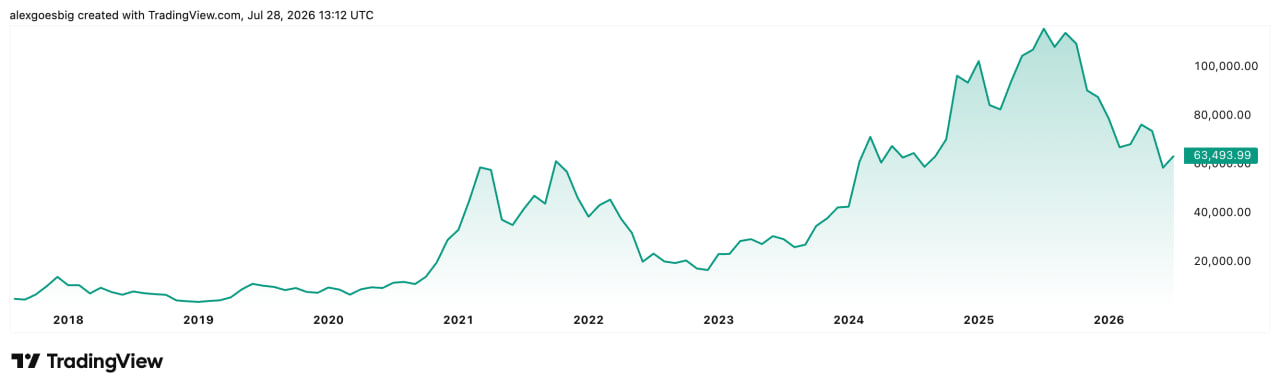
Bitcoin does not generate revenue, does not burn supply, and does not require anyone to hold it in order to use the network. Its entire case rests on the first channel in the framework above, and it is the only major asset where that is enough.
Total supply is capped at 21 million coins. The April 2024 halving cut annual issuance to roughly 164,000 BTC, and the next halving will cut it again. That number is not a target or a policy. It is enforced by every node on the network, and changing it would require near-universal agreement among people who hold the asset specifically because it cannot be changed.
Against that fixed issuance sits demand from two sources that did not exist during previous cycles. Spot ETFs have accumulated cumulative net inflows above $50 billion since launching in early 2024, spread across thirteen US funds. Corporate treasuries add a second layer, with Strategy, formerly MicroStrategy, holding more than 840,000 BTC at an average cost in the mid-$70,000s.
That treasury demand proved less permanent than its advocates suggested. Strategy began selling small tranches to fund preferred stock distributions after years of insisting it never would, and its shares fell roughly 80% from their high. The sales amounted to well under 1% of holdings, which is the honest scale, though the reversal of the narrative mattered more than the volume.
“2026 is the year where Bitcoin emerged as the consensus global digital capital.”
Executive Chairman, Strategy
Bitcoin peaked above $126,000 in late 2025 and lost roughly half its value over the following two quarters. Every prior cycle produced a comparable decline, and recovery has historically taken two to three years rather than months. The 2021 correction was the exception, running from spring peak to summer bottom to a new high by autumn.
Anyone building a position should treat a 50% drawdown as a normal feature of holding this asset rather than as evidence that something broke. The 2026 decline arrived without an exchange failure, a stablecoin depeg or a fraud revelation. Macro conditions and fund outflows did the work.
Institutional forecasts and market-implied probabilities have diverged unusually far, and reading both together is more informative than reading either alone.
“We do think there is an asset allocation shift beginning towards Bitcoin.”
Cathie Wood
CEO and Chief Investment Officer, ARK Invest
Prediction markets have consistently priced these outcomes far lower than the banks do. Traders putting money on the question have assigned roughly a one-in-three chance to targets the same analysts describe as base cases. Kendrick’s counterargument is that the buyer base has changed permanently, and that pension and institutional money entering through funds behaves differently from the retail flows that drove earlier cycles.
Pros
Cons
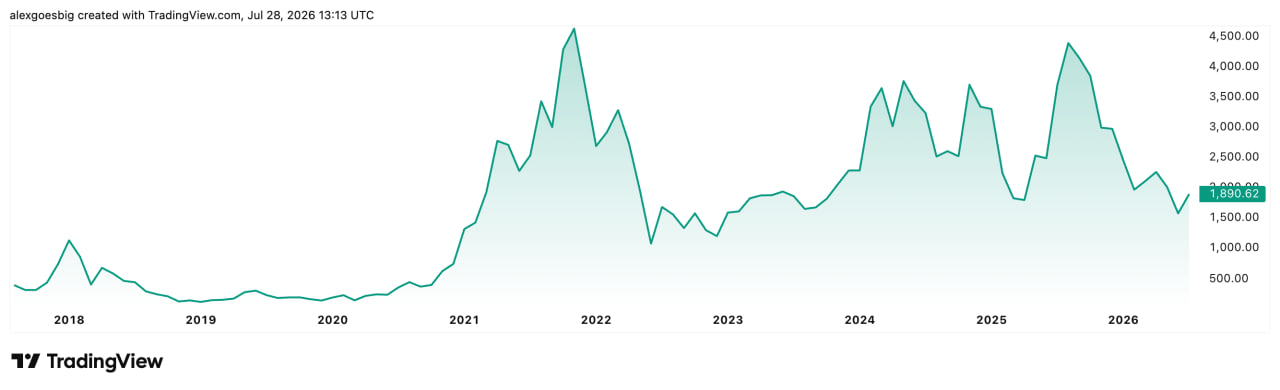
Ethereum’s investment case rested on the second channel: activity burns supply, so growth makes the asset scarcer. That mechanism has largely stopped functioning, and the reason is a technical success rather than a failure.
The Fusaka upgrade activated in late 2025, bringing Peer Data Availability Sampling to mainnet. It reduced the cost of posting data from Layer-2 rollups by an order of magnitude. Networks like Base, Arbitrum and Optimism became dramatically cheaper to use, and activity migrated to them.
EIP-1559 burns the base fee paid on Ethereum’s main chain. Layer-2 networks pay a fraction of what they used to. Weekly base-layer fee revenue collapsed from a peak near $30 million to a small fraction of that. Low fees mean low burn, and with roughly 28.5% of supply staked and validator issuance continuing regardless, ETH has spent extended periods in a mildly inflationary state.
21Shares put the risk plainly in its research, warning that issuance could become a persistent valuation headwind rather than a neutral factor if fee generation fails to scale with activity.
The network processes more economic activity than at any point in its history, yet the token captures a smaller share of it than it did before the scaling roadmap succeeded.
The introduction of staking-enabled exchange-traded products changed what Ethereum is as an investment. Funds now hold ETH in validators and pass rewards through to shareholders, typically in the region of 3% gross and closer to 2% after fees. BlackRock’s staked product stakes the large majority of its holdings.
No Bitcoin product can offer that, which gives Ethereum a claim to being a yield-bearing asset comparable to short-duration fixed income.
The catch is arithmetic. A staking yield near 3% competes poorly against a US ten-year Treasury yielding above 4%, and until that spread inverts the product is a harder sell to allocators who care about carry. A meaningful rate-cutting cycle would flip the comparison, which is why Ethereum’s institutional case is unusually sensitive to central bank policy.
The dispersion in Ethereum forecasts reflects genuine disagreement about whether the burn recovers.
The Ethereum Foundation cut 54 roles alongside a 40% budget reduction and closed its Privacy and Scaling Explorations group. Core development is shifting toward independent client teams and outside funding.
This may prove healthy. Concentrated foundation control has been a criticism of Ethereum for years, and distributed development is what the network says it wants. It also introduces coordination risk during the Glamsterdam upgrade cycle.
Pros
Cons
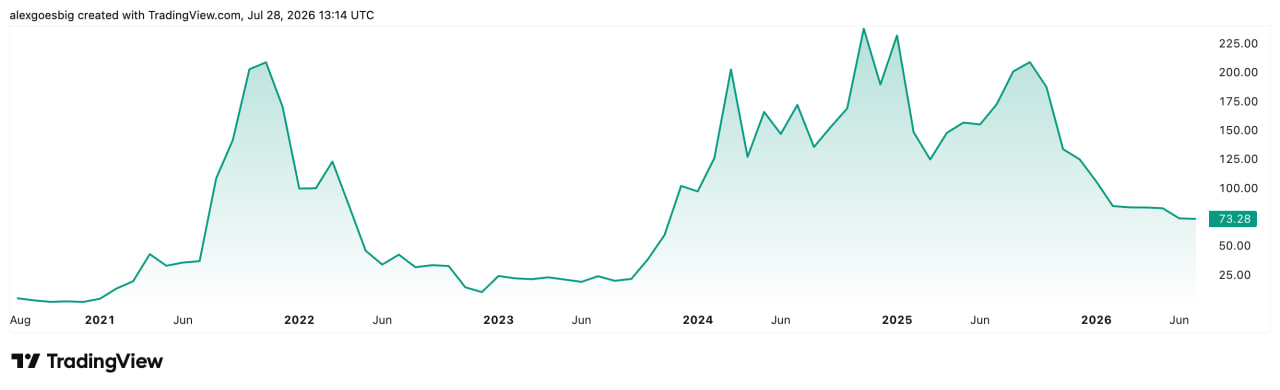
Solana is the clearest example of a network where usage and token value have decoupled. It processes more transactions than any competing chain and captures very little of the resulting economic value. Two engineering programmes are meant to change what the network is capable of, though neither directly addresses the take rate.
Firedancer is a validator client written from scratch in C and C++ by Jump Crypto, independent of the original Agave client. It runs on mainnet after an extended controlled rollout, and stress testing has demonstrated throughput above one million transactions per second.
The throughput number matters less than what it represents. Before Firedancer, Solana ran essentially one client implementation, meaning a single software bug could stop the entire network. That is exactly what produced the outages that damaged the chain’s reputation in 2021 and 2022. With two independent implementations, a bug in one does not halt block production, because validators running the other keep going. Client diversity is the reason Ethereum has never suffered a comparable outage, and it was the specific objection institutional allocators raised about Solana for years.
Alpenglow replaces Solana’s consensus and finality mechanism. The target is finality in roughly 150 milliseconds, down from around 12.8 seconds.
Finality means the point at which a transaction cannot be reversed. Thirteen seconds is unusable for payment or settlement applications that need to confirm and move on. Visa settles in roughly 200 milliseconds, so the target places Solana inside the range where card-network workloads become technically feasible. Co-founder Anatoly Yakovenko has guided toward mainnet activation, and the upgrade has run on a test cluster.
Consensus rewrites are among the riskiest changes a live blockchain can attempt, and timelines for them have a history of slipping.
Sub-penny fees create outstanding user experience and almost no protocol revenue. Validators depend heavily on maximal extractable value tips and localised fee markets rather than base fees, which means the network’s income is tied to trading intensity rather than to steady usage. When the memecoin cycle that drove much of that intensity ended, revenue fell with it.
Staking partially compensates holders, with yields in the 5% to 7% range, comfortably above Ethereum’s. That is one reason Solana exchange-traded products held up better than their peers during periods when Bitcoin and Ethereum funds saw redemptions.
Pros
Cons
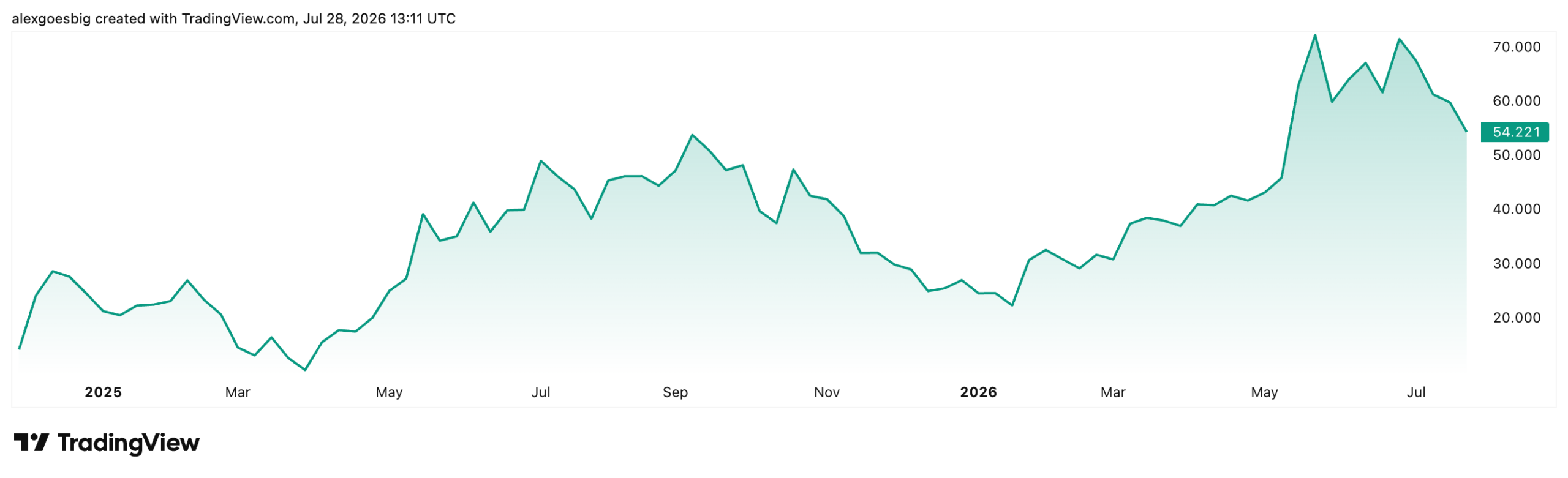
Hyperliquid occupies the third channel in the framework, and it does so more aggressively than anything else at its scale. Roughly 99% of protocol trading fees flow into open-market purchases of HYPE through the Assistance Fund. Every trade executed on the platform converts mechanically into buying pressure on the token.
That is not a governance promise or a roadmap item. It is code that runs continuously, and it is the reason the asset behaved so differently from the rest of the sector during the drawdown, rising sharply while most large caps fell.
The comparison Bitwise draws is deliberate. Chief Investment Officer Matt Hougan has valued Hyperliquid against listed exchange operators rather than against crypto protocols, estimating annualised revenue in the region of $800 million to $1 billion against a market capitalisation that implied roughly ten to fourteen times the buyback stream. Robinhood and CME Group trade at materially higher multiples on slower growth.
The argument underneath is that the market misclassified the business twice. It valued a multi-asset trading venue as a crypto perpetuals exchange, and it priced a token with a mechanical revenue link like earlier tokens that grew platform usage while returning nothing to holders.
“I think the token could double in price and still be fairly valued.”
Chief Investment Officer, Bitwise Asset Management
The protocol passed $1 billion in cumulative lifetime revenue, which places it among a very short list of crypto businesses generating real cash flow rather than distributing inflationary token emissions.
Three protocol upgrades broadened the business well beyond crypto derivatives:
Hougan estimates that close to half of platform volume already comes from non-crypto assets. The network holds roughly 70% of decentralised perpetual futures volume and a mid-single-digit share of the global perpetuals market including centralised venues.
As the exchange captures a larger share of on-chain derivatives volume and its real-world-asset markets scale, more trading fees route into the buyback, which is the mechanism that connects that growth to HYPE demand. The RWA expansion matters most here, because it pulls in volume that does not depend on crypto market cycles.
Only a fraction of total HYPE supply circulates, with the remainder unlocking on a schedule. That creates continuous overhead supply that the buyback must absorb before it can push price higher.
The buyback also weakens exactly when it is needed most. It scales with trading volume, and trading volume falls during broad market drawdowns. The mechanism that outperformed during the correction would provide less support during a deeper one.
Regulated access exists through a Grayscale staking product carrying a 0.29% gross management fee, though the assets in these wrappers remain small relative to the Bitcoin and Ethereum complexes. Direct trading interfaces stay geofenced for US retail users.
Pros
Cons
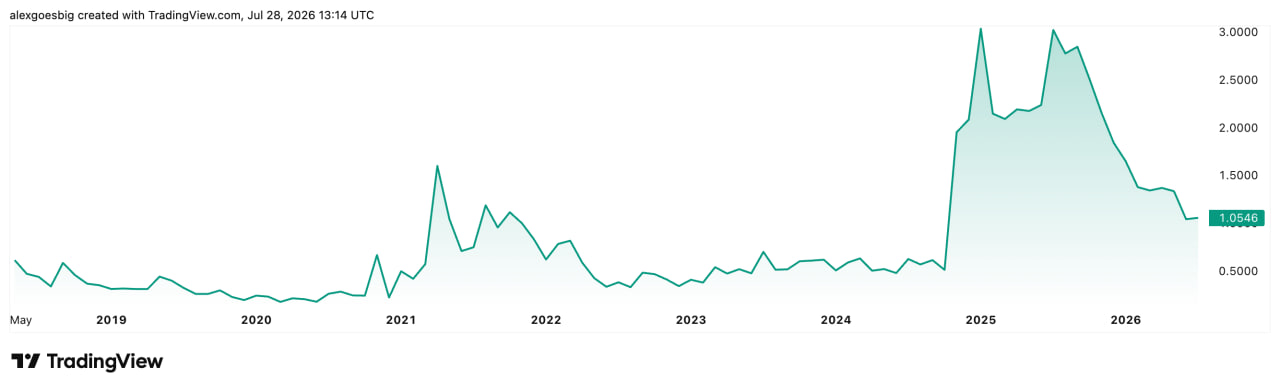
XRP relies on the fourth channel, transactional necessity, which is the hardest to verify and the easiest to lose. The XRP Ledger has real institutional usage. Whether that usage requires anyone to hold XRP is a separate question, and it is the one that determines the outcome.
Regulatory resolution positioned XRP alongside Bitcoin and Ethereum as a digital commodity under commodities regulator oversight, ending years of litigation risk that had kept US institutions at arm’s length. That is genuine and it unlocked the exchange-traded fund category.
Statutory clarity is a different thing, and conflating the two produces bad analysis. Comprehensive market structure legislation cleared the US House by a wide bipartisan margin and advanced out of Senate Banking Committee, then stalled short of the sixty votes needed to overcome a filibuster. Every institutional XRP target meaningfully above current levels is conditioned on that legislation passing, because the assumed institutional allocation depends on it.
The distinction matters for position sizing. Court outcomes are settled. Legislative outcomes are not, and they can slip by years without anything about the underlying technology changing.
Clarity is “no longer a question of if, but when Congress gets it across” the finish line.
CEO, Blockchain Association
Prediction markets have consistently priced that outcome well below the industry’s stated confidence.
Here is the objection that keeps XRP targets suppressed, and it deserves a fair hearing rather than dismissal.
A dollar-backed stablecoin can move value across a border without anyone ever touching XRP. Ripple issues one, RLUSD, and major institutional arrangements on the XRP Ledger settle in it. On-Demand Liquidity volume is real, but XRP is typically held for a few seconds mid-transaction, generating throughput without creating durable demand to hold the asset.
The bull case requires that bridging through XRP remains cheaper or more efficient than holding a stablecoin at both ends. That is an empirical question and the answer is not settled. Bitwise’s published valuation framework spans roughly $29 to $0.13 across its scenarios for the same date, which is a two-hundred-fold range and an honest admission of how binary the outcome is.
The utility metrics are stronger than the price history suggests:
Against that sits a supply schedule releasing hundreds of millions of tokens monthly from escrow, which requires continuous demand simply to hold ground.
Pros
Cons
The differences that matter are not speed or price. They are the value accrual channel in the first column, because that is what determines whether holding the token has any claim on the network’s success. Bitcoin relies on scarcity alone. Ethereum’s burn mechanism is impaired. Solana captures little of what it processes. Hyperliquid returns almost everything it earns. XRP’s claim depends on whether settlement runs through the token at all. Settlement speed and native yield are included because they shape which use cases each network can serve and how it competes for capital when interest rates are high, but they are secondary to the channel question.
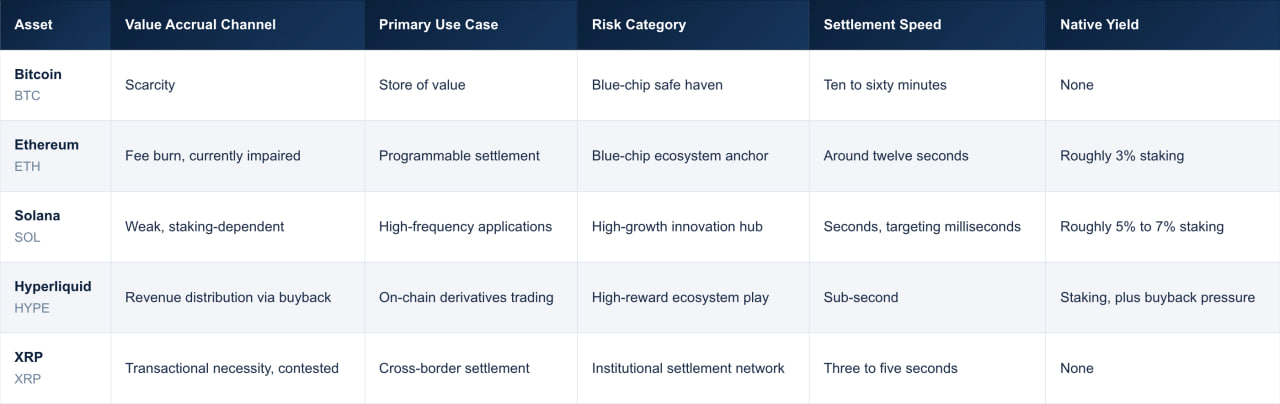
The framework produces one specific question per asset, and the answers change while the questions do not.
These are illustrative structures, not advice. Adjust for your own circumstances, tax jurisdiction and time horizon.
Conservative Anchor
Lowest volatility focus
Balanced Growth
Standard market allocation
Aggressive Alpha
High-reward focus
Size positions to survive another halving of value. Every asset here has halved in value at least once, and you should assume it happens again.
The framework survives cycles. Four developments would force a genuine revision of it.
A sustained rate-cutting cycle would flip the yield comparison that currently disadvantages staking assets against government bonds, which would matter more for Ethereum and Solana than for Bitcoin. Enacted US market structure legislation would remove the largest conditional variable sitting under XRP and would broaden custodian eligibility across the sector. A successful consensus upgrade delivering sub-second finality on Solana would open settlement workloads that currently route around blockchains entirely.
One shift sits outside crypto-native framing and may matter more than any of them. Custody banks have begun building tokenised government bond products with round-the-clock settlement. Retail brokerages have launched their own chains to trade tokenised equities across dozens of countries. Asset managers who spent a decade refusing to touch the category have started opening access. None of that infrastructure requires token prices to rise in order to proceed, and it is being built by institutions that will not abandon it during a drawdown. If it succeeds, the networks underneath it get repriced on measurable throughput rather than on sentiment. Watch what the custodians build, because they are constructing the demand curve that these five assets will eventually be valued against.
What is the best cryptocurrency to invest in?
There is no single best cryptocurrency, only a best fit for a given risk tolerance and time horizon. The more useful question is whether a network turns usage into token demand, which is the test this article applies to Bitcoin, Ethereum, Solana, Hyperliquid and XRP. Bitcoin suits investors who want the lowest probability of permanent loss, while Hyperliquid and Solana sit at the higher-risk, higher-reward end. Match the asset to your own profile rather than chasing a ranking.
Is it too late to invest in crypto?
Every asset covered here trades well below its cycle peak, some by more than half, which is closer to the opposite of “too late” than to a top. Timing the entry matters far less than sizing the position and understanding what actually drives the token’s value. Drawdowns of this scale are a normal feature of the asset class rather than a sign that the opportunity has passed, though that cuts both ways and prices can fall further.
Which cryptocurrency is the safest investment?
No cryptocurrency is safe in the conventional sense, since all of them can lose a large share of their value quickly. Bitcoin carries the lowest realised volatility of the major assets and the deepest regulated access through spot funds, which is why it anchors the conservative allocation model above. That makes it the least volatile choice, not a low-risk one.
How much of my portfolio should be in crypto?
That depends entirely on your finances, goals and tolerance for large swings, and no article can set the number for you. The allocation models in this piece are illustrative examples of how different risk profiles might structure exposure, not a recommended split. A common principle is to allocate only what you can afford to lose entirely, and to reach any target position gradually rather than all at once.
Do I have to pay tax on cryptocurrency?
In most countries, selling, swapping or spending crypto is a taxable event, and staking rewards are often taxed as income, but the specific rules vary widely by jurisdiction. Keeping records of every transaction from the start is far easier than reconstructing them later. Because the treatment differs so much from one country to the next, confirm your obligations with a qualified tax professional in your own jurisdiction.
What makes Hyperliquid different from the other assets?
Hyperliquid routes roughly 99% of its trading fees into buying back its own token on the open market, which links platform revenue to token demand more directly than almost anything else in crypto. Most tokens grow usage without returning value to holders, while Hyperliquid’s buyback works more like a corporate share repurchase. Its expansion into commodities, equity indices and prediction markets also pulls in trading volume that does not depend on crypto market cycles.
Disclaimer
This article is published by Coindoo for informational and educational purposes only. It does not constitute financial, investment, legal or tax advice, and nothing in it should be read as a recommendation to buy, sell or hold any cryptocurrency or other asset. The author is a financial journalist, not a licensed financial adviser, and does not know your personal circumstances, goals or risk tolerance.
Cryptocurrencies are highly volatile. The assets discussed here have each lost more than half their value from their peaks, and you can lose some or all of your capital. Analyst price targets referenced in this article are third-party forecasts, not guarantees, and they are revised frequently. The allocation models shown are illustrative examples of how different risk profiles might structure a portfolio, not a suggested split for any individual reader.
Always do your own research and consider consulting a qualified, licensed financial adviser before making any investment decision. Coindoo and the author accept no liability, to the fullest extent permitted by law, for any loss or damage arising from reliance on the information in this article.
The author may hold positions in one or more of the assets discussed. Coindoo does not receive payment from any project, exchange or issuer in exchange for coverage, and no asset in this article was featured in return for compensation.
The post Best Crypto to Invest In: 5 Assets Worth Owning in 2026 appeared first on Coindoo.





