TL;DR:
OKX published the results of a survey conducted among 1,000 active traders in the United States, aimed at understanding how users interact with exchanges and what conditions could accelerate exponential adoption of on-chain markets. The findings point to a scenario where the integration between centralized and decentralized infrastructure becomes the dominant expectation, not the exception.
52% of respondents operate exclusively on centralized platforms, while the remaining 48% combine tools from both types. However, when presented with the concept of CeDeFi, a model that combines the interface of a centralized exchange with direct on-chain execution, more than 90% responded with positive interest. More than a third also expects centralized exchanges to serve as the main gateway to on-chain markets.
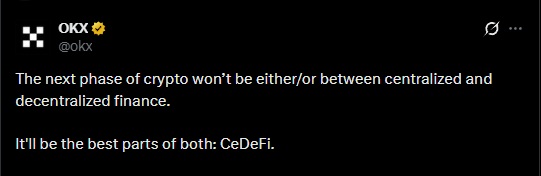
“These findings suggest that users are not looking to move away from centralized platforms, but rather expect them to evolve with integrated tools like CeDeFi,” OKX stated in the report.
The study identified yield generation strategies as a crucial entry point into on-chain activity. 65% of respondents use on-chain tools to earn yield on stablecoins at least occasionally, and more than a quarter do so on a regular basis. Providing liquidity to stablecoin pools was the most frequent strategy, with nearly 40% of surveyed users employing it. Stablecoin staking on centralized platforms followed at 36%, and lending via DeFi protocols attracted nearly one in five users.

On the custody front, OKX found that 51% prefer to retain control over most operational aspects, acknowledging they use only a small degree of automation in execution. 38% opt for full personal responsibility. The most sought-after automation features were best-price routing, scam detection and execution timing optimization.
Limitations and concerns were also addressed: 29% cited scams and security risks as the main obstacle to operating in on-chain markets, 22% mentioned unpredictable fees, and nearly half of users expect platforms to actively help prevent fraud. According to data gathered by OKX, managing multiple wallets, bridging between networks and unfamiliar interfaces also contribute to a widespread perception that on-chain markets remain operationally demanding.





