TL;DR:
The U.S. Department of Commerce issued an emergency export control directive that forced Anthropic to suspend access to its new flagship models, Fable 5 and Mythos 5. The measure was taken citing vague national security concerns after identifying an alleged jailbreak method in Fable 5, though no detailed public evidence was presented. Since isolating users by nationality proved technically unfeasible under the current architecture, Anthropic disabled both models for all its clients worldwide.
The company stated it complies with the order but rejects its scope. According to the official statement, Anthropic had dedicated thousands of hours to red-teaming exercises alongside the U.S. government, the UK AI Safety Institute and external organizations prior to launch. The company argued that applying this standard broadly would “essentially halt all new frontier model deployments” across the industry.
Decentralized artificial intelligence tokens reacted sharply in the market. According to data from CoinMarketCap, the segment accumulated gains of around 10% over the past ten days.

Several tokens posted considerable gains. Bittensor (TAO) climbed to $278.65 with a daily gain of 5.5% and a trading volume of $567.9 million, a figure exceeding 18% of its market capitalization. NEAR Protocol surpassed $2.47 after rising 18.9% in the last 24 hours, with a volume of $514.6 million. Meanwhile, Render (RENDER) rose to $1.85 with an increase of 6.7% on the day and a volume of $51.7 million.
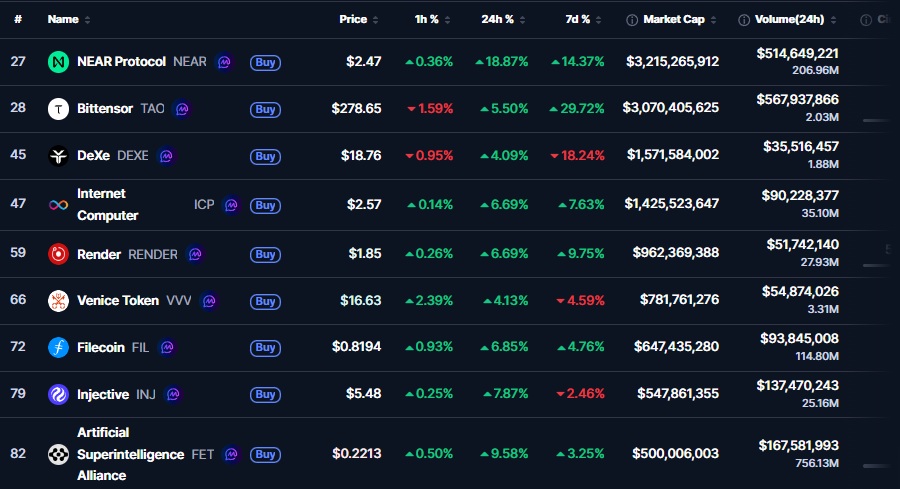
Artificial Superintelligence Alliance (FET) surpassed $0.22 with a jump of 9.6% in 24 hours and a volume of approximately $167.6 million. Injective (INJ) reached $5.48 with a gain of 7.9% and trading of $137.5 million. Filecoin (FIL) hit $0.819 after climbing 6.9%, with a volume of $93.8 million. Internet Computer (ICP) trades at $2.57 with a gain of 6.7% and $90.2 million in volume.
Venice Token (VVV) surpasses $16.6 on a gain of 4.1% and volume of $54.9 million. DeXe (DEXE) trades at $18.76 with an increase of 4.1% and a market capitalization of $1.570 billion. This episode has exposed the structural vulnerability of centralized artificial intelligence systems to state intervention, directly and consistently strengthening the appeal of decentralized networks as an operational and investment alternative, and by extension, the tokens of that ecosystem.





