TL;DR
Apex Fusion has rolled out VECTOR, a new Cardano-aligned blockchain built to address a specific issue: the gap between the ecosystem’s technical rigor and its real-world execution capacity. The network is already live and open for project onboarding, with a clear focus on higher speed, lower latency, and full compatibility with Cardano’s original design.
VECTOR aims to deliver near-instant finality and a tangible jump in performance. According to Apex Fusion, the network reaches 99.9% finality confidence in about 13 seconds under standard conditions and can process up to four times more transactions than Cardano’s mainnet. The goal is to allow DeFi applications, stablecoin flows, and institutional use cases to operate without the bottlenecks that currently constrain the ecosystem.
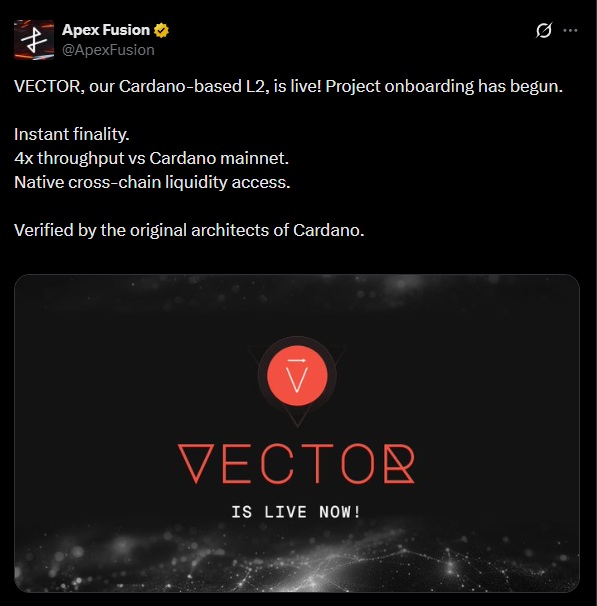
The design preserves the UTxO model. This choice removes the need to rewrite logic or abandon tools already familiar to developers. For native teams, the proposal is not about migrating away, but about extending their capabilities. VECTOR operates as a companion chain, designed to coexist with Cardano’s core roadmap while initiatives such as Leios remain under development.
In terms of economic activity, Cardano has lagged behind Ethereum, Solana, Tron, and several layer-two solutions. Fee revenue points to a network with relatively low usage, even compared with newer infrastructures. As RWAs and stablecoin flows gain relevance, latency and throughput stop being technical details and become basic conditions for adoption.

VECTOR adopts an approach similar to the dominant L1–L2 model in the EVM ecosystem, but built on a foundation of high assurance and formalism. It does not redesign the original network; it extends it. Integration with LayerZero enables native connectivity to more than 150 networks, a key factor for accessing cross-chain liquidity and users outside Cardano’s immediate environment.
Development involved architects who worked on Cardano’s original design, including Duncan Coutts, alongside Neil Davies and Peter Thompson. The team completed formal validations and a peer-reviewed assurance report aimed at assessing the network’s readiness for institutional use.
Apex Fusion had already focused on improving liquidity access within the ecosystem, including an integration with Stargate to enable USDC flows. VECTOR fits squarely into that trajectory: fewer abstract promises and more operational infrastructure, allowing the network to scale without compromising its core principles





