TL;DR:
Arkham launched a new analytics platform dedicated to prediction markets, allowing users to track top traders, monitor positions in real time, and analyze activity across the leading event contract markets.
This new feature expands the blockchain intelligence platform’s coverage into one of the fastest-growing sectors within the crypto industry. Prediction markets accumulate billions in trading volume and are attracting increasing attention from institutions.
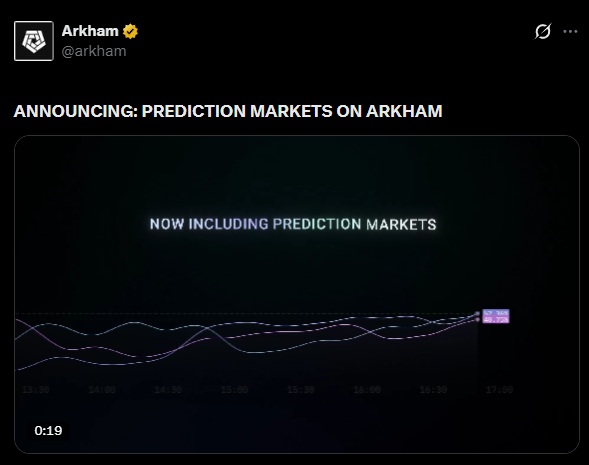
According to Arkham, users can now view trader rankings sorted by profit and loss, inspect open and historical positions, monitor trades in real time, and analyze wallet activity linked to market traders. The company highlighted the case of trader “Theo4,” whose account reportedly generated $22 million in total profits and $14.4 million from the U.S. popular vote market alone in 2024.
The platform builds on Arkham’s existing blockchain analytics infrastructure, which tracks wallets, entities, token movements, and exchange activity across multiple chains. It now combines prediction market trading data with its address labeling system, enabling analysis of how large traders behave both in event markets and across the broader crypto ecosystem.
Arkham stated that its database contains more than 3.5 billion address labels and over 800,000 verified entities. The platform includes leaderboards, profitability metrics, return on investment tracking, win rates, and per-market dashboards with Yes and No position breakdowns. Users can also set activity alerts linked to specific wallets or traders.

Kalshi recently announced a $1 billion Series F round at a valuation of $22 billion. The company reported that its institutional volume grew 800% over the past six months, with annualized volume rising from $52 billion to $178 billion. Platforms such as Polymarket, meanwhile, expanded their offering beyond elections and moved into sports, macroeconomics, and geopolitical events.
Nevertheless, prediction markets constantly face pressure from various jurisdictions on regulatory grounds. In the United States, courts and regulators debate whether event contracts should be classified as regulated financial derivatives or as betting products.





