TL;DR:
Azul is the name of the first independent upgrade to Base, the Ethereum layer-2 network incubated by Coinbase. The Base team deployed the upgrade on testnet and announced its mainnet activation for May 13. The upgrade introduces a multiproof system and a new client architecture that, according to the protocol, brings the network closer to Stage 2 decentralization.
Azul’s core mechanism combines trusted execution environment proofs, or TEE, with zero-knowledge proofs, or ZK. Either type can finalize a proposal autonomously, but when both agree, withdrawal finality time is reduced to a single day. Additionally, permissionless ZK proofs can override permissioned TEE proofs in the event of a conflict, which improves the system’s security guarantees.
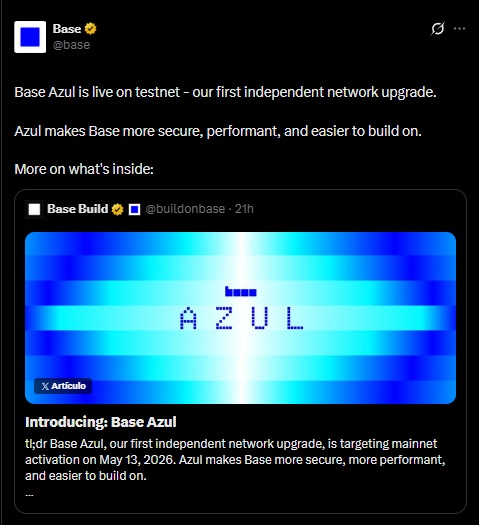
The upgrade also simplifies the network’s underlying infrastructure. Azul establishes base-reth-node as the sole execution client and incorporates base-consensus, a new consensus client based on Kona. According to the team, empty blocks dropped by 99% over the past two months, falling from around 200 per day to just two. The network also sustained multiple bursts of 5,000 transactions per second.
Base also aligns Azul with Ethereum’s Osaka execution layer specifications, an adjustment aimed at improving the developer experience without forcing rewrites on existing applications. Most apps will not require changes, although some node operators and developers with specialized implementations will need to prepare ahead of activation.

To audit the code ahead of the mainnet launch, Base launched a competition on Immunefi running until May 4, with a maximum pool of $250,000 in rewards for the detection of critical bugs.
Data from DefiLlama places Base with approximately $4.98 billion in stablecoin market cap and around $4.4 billion in total value locked in the DeFi ecosystem. It is also the leading optimistic rollup by active addresses. The team projects a performance-focused upgrade for late June and another centered on user experience toward the end of August, with native account abstraction as its long-term horizon.





