TL;DR:
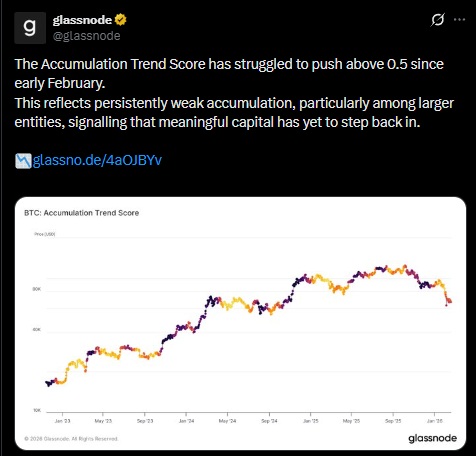
Bitcoin accumulation lost momentum during February 2026, according to data from Glassnode, whose accumulation index barely exceeded 0.5 points since the start of the month. The indicator reflects that neither whales nor retail investors took advantage of the lower price range to buy with conviction. BTC managed to hold above $65,000 in the short term, but every recovery attempt was absorbed by waves of selling, blocking a push toward $70,000.
Market sentiment remains close to historical lows. In that context, spot demand showed clear signs of weakening, and the creation of new addresses was practically flat, far from the exponential growth that characterized earlier stages of the cycle.
BTC addresses with a non-zero balance continue to grow, but at a markedly slower pace. The holding ratio shows no dominance from either whales or retail participants, remaining stable over the past month. According to MacroMicro data, the creation of new addresses shows no significant variation, indicating that Bitcoin has ceased to be the target of rushed investments in this cycle.
Traders are waiting for signals that confirm a local bottom, with projections that contemplate a possible drop toward $50,000. The majority of identified whale transactions correspond to institutions or market makers, while crypto-native whales have reduced their activity.

As flows toward personal wallets slow down, more Bitcoin has moved toward exchanges, particularly toward Binance. Total reserves across exchanges stand at 2.75 million BTC, near the lower end of the historical range. However, Binance recorded an expansion in February and reached its highest level since late 2024, with more than 674,000 BTC under custody.
Inflows to Binance have historically coincided with new local lows in the price of Bitcoin. The accumulation of coins ready to be sold generates pressure on long positions in derivatives and discourages directional bets. The fear and greed index at 11 points confirms that dynamic: the market is avoiding taking positions that could be liquidated in the face of a new wave of selling.