TL;DR:
The Bitcoin network recorded a two-block reorganization, an infrequent technical phenomenon that drew the attention of researchers and analysts across the ecosystem. The event did not represent an attack or a protocol error: the network’s decentralized consensus mechanism functioned exactly as it was designed.
The situation began at block height 941880, when the network temporarily split into two competing chains of equal length. Mining pool AntPool found block 941881 first on its branch, and shortly after ViaBTC added block 941882 on that same route. Simultaneously, Foundry USA mined its own version of block 941881 and then found its version of block 941882 as well, generating an active dispute between two valid parallel chains.
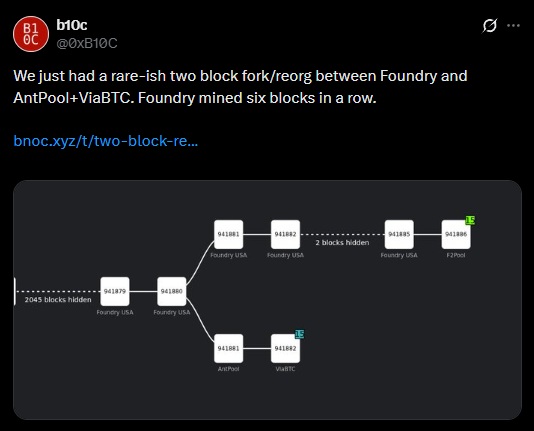
Under normal circumstances, single-block ties in Bitcoin resolve quickly. The fact that the tie extended for an additional cycle is what makes this event a two-block reorganization, considerably rarer than single-block ones, which occur periodically on the network.
The tiebreak came when Foundry USA chained blocks 941883, 941884, and 941885 consecutively, consolidating a streak of seven successive blocks between heights 941879 and 941885. With that accumulation of proof of work, the Bitcoin protocol automatically discarded the AntPool and ViaBTC branch. Their blocks were classified as orphaned or stale blocks, with no reward or validity on the main chain.

The data was shared by Bitcoin researcher known as b10c, which made it possible to reconstruct with precision the sequence of the dispute among the three pools. This case illustrates how Bitcoin’s design handles competitive scenarios among miners without requiring any external intervention: the longest chain, backed by the greatest accumulated computing power, always prevails.





