Bitcoin fell below $60,000 last Friday, capping its worst week since the FTX exchange collapse in November 2022. The drop marked a 16% decline over seven days, the steepest weekly fall in over two years.
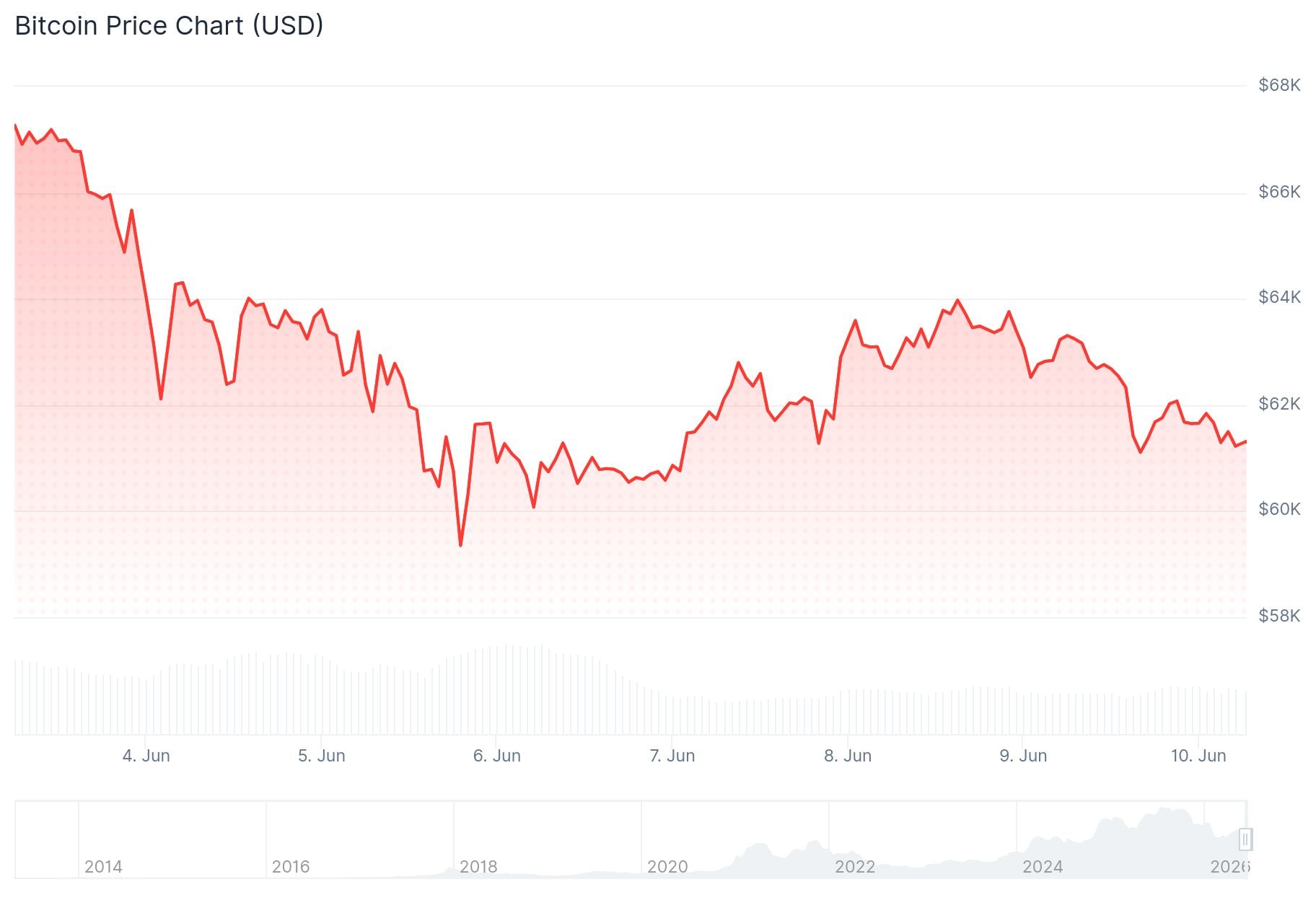
At the time of writing, BTC was trading around $61,500, still down more than 50% from its all-time high above $126,000.
The sell-off deepened on June 9 after US Central Command announced “self-defense” strikes against Iran. The strikes followed the shooting down of a US Army Apache helicopter near the Strait of Hormuz. BTC fell 3% on the news, hitting $61,766.
President Trump confirmed the incident on Truth Social, stating: “The United States must, of necessity, respond to this attack.” Iran denied deliberately targeting the aircraft.
"I have just been informed by our Great Military that last night the Iranians shot down one of our highly sophisticated Apache Helicopters while patrolling over the Strait of Hormuz. There were two pilots involved, both are safe and uninjured. Nevertheless, the United States… pic.twitter.com/yMGXqG89ax
— The White House (@WhiteHouse) June 9, 2026
Crypto long liquidations hit $136 million in the 24 hours following the news, with Bitcoin accounting for the majority, according to CoinGlass data.
Adding to the pressure, Strategy Inc. — Michael Saylor’s Bitcoin-holding company — sold a small portion of its BTC holdings, denting the widely held belief that the firm would never sell. Strategy moved quickly to buy 1,550 BTC for around $101 million, but the damage to confidence had already been done.
Bitcoin also slipped below its 200-week moving average last week, a technical level watched closely by traders. Paul Howard of crypto trading firm Wincent called it “important confirmation that markets may have entered a bear phase.”
Griffin Ardern, co-founder of Primal Fund, said longer-dated options are not yet showing the bullish shift typically seen at genuine market bottoms. “I believe there is further downside,” he said. “We are still some way off a proper bottom.”
On-chain data from Santiment shows a split between small and large holders. Wallets holding less than 0.01 BTC increased their holdings by 0.36% over the past two weeks, even as BTC struggled to hold $60,000. Meanwhile, wallets holding between 10 and 10,000 BTC reduced holdings by 0.20%.
TL;DR: Small $BTC traders keep buying dips, while whales slowly offloading
Metrics Used: Supply Distribution
Chart link: https://t.co/3WXE2N6Yid
Our on-chain research indicates that retail investors continue to view every Bitcoin dip as a buying opportunity. Over the… pic.twitter.com/IdOgAcV6ob
— Santiment Intelligence (@SantimentData) June 9, 2026
Analyst Ted Pillows weighed in on X, pointing out that no Bitcoin cycle bottom has ever formed above the “Realized Price,” which currently sits at $53,000. He said BTC will “most likely drop towards $50,000–$52,000 before a cycle bottom.”
No $BTC bottom has happened above its "Realized Price" which currently sits at $53,000.
IMO, Bitcoin will most likely drop towards $50,000-$52,000 before a cycle bottom. https://t.co/yPdba96Kww pic.twitter.com/1FGt2GCgdm
— Ted (@TedPillows) June 9, 2026
US-listed spot Bitcoin ETFs have now seen $5.5 billion in net outflows over 13 consecutive days.
The post Bitcoin (BTC) Price: Worst Week Since FTX Crash as US-Iran War and Rate Fears Pile On appeared first on CoinCentral.





