Bitcoin price traded near $63,069 after a muted session, extending a difficult year for the largest cryptocurrency. Michael Saylor said BTC lost 47% during the past 12 months, while Strategy’s STRC preferred stock returned 9%. The contrast places Strategy’s preferred stock structure under market attention. That divergence has become central to Saylor’s latest argument.
STRC sits within Strategy’s digital credit lineup, which posted returns ranging from negative 27% to positive 9%, Saylor wrote. The company designed these securities to deliver income and reduce downside sensitivity relative to Bitcoin. Still, their returns, payment terms, and risks differ from holding BTC directly.
Bitcoin price remains below key moving averages, which indicates weak short-term momentum. Trading activity also appears subdued, leaving the price sensitive to shifts in risk appetite and liquidity. The immediate range runs from $61,126 support to $64,346 resistance.
Current market modeling assigns a 70% probability to a lower move and 30% to an upside break. Such probabilities describe a scenario, not a guaranteed path. Sideways trading therefore stays plausible while BTC holds inside the projected volatility band.
Bitcoin price above $63,517 would improve the short-term structure and open a test of $64,346. Buyers would need follow-through above that ceiling to weaken the broader bearish signal. Without confirmation, rebounds may struggle beneath moving-average resistance.
On the other hand, a break below $61,126 would confirm renewed selling pressure. That loss could increase volatility as traders reduce exposure or protect leveraged positions. The Bitcoin price would then need a quick recovery above support to limit technical damage.
The annual loss also frames Saylor’s comparison with Strategy’s securities. BTC offers direct exposure to asset appreciation, but investors absorb its full market volatility. STRC instead combines preferred equity risk with scheduled cash income and a price-management mechanism.
These structures serve different objectives, so the one-year return gap does not establish permanent outperformance. Bitcoin could reverse faster during a broad risk rally. STRC could face pressure from issuer credit, dividend changes, market liquidity, or a widening discount to par. Investors must compare total return, not headline price movement alone. Time horizons also shape each instrument’s risk profile.
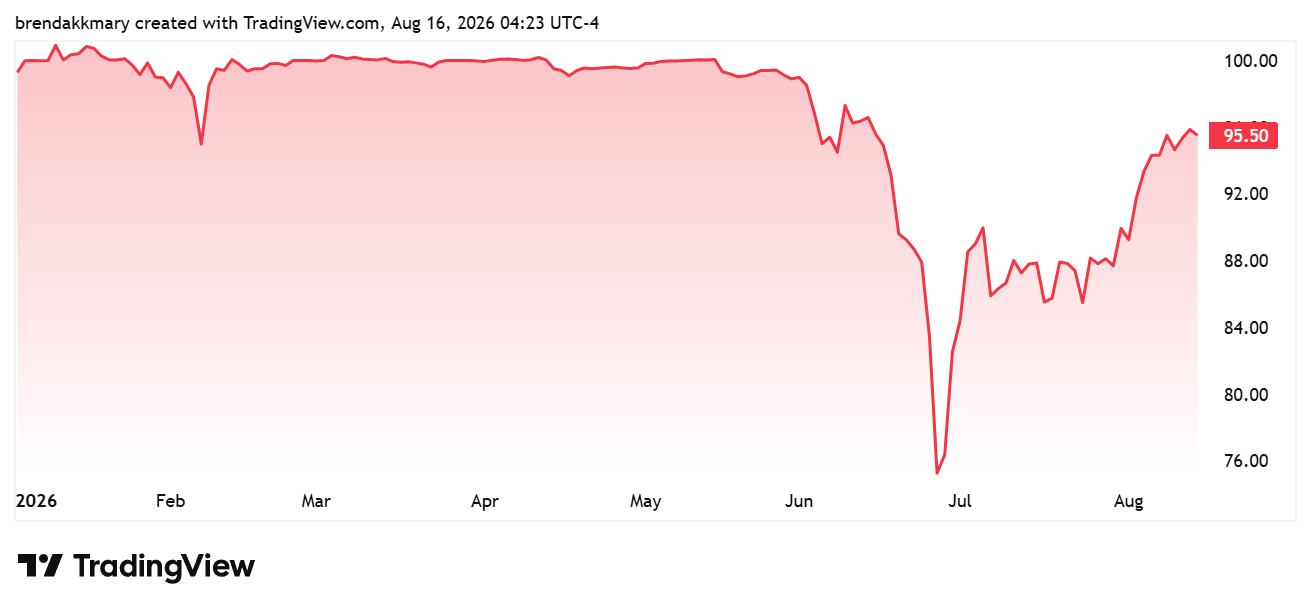
The STRC preferred stock is Strategy’s Variable Rate Series A Perpetual Stretch Preferred Stock. Its product page identifies a 12% annual dividend, paid semi-monthly in cash. The company adjusts the rate monthly to encourage trading near the $100 stated amount.
STRC therefore carries a different return profile from Bitcoin. Cash distributions may cushion price weakness, while rate changes may support demand. Strategy authorized up to $1 billion for digital credit repurchases, including STRC. The shares are not collateralized by Strategy’s Bitcoin holdings.
These protections are not guarantees. Strategy says dividends require board declaration and available funds. The company may change, suspend, or discontinue repurchases, depending on market conditions and capital needs. STRC can trade materially below $100 despite management’s target range.
Saylor argues that financial engineering can reshape volatile digital capital into securities designed for income and stability. The 47% Bitcoin price decline and STRC’s 9% return support that case over the measured year. They do not remove issuer risk or ensure future results.
Markets will watch Strategy’s Bitcoin trades, dollar reserve, and future changes to STRC’s dividend rate. Repurchase activity could affect liquidity and the discount to stated value. A sustained move toward $100 would strengthen the stability claim, while renewed weakness would challenge it.
Bitcoin price remains a key variable. A recovery above $63,517 could improve sentiment across Strategy’s capital structure. Losing $61,126 could revive concerns about reserve coverage, financing costs, and preferred-share demand. Strategy reviews STRC’s rate using Bitcoin volatility, credit spreads, trading levels, and market yields.
The post Michael Saylor Touts STRC Income During the Bitcoin Price Slump appeared first on Blockonomi.





