TL;DR:
BitGo, the digital asset custody firm, announced that its European entity received dual authorization from BaFin, the German financial regulator, to operate under the Markets in Crypto-Assets Regulation (MiCA) and Payment Services Directive 2 (PSD2/ZAG) frameworks. This factor is crucial to the company’s expansion within the European Union.
The approval enables BitGo to provide infrastructure services linked to E-Money Tokens (EMTs), the category defined under MiCA that covers stablecoins backed by fiat currencies.
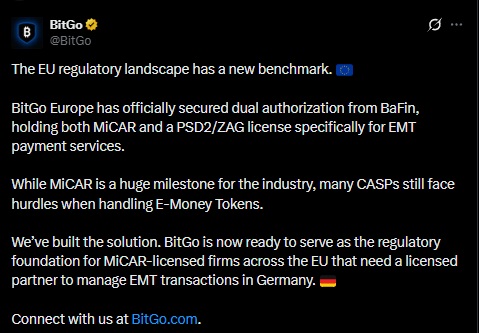
The MiCA framework sets the general conditions for crypto-asset service providers across the EU, but firms operating with EMTs must also comply with pre-existing payment services regulations, which creates a degree of regulatory complexity. By obtaining both licenses simultaneously, the company can operate as regulated infrastructure for issuers and managers of stablecoins based in Germany.
The choice of Germany as the seat of these authorizations is no coincidence. BaFin has established itself as one of the reference regulatory authorities for digital assets within the EU, and the licenses obtained there carry validity across the broader European market. BitGo indicated that its intention is to act as a licensed partner for crypto firms that need regulated infrastructure to process transactions with EMTs in both the German market and the rest of the bloc.

One of the concrete problems the sector has faced since the implementation of MiCA is the overlap between its requirements and those of traditional payment services regulations. Many crypto service providers have run into that regulatory ambiguity when attempting to operate with stablecoins. BitGo’s dual authorization directly addresses that gap, positioning the company as a bridge between Europe’s new crypto regime and the conventional regulated financial system.





